Textiles Minister Giriraj Singh hails Sukanti Meher
Synopsis
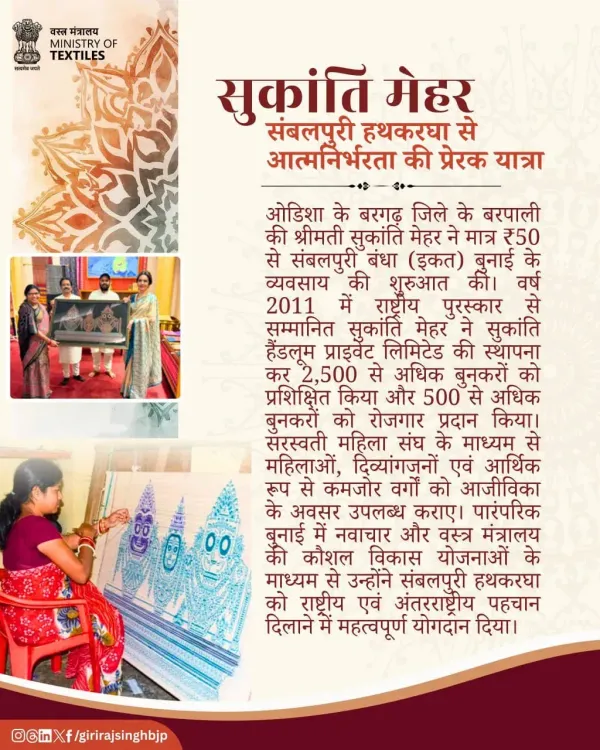
Union Textiles Minister Giriraj Singh has praised Bargarh weaver Sukanti Meher for starting Sambalpuri handloom work with ₹50 and, he said, training over 2,500 weavers while generating jobs for more than 500 people, calling her journey a model of women's empowerment.
Key Takeaways
Union Textiles Minister Giriraj Singh on 25 November 2026 praised Smt Sukanti Meher of Bargarh, Odisha.
He said she began Sambalpuri handloom weaving with just ₹50 and set an example of self-reliance.
According to Singh, her efforts have trained more than 2,500 weavers and employed over 500 people.
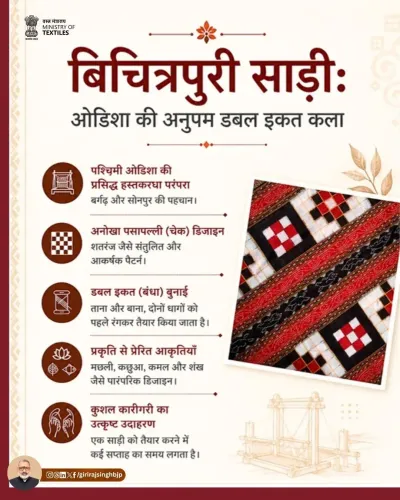
Bargarh is a major Sambalpuri saree and ikat handloom cluster in western Odisha.
The National Handloom Development Programme has supported weaver clusters since 2015.
Atmanirbhar Bharat, announced in 2020, frames local crafts as a self-reliance pathway.
Union Textiles Minister Giriraj Singh on 25 November 2026 held up a Bargarh woman who began with ₹50 as a national example of self-reliance. He named Smt Sukanti Meher of Odisha, saying her Sambalpuri handloom work has trained more than 2,500 weavers and given jobs to over 500 people.
Writing in Hindi, Singh said she had begun her Sambalpuri handloom weaving journey with a mere ₹50 and presented aatmanirbharta ki misaal (an example of self-reliance). Her efforts, he added, have trained more than 2,500 weavers and employed more than 500 people. He called that journey inspiring for women's empowerment and for giving traditional handicraft a new identity.
The ₹50 start in Bargarh
Bargarh district is one of western Odisha's core Sambalpuri saree and ikat weaving belts. A woman artisan who turns a household loom into a training network is the kind of figure that lands in a ministerial post: local, concrete, and easy to hold up as proof that craft can still pay.
Singh's figures of 2,500-plus trained weavers and 500-plus jobs come from his own post and are not independently confirmed in public records. The frame is still sharp. A fifty-rupee start becomes a nationwide argument for skill, employment, and weave revival.
Sambalpuri looms and the cluster years
The Ministry of Textiles has run National Handloom Development Programme clusters since 2015 to back traditional weavers and skill upgradation. Atmanirbhar Bharat, announced in 2020, folded local crafts and micro-entrepreneurship into a self-reliance pitch.
Spotlighting individual cases from GI-tagged textile regions such as Odisha fits a wider pattern. These stories are used to pull attention toward cluster development, market linkages, and women's economic participation in handloom belts, not only toward a single name.
Bargarh's next training sheds
Weavers in Bargarh and similar Odisha clusters will watch whether the next textiles ministry review adds training infrastructure or marketing support on the ground. For now, the minister's message is unambiguous: a woman who started with fifty rupees is the face he wants the country to see.
Praise travels fast. Looms still need yarn, orders, and trainers if Bargarh's story is to outlast a single post.
Point of View
The Textiles Ministry ties Atmanirbhar Bharat and the National Handloom Development Programme to a face, a district, and a GI-linked weave. The employment and training numbers he cites remain his claim, not an audited census. Watch whether Bargarh gets more cluster training and market linkage in the next ministry review. That is where the story either scales or stays a speech.
NationPress
25 Nov 2026
Frequently Asked Questions
Who is Sukanti Meher of Bargarh?
Sukanti Meher is a woman weaver from Bargarh in Odisha whom Union Textiles Minister Giriraj Singh has praised for starting Sambalpuri handloom work with ₹50. He said her efforts have trained more than 2,500 weavers and provided employment to over 500 people.
What did Giriraj Singh say about Sukanti Meher?
On 25 November 2026, Giriraj Singh said Smt Sukanti Meher of Bargarh began Sambalpuri handloom weaving with just ₹50 and set an example of self-reliance. He described her journey as inspiring for women's empowerment and traditional handicrafts.
What is Sambalpuri handloom weaving?
Sambalpuri is a traditional ikat-style handloom weave from western Odisha, especially associated with clusters such as Bargarh. It is known for tie-and-dye motifs on sarees and other textiles produced on household and cluster looms.
Where is Bargarh and why does it matter for handlooms?
Bargarh is a district in western Odisha and a major centre for Sambalpuri saree and handloom weaving. The Textiles Ministry has long treated such districts as cluster sites for skill upgradation and market linkage.
Which government programmes support handloom weavers in Odisha?
The National Handloom Development Programme has run weaver clusters since 2015, and Atmanirbhar Bharat since 2020 has emphasised local crafts and micro-entrepreneurship. Singh's post does not announce a new scheme; it highlights one artisan's story within that existing frame.