Anurag Thakur slams Rahul Gandhi over journalist row
Synopsis
BJP MP Anurag Thakur accused Leader of Opposition Rahul Gandhi of rudeness toward a journalist asking about injured Jantar Mantar police families, invoking the 1975 Emergency press censorship and past military-operation controversies to argue Gandhi harbours deep hostility toward India's security forces and the press.
Key Takeaways
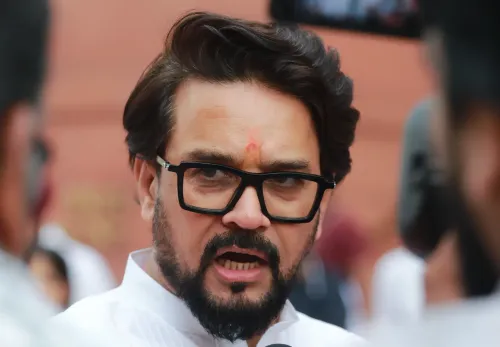
BJP MP Anurag Thakur posted a sharp political attack on July 31, 2026 targeting Leader of Opposition Rahul Gandhi .
The trigger: Gandhi allegedly behaved rudely toward a journalist who asked about a press conference by families of police personnel injured at a Jantar Mantar demonstration.
Thakur drew a direct comparison between Gandhi's alleged press hostility and Indira Gandhi's 1975 Emergency press censorship.
The BJP MP cited Gandhi's past statements on the 2016 Surgical Strikes and other military operations as a pattern of undermining troop morale.
Thakur declared Gandhi's conduct as Leader of the Opposition 'extremely unbecoming and condemnable.'
A pointed political attack landed on the evening of Friday, July 31, 2026, when BJP MP Anurag Thakur accused Leader of Opposition Rahul Gandhi of disrespecting both the press and injured police personnel — drawing a sharp historical parallel that cut straight to the Congress dynasty's most contested chapter.
The journalist incident at the centre of the storm
Thakur's post alleges that when a journalist asked Rahul Gandhi about a press conference held by families of police personnel injured during a demonstration at Jantar Mantar, New Delhi, the Congress leader responded with what Thakur describes as 'durgavyavhar' — misconduct or rudeness. The BJP MP frames this not as a one-off moment but as a pattern: 'जो देश के लिए देते हैं बलिदान, राहुल गांधी करते हैं उनका अपमान' ('Those who sacrifice for the country, Rahul Gandhi insults them').
The charge carries particular weight because it involves police families seeking public attention for their injured kin — a constituency that cuts across party lines in its emotional appeal.
The Indira Gandhi press-censorship comparison
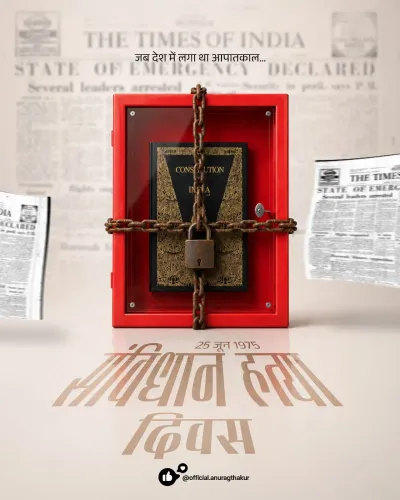
Thakur escalates quickly to a generational indictment, invoking former Prime Minister Indira Gandhi and the Emergency of 1975 — a period during which her government imposed sweeping press censorship across India. 'Just as his grandmother crushed the press,' Thakur writes, 'Rahul Gandhi harbours the same hatred for the media.' The comparison is a staple of BJP political rhetoric but lands with specific historical grounding: the 1975 Emergency remains one of the most documented instances of state-directed media suppression in independent India's history.
Armed forces in the crossfire — again
Thakur broadens the attack to cover what he calls Rahul Gandhi's long record of questioning the military. He cites statements made in the context of the 2016 Surgical Strikes — conducted by Indian forces across the Line of Control following the Uri attack — as examples of the Congress leader undermining troop morale. He also references Operation Sindoor and other military operations as further instances, though specific details of those references remain unverified.
BJP has consistently deployed this framing — that Congress criticism of security operations amounts to hostility toward the armed forces — particularly after major military or internal-security events. Thakur's post fits squarely within that established playbook, but the specific trigger here — a journalist being rebuffed while asking about injured policemen's families — gives the attack an unusually human, ground-level hook.
Thakur's verdict on Gandhi's conduct as LoP
Thakur closes with a direct assessment of Gandhi's fitness for his constitutional role: 'As Leader of the Opposition, Shri Rahul Gandhi's conduct is extremely unbecoming and condemnable.' The final line is blunter still — 'फितरत से नफरती हैं राहुल' ('Rahul is hateful by nature') — a phrase designed for social-media circulation rather than parliamentary record.
Political opposition, Thakur concedes, is legitimate. What he argues is not acceptable: disrespect toward uniformed personnel who serve the nation, and contempt for a press that holds power to account. Whether the incident at Jantar Mantar bears out that characterisation will likely be tested in the next parliamentary session, where opposition-versus-government clashes on internal security and defence have become a near-permanent fixture.
Point of View
A period that still carries strong negative resonance with older voters and press-freedom advocates. By linking a single alleged interpersonal incident — Gandhi's reported rudeness to a journalist — to a 50-year lineage of alleged Congress authoritarianism, the BJP frames its opponent not as a critic but as a dynasty repeating its worst instincts. The armed-forces angle adds a second front, reinforcing a BJP narrative that has proved electorally potent since the 2016 Surgical Strikes debate. What is notable here is the specific trigger: injured police families, not an abstract policy dispute — a human detail that makes the attack harder for Congress to deflect on purely ideological grounds.
NationPress
15 Sept 2026
Frequently Asked Questions
What did Anurag Thakur accuse Rahul Gandhi of?
Anurag Thakur accused Rahul Gandhi of behaving rudely toward a journalist who asked him about a press conference held by families of police personnel injured during a protest at Jantar Mantar, New Delhi.
Why did Thakur compare Rahul Gandhi to Indira Gandhi?
Thakur invoked Indira Gandhi's imposition of the Emergency in 1975, during which press censorship was enforced, to argue that Rahul Gandhi's alleged hostility toward the media follows a family pattern.
What is the Jantar Mantar protest Thakur referred to?
Thakur referenced a demonstration held at Jantar Mantar in New Delhi during which police personnel were reportedly injured, with their families subsequently holding a press conference.
What military controversies did Thakur cite against Rahul Gandhi?
Thakur cited Rahul Gandhi's past statements on the 2016 Surgical Strikes — conducted after the Uri attack — as examples of undermining troop morale, and also referenced Operation Sindoor and other military operations.
What is Rahul Gandhi's current constitutional role in India?
Rahul Gandhi serves as Leader of the Opposition in the Lok Sabha, the lower house of India's Parliament, a position Thakur directly referenced in his criticism.