Anurag Thakur warns of 'regime change' plot by foreign forces
Synopsis
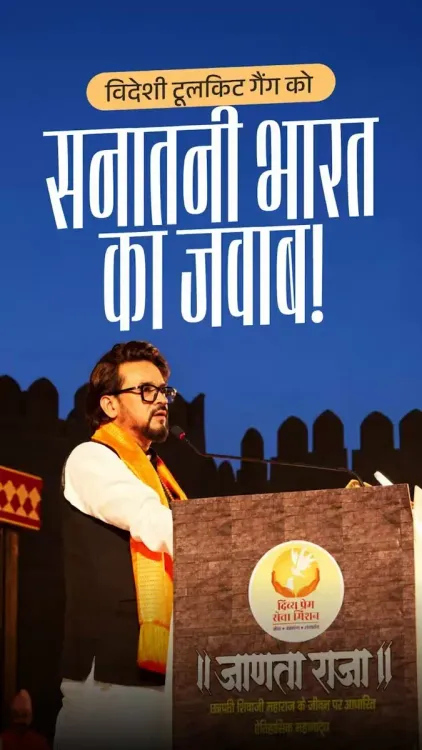
BJP MP Anurag Thakur on 28 October 2026 accused globally destructive forces and their domestic agents — labelled 'Neo-Mughals', 'Neo-Turks', and 'Neo-Britishers' — of plotting to spread anarchy and engineer regime change in India, vowing to stop them.
Key Takeaways
BJP MP Anurag Thakur posted a sharp warning on 28 October 2026 alleging a foreign-backed 'regime change' plot against India.
He coined three labels — 'Neo-Mughals', 'Neo-Turks', and 'Neo-Britishers' — to describe domestic actors he accused of serving foreign interests.
The post invokes the Mughal Empire (16th–19th century) and British colonial rule (ended 1947) as historical precedents for alleged present-day subjugation.
Thakur framed the accused not as external actors but as Indians who have 'sold their conscience', implicating domestic opponents without naming them.
The statement closed with a direct pledge: 'we will not let this happen,' positioning the BJP as a bulwark against the alleged conspiracy.
Analysts note this rhetorical pattern — linking opposition figures to foreign-backed destabilisation — tends to intensify during periods of sharp political contestation in India.
A sharp political warning rang out on Wednesday, 28 October 2026, as BJP MP Anurag Thakur — Lok Sabha representative from Hamirpur, Himachal Pradesh and former Union Minister — accused what he called destructive global forces and their domestic agents of attempting to destabilise India and engineer a regime change. The accusation came loaded with striking historical shorthand: 'Neo-Mughals', 'Neo-Turks', and 'Neo-Britishers' — a rhetorical framework designed to draw a straight line from centuries of foreign domination to, in his telling, present-day political subversion.
Thakur posted in Hindi: 'फिर से दुनिया भर की विध्वंसकारी शक्तियां और उनके एजेंट्स भारत में अराजकता फैलाकर रेजीम चेंज के सपने देख रहे हैं' — translating as: 'Once again, destructive forces from across the world and their agents are dreaming of regime change by spreading anarchy in India.' He then identified the alleged culprits not as outsiders but as Indians who have, in his framing, 'sold their conscience' and are 'looking to sell India into foreign hands once again.'
Three historical labels, one political charge
The three terms Thakur deployed carry deliberate weight. 'Neo-Mughals' invokes the Mughal Empire, which ruled large parts of the Indian subcontinent from the 16th to the 19th century. 'Neo-Britishers' summons the memory of British colonial rule, which ended with Indian independence in 1947. 'Neo-Turks' adds a third historical layer to the same argument. Together, they construct a narrative of cyclical foreign-backed subjugation — and position the speaker as standing in the way of its repetition. It is a rhetorical structure that has appeared with increasing frequency in BJP political communication during periods of sharp electoral or legislative contestation.
The 'foreign hand' as a recurring political frame
The charge of foreign-influenced destabilisation is not new in Indian politics — it has been deployed across party lines and across decades. What is distinctive in Thakur's framing is the explicit merger of the 'foreign hand' accusation with domestic political opponents, labelled here as 'agents.' This formulation directly implicates opposition-aligned figures without naming them, a technique that amplifies the charge while keeping it legally non-specific. The broader pattern, as analysts note, is that such rhetoric tends to intensify around politically charged moments — elections, parliamentary sessions, or high-profile legal or civil-society actions. Thakur's closing line — 'but we will not let this happen' — was a direct pledge of resistance, framing the ruling dispensation as India's last line of defence against this alleged conspiracy.
Whether the statement foreshadows concrete policy action — tighter foreign-funding regulations for civil society groups, for instance — or serves primarily as a political mobilisation signal remains to be seen in the days ahead. What it does, unambiguously, is raise the temperature of the national conversation around sovereignty, dissent, and who gets to define loyalty to the nation.
Point of View
Drawing on Mughal and colonial history to delegitimise domestic dissent. By coining compound labels like 'Neo-Mughals' and 'Neo-Britishers', the framing bypasses the need to name specific opponents while maximising associative damage, a tactic that plays well to a base steeped in nationalist historical memory. The timing and intensity of such rhetoric typically correlates with upcoming electoral cycles or flashpoint legislative moments, making it worth watching whether concrete policy moves — such as tighter scrutiny of foreign funding to NGOs or civil society — follow the rhetorical volley. Ultimately, the statement is as much a mobilisation signal to BJP voters as it is a political indictment of opponents.
NationPress
28 Oct 2026
Frequently Asked Questions
What did Anurag Thakur mean by 'Neo-Mughals' and 'Neo-Britishers'?
Thakur used these terms as political labels for domestic actors he accused of serving foreign interests — drawing on the historical imagery of the Mughal Empire and British colonial rule to frame them as modern-day equivalents selling India to outsiders.
Who is Anurag Thakur?
Anurag Thakur is a BJP Lok Sabha MP from Hamirpur, Himachal Pradesh, and a former Union Minister who held the portfolios of Information and Broadcasting and Youth Affairs and Sports.
What is the 'regime change' accusation Thakur made?
Thakur alleged that destructive global forces and their agents inside India are attempting to spread anarchy in order to engineer a change of government, and pledged that his party would prevent it.
Is the 'foreign hand' accusation common in Indian politics?
Yes — allegations of foreign-backed destabilisation have appeared across party lines in Indian politics for decades, though the BJP has increasingly combined this charge with historical civilisational imagery during periods of political contestation.
Could this statement lead to policy action on foreign funding?
Analysts flag that such rhetoric sometimes precedes tighter regulatory scrutiny of foreign funding to civil society organisations in India, though no specific policy announcement has been made alongside this post.