Tharoor Urges Global Action Against Terrorism in New Column
Synopsis
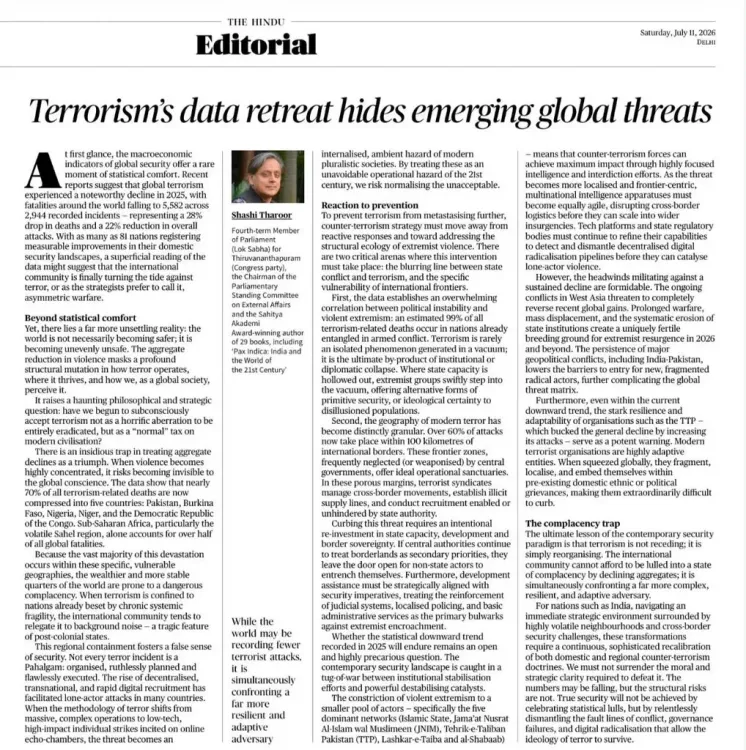
Congress MP Dr. Shashi Tharoor, writing in a leading English daily, analyses the latest global terrorism data and argues that the world must reject fatalism about political violence, calling for determined international cooperation to confront and reduce terrorism.
Key Takeaways
Shashi Tharoor published a new opinion column on 11 July 2026 examining the most recent global terrorism statistics.
He argues that terrorism must not be normalised as unavoidable and calls for 'determination and international support' to tackle it.
India has advocated since 1996 for a UN Comprehensive Convention on International Terrorism (CCIT) , which remains unadopted due to definitional disagreements among member states.
Post- 2008 Mumbai attacks , India intensified calls for stronger multilateral sanctions regimes against terrorism sponsors.
Tharoor 's background as a former UN Under-Secretary-General gives his commentary added diplomatic resonance beyond standard parliamentary opinion.
The column is pinned to his social media profile, indicating he views it as a priority policy statement.
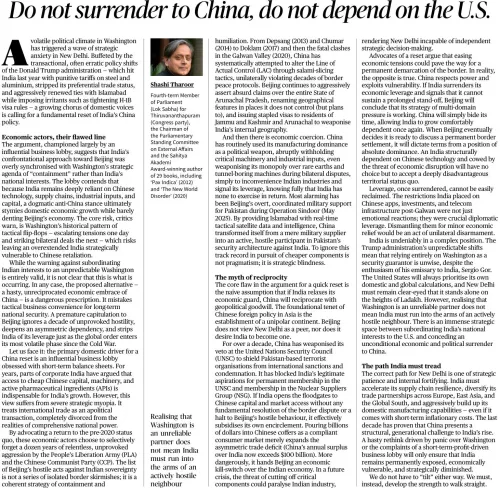
Congress MP Dr. Shashi Tharoor on Saturday, 11 July 2026, shared a new opinion column examining the latest global terrorism statistics, arguing that the international community must refuse to treat terrorism as an inevitable fact of modern life and instead pursue it with coordinated resolve.
Context
In the column, Dr. Tharoor draws on recent global terrorism data to make the case that the phenomenon is neither unavoidable nor beyond the reach of collective action. He writes that humanity 'can and should tackle it with determination and international support' — a framing that places moral responsibility squarely on governments and multilateral institutions rather than treating violence as background noise.
The piece is pinned to the top of his social media profile, signalling that Dr. Tharoor regards it as a priority statement rather than a routine contribution. Coming from a former UN Under-Secretary-General who spent decades in multilateral diplomacy, the column carries institutional weight beyond a standard parliamentary opinion.
Policy Backdrop
India has been one of the most persistent advocates for a UN Comprehensive Convention on International Terrorism (CCIT), a draft treaty first proposed by New Delhi in 1996 that remains unadopted three decades later because member states cannot agree on a common definition of terrorism. The definitional impasse has long frustrated Indian policymakers who argue it allows some states to draw distinctions between 'terrorism' and 'resistance' in ways that shield perpetrators from accountability.
After the 2008 Mumbai attacks, India intensified its push for stronger international cooperation, tougher sanctions regimes against states that sponsor or harbour terrorist groups, and a zero-tolerance norm at the United Nations. Dr. Tharoor's column sits squarely within this long-running Indian diplomatic tradition, lending a parliamentarian's voice to positions that successive governments have advanced in multilateral forums.
Stakeholders and Impact
The immediate audience for such a column includes counter-terrorism agencies, foreign-policy professionals, and civil society organisations working in conflict-affected regions. Civilian populations in active conflict zones — who bear the heaviest cost of political violence — are the implicit subject of the argument that normalisation of terrorism is morally and strategically unacceptable.
Indian parliamentarians and former diplomats have periodically used media platforms to highlight terrorism indices and urge zero-tolerance approaches alongside multilateral engagement. This pattern reflects India's consistent emphasis, in forums from the UN Security Council to bilateral dialogues, on distinguishing terrorism from legitimate political struggle — a distinction that has direct implications for how the international community responds to attacks on Indian soil.
What's Next
India's posture at the next UN General Assembly session will be closely watched, particularly any fresh push on the stalled CCIT draft. Dr. Tharoor's column, amplified through his parliamentary profile, could feed into domestic legislative debate when the External Affairs Ministry or the Home Ministry faces questions during the upcoming parliamentary session.
If global terrorism indices continue to show concerning trends, pressure on multilateral bodies to move beyond rhetorical condemnation toward binding legal frameworks is likely to grow — and voices like Dr. Tharoor's, bridging parliamentary politics and UN-level experience, will remain central to that conversation.
Point of View
He attempts to shift the conversation from political will to empirical urgency. The timing, pinned prominently on his public profile, suggests a calculated effort to keep counter-terrorism on the parliamentary and diplomatic agenda ahead of the next UN General Assembly cycle. For the Congress party, it also reinforces a foreign-policy credential at a moment when national-security narratives are politically contested.
NationPress
10 Oct 2026
Frequently Asked Questions
What did Shashi Tharoor write about terrorism in his latest column?
Dr. Shashi Tharoor examined the most recent global terrorism statistics and argued that terrorism must not be accepted as inevitable, calling on governments and the international community to confront it with determination and coordinated support.
What is India's position on the UN Comprehensive Convention on International Terrorism?
India first proposed the CCIT at the United Nations in 1996 and has consistently advocated for its adoption, but the convention remains unadopted because member states disagree on a common definition of terrorism.
Why is Shashi Tharoor considered an authority on international security issues?
Dr. Tharoor served as UN Under-Secretary-General for Communications and Public Information before entering Indian politics, giving him direct experience with multilateral diplomacy and global security governance.
How does India's counter-terrorism stance fit into its foreign policy?
India emphasises a zero-tolerance approach and insists on distinguishing terrorism from legitimate political struggle in international forums, a position that intensified after the 2008 Mumbai attacks and shapes its bilateral and UN-level engagements.
What could follow from Tharoor's column on global terrorism?
The column could inform parliamentary debate during upcoming sessions on external affairs or home ministry demands, and may feed into India's statements at the next UN General Assembly, particularly around renewed efforts on the stalled CCIT draft.