Tharoor Flags Brazen Violations of International Law
Synopsis
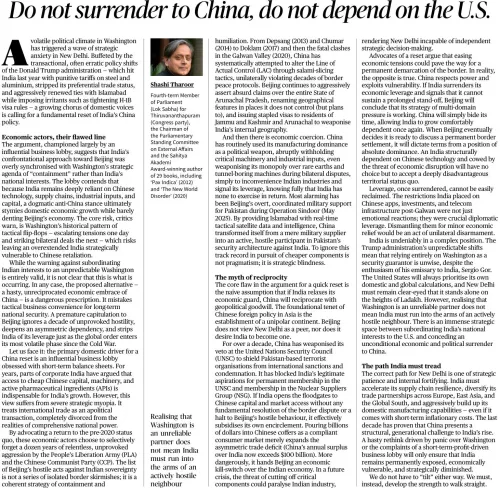
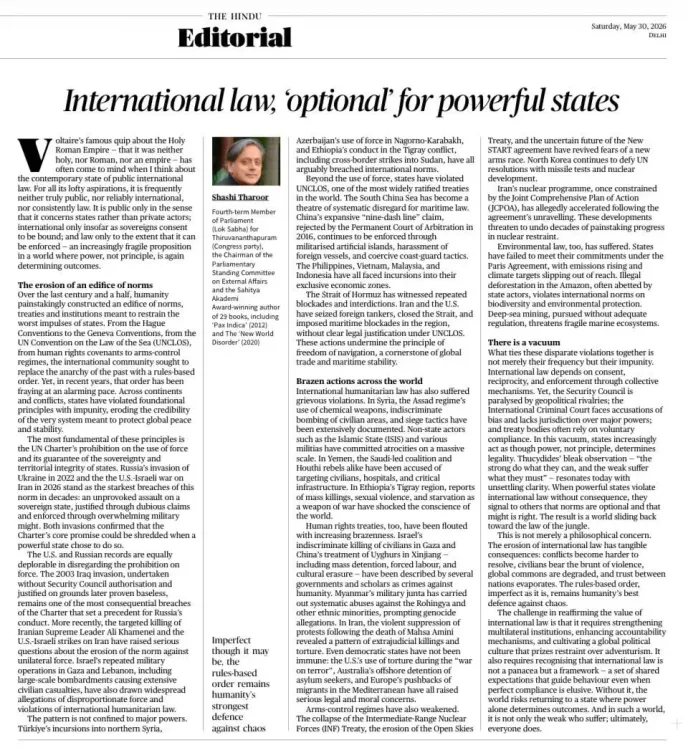
Congress MP Dr. Shashi Tharoor flagged an article on June 1, 2026, cataloguing what he called brazen violations of international law, warning that such breaches undermine the foundational rules binding sovereign states under the post-1945 multilateral order.
Key Takeaways
Shashi Tharoor shared an article on June 1, 2026 , highlighting alleged violations of international law.
He described the violations as 'brazen' and warned they undermine 'the very concept of rules that bind states.' Tharoor is a former UN Under-Secretary-General and former Union Minister of State for External Affairs , giving his commentary institutional weight.
The UN Charter (1945) prohibits unilateral use of force except in self-defence or with Security Council authorisation — the foundational framework at issue.
Accountability bodies such as the ICJ and UN General Assembly remain the formal arenas for addressing such violations.
The post reflects a broader pattern of former senior UN officials publicly naming norm erosion that serving diplomats typically cannot.
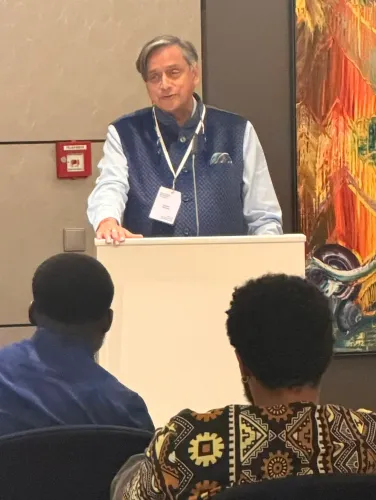
Congress MP Dr. Shashi Tharoor on Monday, June 1, 2026, shared what he described as an article cataloguing 'brazen violations of international law' that have, in his words, 'undermined the very concept of rules that bind states.' The post, directed at a global audience, signals the Thiruvananthapuram MP's continued engagement with questions of multilateral order and state accountability.
Context
Tharoor, a former UN Under-Secretary-General and former Union Minister of State for External Affairs, has long been one of India's most prominent voices on international law and global governance. His framing — 'brazen violations' that erode the very concept of binding rules — reflects a concern shared widely among former multilateral officials: that selective compliance by powerful states is hollowing out the post-1945 legal architecture.
The UN Charter, adopted in 1945, established the foundational prohibitions on the unilateral use of force, requiring either self-defence justification or explicit UN Security Council authorisation. When states circumvent these constraints, critics argue, the normative foundation of the entire rules-based international order is placed at risk.
Policy Backdrop
Debates over compliance with international law have intensified across multiple active conflict zones and territorial disputes in recent years, testing institutions that were designed for a different era of great-power relations. Bodies such as the International Court of Justice (ICJ) and the UN General Assembly have been repeatedly invoked — and just as repeatedly bypassed — as accountability mechanisms.
Former senior UN officials occupy a distinctive position in these debates: they carry institutional credibility but speak without the diplomatic constraints of serving governments. Tharoor's commentary fits a broader pattern of such figures publicly naming norm erosion in ways that sitting ministers typically cannot.
Stakeholders and Impact
The primary stakeholders in any breakdown of international legal norms are sovereign states — particularly smaller and middle-power nations that depend on multilateral rules as a counterweight to raw power asymmetries. For a country like India, which has historically championed non-alignment and multilateral dialogue, the erosion of rules-based frameworks carries strategic as well as principled implications.
Civil society organisations, international legal scholars, and UN-affiliated bodies monitoring compliance with humanitarian and territorial law are also directly affected. Each documented violation cited in academic or journalistic analyses adds to a growing evidentiary record that advocacy groups use to press for accountability at international forums.
What's Next
Tharoor's post may prompt responses from India's Ministry of External Affairs or from opposition and ruling-party legislators who hold differing views on how publicly Indian parliamentarians should characterise violations by specific states. Interventions in UN General Assembly sessions and ICJ proceedings will continue to be the formal arenas where such concerns are tested against state practice.
More broadly, the post adds to a growing chorus of voices — from former diplomats, legal scholars, and multilateral officials — calling for renewed debate on enforcement mechanisms within the international system. Whether that debate translates into institutional reform remains the central open question for global governance in the years ahead.
Point of View
Making it harder to dismiss as partisan. For India, which has historically positioned itself as a principled voice in multilateral forums, such commentary from a sitting parliamentarian with UN credentials carries diplomatic undertones. The post fits a wider arc in which the post-1945 institutional framework is being stress-tested, and former insiders are increasingly willing to say so on the public record.
NationPress
15 Oct 2026
Frequently Asked Questions
What did Shashi Tharoor say about international law in June 2026?
On June 1, 2026, Dr. Shashi Tharoor shared an article he described as cataloguing brazen violations of international law that have undermined the concept of rules binding sovereign states.
Why is Shashi Tharoor considered an authority on international law?
Dr. Tharoor served as UN Under-Secretary-General and as India's Union Minister of State for External Affairs , giving him direct experience with multilateral institutions and international legal frameworks.
What is the rules-based international order?
The rules-based international order refers to the system of laws, norms, and institutions — anchored by the UN Charter of 1945 — that governs relations between sovereign states, including prohibitions on the unilateral use of force.
Which bodies enforce international law when states violate it?
The primary formal accountability mechanisms are the International Court of Justice (ICJ) and the UN General Assembly , though enforcement depends heavily on the political will of member states.
What could be the implications of Tharoor's comments for India's foreign policy?
The comments could prompt responses from India's Ministry of External Affairs and may influence India's positioning in upcoming UN General Assembly debates on accountability and compliance with international norms.