Tharoor visits Keeladi, calls finds 'history-rewriting'
Synopsis
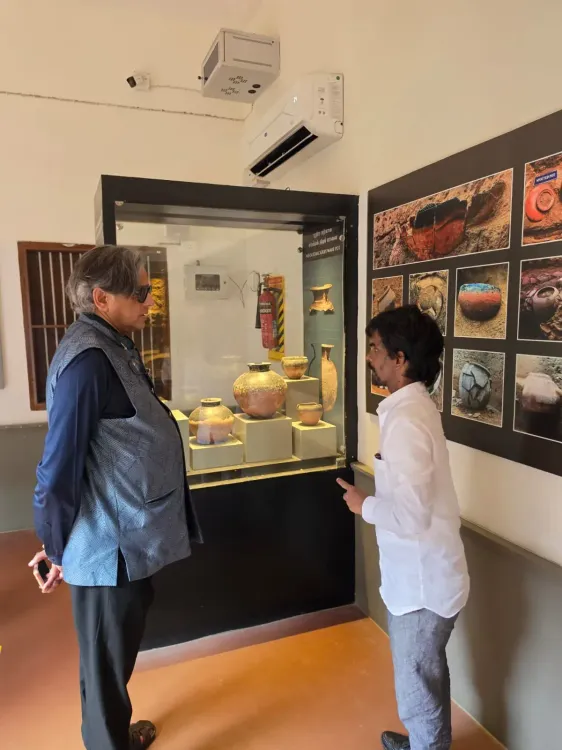
Congress MP Dr. Shashi Tharoor visited the Keeladi archaeological site in Tamil Nadu, highlighting findings that suggest an advanced Iron Age civilisation dating to 3450 BC — predating and technologically rivalling the Harappan Bronze Age culture — and called ongoing excavations at Keeladi and Sivagalai potentially history-rewriting.
Key Takeaways
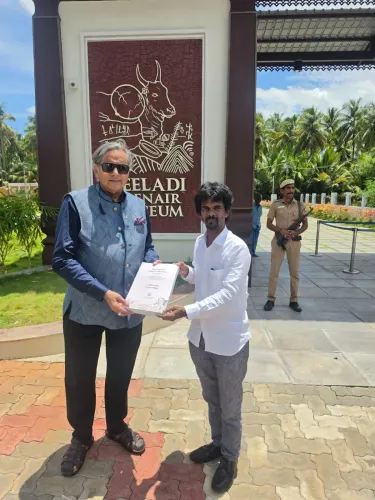
Shashi Tharoor spent two and a half hours at the Keeladi excavation site on September 26, 2026 .
Findings at Keeladi suggest civilisation there may date to as early as 3450 BC , according to the site's ongoing research claims.
The excavated culture is identified as an advanced Iron Age settlement, while the Harappan civilisation was still in the Bronze Age during the same period — a striking technological inversion.
Excavations began at Keeladi , near Madurai , in 2014 under the Archaeological Survey of India and were later transferred to the Tamil Nadu State Department of Archaeology .
A parallel excavation is underway at Sivagalai , further south in Tamil Nadu, which Tharoor says strengthens the case for rewriting subcontinent antiquity.
The specific dating claims remain subject to peer-reviewed publication and independent scientific verification.
Deep beneath the fields of Tamil Nadu, diggers may be unearthing a challenge to everything we thought we knew about the subcontinent's ancient past — and Congress MP Dr. Shashi Tharoor spent two and a half hours on Saturday, September 26, 2026, walking through the evidence firsthand at Keeladi.
What Keeladi's layers are telling us
Tharoor described the visit as 'extraordinary', pointing to findings that suggest civilisation at Keeladi flourished as early as 3450 BC. The detail that struck him hardest was the technological contrast: the culture buried in these Tamil Nadu soils was already an advanced Iron Age society at a time when the more widely celebrated Harappan civilisation — the Bronze Age urban culture of the northwest — was still working in bronze. That is not a minor footnote. It inverts the conventional story of which part of the subcontinent was 'ahead'.
The Archaeological Survey of India first broke ground at Keeladi, near Madurai, in 2014. The site was subsequently handed to the Tamil Nadu State Department of Archaeology, which has driven successive excavation seasons and pushed the dating estimates progressively further back. The research note cautions that the specific figure of 3450 BC and the direct Iron-Age-versus-Bronze-Age contemporaneity remain subject to peer review — the numbers Tharoor cites reflect the site's most recent and still-evolving scientific claims.
Sivagalai: the second front further south
Tharoor flagged a second site that is receiving far less public attention: Sivagalai, located further south in Tamil Nadu, where parallel excavations are underway. Together, he argued, these two digs 'could rewrite the history of the subcontinent's antiquity.' The pairing matters — corroborating evidence from multiple proximate sites strengthens any dating claim far more than a single excavation can alone.
For Tamil archaeologists and historians, the stakes are considerable. Decades of scholarship have argued that peninsular Iron Age urbanism developed independently and simultaneously with — or even prior to — the northwest Bronze Age centres. Keeladi and Sivagalai are, in effect, the physical evidence in that long-running debate. What emerges from the laboratories — carbon-dating reports, stratigraphic analyses, peer-reviewed publications — will determine whether these claims graduate from 'remarkable' to 'authoritative'.
The kicker, as Tharoor framed it, is that the shovels have not stopped. Every new season of digging at both sites adds another layer — and potentially another few centuries — to India's southern story. The world's understanding of where civilisation 'began' on this subcontinent may look very different by the time these excavations are done.
Point of View
He amplifies a claim that, if peer-reviewed and confirmed, would fundamentally reframe the subcontinent's civilisational timeline southward. The move also fits a broader Congress cultural positioning — engaging with southern identity politics and Tamil pride ahead of any electoral cycle. Watchers should track whether formal peer-reviewed publication of the dating evidence follows: without it, the 3450 BC figure remains politically potent but scientifically provisional.
NationPress
26 Sept 2026
Frequently Asked Questions
What is the Keeladi archaeological site?
Keeladi is an Iron Age urban settlement excavation site located near Madurai in Tamil Nadu . Excavations began in 2014 under the Archaeological Survey of India and are now led by the Tamil Nadu State Department of Archaeology . The site has yielded findings that researchers claim point to a sophisticated urban culture in peninsular India.
How old is the Keeladi civilisation?
Ongoing research at Keeladi suggests the civilisation there may date to as early as 3450 BC , though this specific figure is still subject to peer-reviewed scientific confirmation. The findings, if validated, would place Keeladi among the earliest known urban settlements on the Indian subcontinent.
Why is Keeladi compared to the Harappan civilisation?
The comparison arises because Keeladi's excavated culture appears to have been an Iron Age society at a time when the Harappan civilisation in northwest India and present-day Pakistan was still in the Bronze Age . This suggests advanced metallurgical development in peninsular India that ran parallel to — or ahead of — the more widely known northwestern culture.
What is the Sivagalai excavation and how does it relate to Keeladi?
Sivagalai is a second archaeological site further south in Tamil Nadu where excavations are proceeding alongside those at Keeladi. Together, the two sites are expected to provide corroborating evidence about the antiquity and urban character of ancient southern Indian civilisation.
Why did Shashi Tharoor visit Keeladi?
Congress MP Dr. Shashi Tharoor visited the Keeladi excavation site on September 26, 2026 , spending two and a half hours at the dig. He described the experience as 'extraordinary' and said the findings at Keeladi and Sivagalai 'could rewrite the history of the subcontinent's antiquity.'