Tharoor flags Sree Narayana Guru's reach, cites his own book

Synopsis
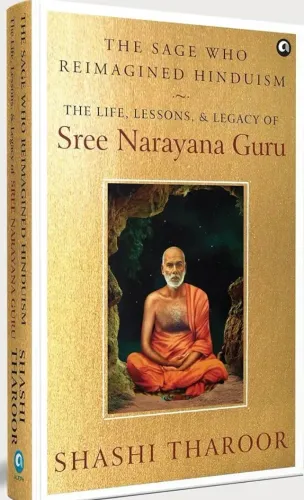
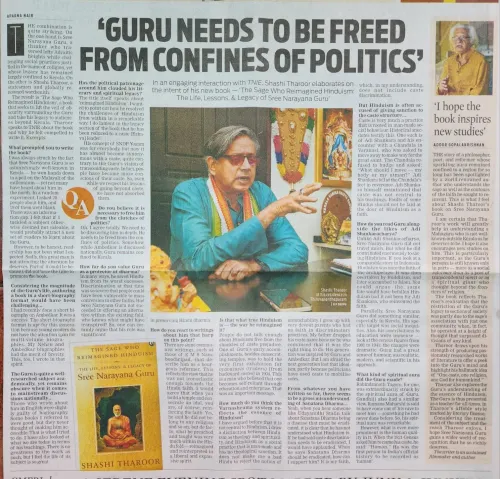
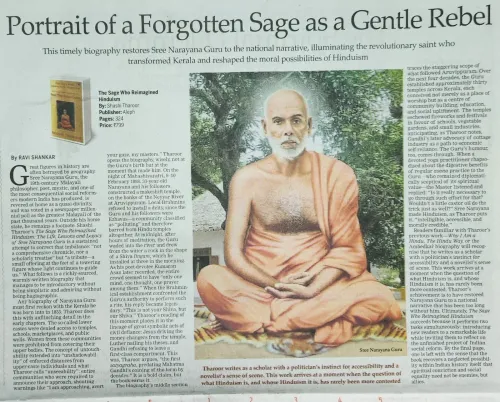
Congress MP Dr. Shashi Tharoor flagged that Sree Narayana Guru's legacy is not widely known across India and said this gap was the reason he wrote a book on the 19th-century Kerala social reformer, reviving debate about regional caste-reform histories in the national mainstream.
Key Takeaways
Shashi Tharoor stated on June 10, 2026 that Sree Narayana Guru's legacy is not fully known across India, citing it as his motivation for writing a book.
Sree Narayana Guru (1856–1928) was a Kerala philosopher and reformer who challenged caste discrimination under the philosophy 'one caste, one religion, one god.' Narayana Guru founded the SNDP Yogam in 1903 to advance social uplift of the Ezhava and backward-caste communities in Travancore.
Tharoor has consistently argued that India's social-reform heritage is plural and rooted in distinct regional contexts.
The post renews calls for greater national recognition of regional caste-reform leaders in mainstream Indian historical narratives.
Congress MP Dr. Shashi Tharoor on Wednesday, June 10, 2026, pointed to the limited pan-Indian awareness of Sree Narayana Guru, the revered Kerala social reformer, saying the gap in public knowledge was precisely what motivated him to write a book on the subject.
Context
Tharoor's post — 'Not quite across India! That's why I wrote the book!' accompanied by the hashtag #SreeNarayanaGuru — was a direct response to the observation that the saint-reformer's legacy has not penetrated mainstream national consciousness to the degree his stature warrants. The remark underscores a recurring theme in Tharoor's public commentary: that India's social-reform heritage is plural, rooted in distinct regional and caste contexts, and cannot be collapsed into a single national narrative.
Sree Narayana Guru (1856–1928) was a philosopher, poet, and reformer from Travancore, present-day Kerala, who mounted a sustained challenge to caste hierarchy and untouchability at a time when such campaigns were rare and dangerous. His philosophy, often summarised as 'one caste, one religion, one god for humanity,' influenced generations of social activists across southern India.
Policy Backdrop
In 1903, Narayana Guru established the Sree Narayana Dharma Paripalana (SNDP) Yogam to advance the social and educational uplift of the Ezhava community and other backward castes in Travancore. The organisation became one of the most consequential caste-reform bodies in colonial India, pioneering access to temples, schools, and public spaces for communities that had been systematically excluded.
Despite this historical significance, Narayana Guru's name and work remain far less familiar in northern and eastern India than those of contemporaries such as B.R. Ambedkar or Mahatma Gandhi. Tharoor's comment reflects a broader scholarly and political argument that regional reformers have been under-represented in the dominant telling of India's freedom and social-justice movements.
Stakeholders and Impact
Kerala's Ezhava community, which forms a substantial share of the state's population, regards Narayana Guru as its foremost spiritual and social patron. The SNDP Yogam today remains one of Kerala's most influential community organisations, with reach into education, healthcare, and cooperative enterprise.
Social-reform advocates and historians have long called for Narayana Guru's inclusion in national school curricula and textbooks. Tharoor's intervention — channelled through a book rather than purely parliamentary speech — adds a prominent political voice to that demand, potentially amplifying it to a wider English-reading audience across India and the diaspora.
What's Next
Narayana Guru's birth anniversary, observed as Sree Narayana Guru Jayanti, typically draws large commemorations across Kerala and among Malayali communities worldwide, renewing annual debate about his place in the national pantheon. Tharoor's reference to his book is likely to draw fresh attention to that publication ahead of or around the Jayanti season. Whether the post sparks a wider parliamentary or policy conversation about recognising regional caste-reform legacies at the national level remains to be seen.
Point of View
He implicitly critiques a historiography that privileges north-Indian or upper-caste reform narratives. The move is consistent with the Congress party's broader electoral and ideological strategy of championing plural, subaltern histories — particularly in a state like Kerala where Ezhava identity and the SNDP's political weight are significant. The book as medium rather than a parliamentary speech signals Tharoor's intent to shape long-term public discourse, not just score an immediate political point.
NationPress
19 Sept 2026
Frequently Asked Questions
Who is Sree Narayana Guru and why is he important?
Sree Narayana Guru (1856–1928) was a Kerala-born philosopher and social reformer who fought against caste discrimination and untouchability in Travancore, founding the SNDP Yogam in 1903 and advancing the rights of Ezhava and backward-caste communities.
What book did Shashi Tharoor write about Sree Narayana Guru?
Tharoor referenced a book he wrote on Sree Narayana Guru in his June 2026 post, though the exact title was not specified in the post itself.
Why is Sree Narayana Guru not well known outside Kerala?
Historians and social-reform advocates argue that regional reformers from southern India have been under-represented in mainstream national narratives, which have tended to centre figures from northern India.
What is the SNDP Yogam?
The Sree Narayana Dharma Paripalana Yogam, founded by Narayana Guru in 1903, is one of Kerala's most influential community organisations, originally formed to advance the social and educational uplift of the Ezhava community.
What did Shashi Tharoor say about Sree Narayana Guru on X?
Tharoor posted on X on June 10, 2026, saying 'Not quite across India! That's why I wrote the book!' with the hashtag #SreeNarayanaGuru, flagging the reformer's limited national recognition as his motivation for writing about him.