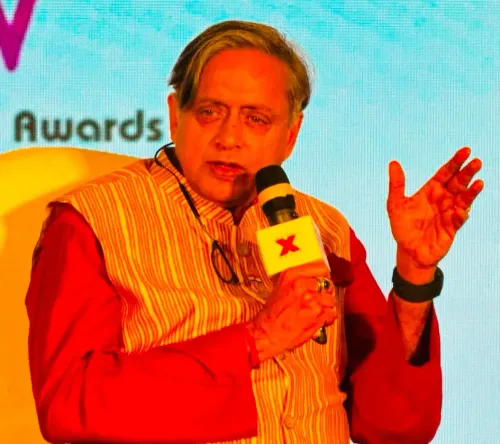
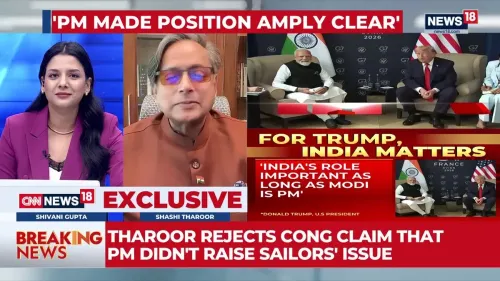
Tharoor Challenges Naidu on Percentage Pay Hikes and Inequality
Synopsis
Congress MP Dr. Shashi Tharoor challenged Andhra Pradesh CM Naidu with a direct salary analogy on June 17, 2026, arguing that uniform percentage pay hikes — where a 50% rise means ₹1 lakh extra for a senior but only ₹10,000 for a driver — structurally widen income inequality, reigniting debate over India's government pay revision model.
Key Takeaways
Shashi Tharoor addressed a public economic argument to Andhra Pradesh CM N.
Chandrababu Naidu on June 17, 2026 .
Tharoor used a thought experiment: a 50% pay hike on a ₹2 lakh salary yields ₹1 lakh extra, while the same rate on ₹20,000 yields only ₹10,000 extra.
The argument challenges the equity of uniform percentage-based pay revisions, the dominant model in Indian government compensation since at least the 7th Pay Commission (2016) .
Lower-rung government employees — drivers, clerical staff, sanitation workers — are the implicit stakeholders most disadvantaged by this formula.
The post adds opposition pressure ahead of potential Andhra Pradesh budget discussions and central government deliberations on the 8th Pay Commission .
Congress MP Dr. Shashi Tharoor on Wednesday, June 17, 2026, directed a pointed economic argument at Andhra Pradesh Chief Minister N. Chandrababu Naidu, using a salary analogy to challenge the fairness of uniform percentage-based pay increases — a model widely used in government pay revisions across India.
Context
Tharoor's post frames the critique as a 'thought experiment' addressed directly to Naidu. He writes: 'Say your salary is 2 lakhs and your driver's is 20,000. You announce a 50% increase for everybody. Your salary is now 3 lakhs and your driver's is 30,000. The percentage or proportional increase is the same — but aren't you much better off?' The argument is a textbook illustration of how equal percentage gains translate into unequal absolute rupee gains, widening the income gap between higher and lower earners.
The post appears to be a direct response to a statement or policy position by Chief Minister Naidu, though the specific trigger — referenced via a link in the original post — could not be independently verified from public records at the time of writing.
Policy Backdrop
Uniform percentage pay hikes have been the dominant model in Indian government compensation for decades. The 7th Central Pay Commission, implemented from 2016, granted percentage-based increases to central government employees; several states, including Andhra Pradesh, subsequently mirrored this structure in their own pay revisions.
Critics of this approach have long argued that while percentage increases appear equitable on paper, they mechanically widen absolute income gaps. A 50% raise on a ₹2 lakh salary adds ₹1 lakh per month to a senior official's pay, while the same percentage on a ₹20,000 wage adds only ₹10,000 — a difference of ₹90,000 per month in new income alone. Tharoor's analogy makes precisely this point in accessible terms.
The debate sits at the intersection of minimum wage policy and progressive pay structures, with labour economists and opposition politicians periodically calling for flat-amount increases or higher percentage hikes for lower pay bands to counteract this effect.
Stakeholders and Impact
State government employees in Andhra Pradesh, particularly those at the lower end of the pay scale — drivers, sanitation workers, and clerical staff — are the implicit focus of Tharoor's argument. For this group, even a generous percentage hike leaves the absolute rupee gain far behind that of senior bureaucrats or ministers.
The argument also resonates with the broader debate over the 8th Pay Commission, whose timeline and structure are being watched closely by central government employees. If the next commission endorses a uniform percentage formula, critics argue the distributional gap will widen further at a time when cost-of-living pressures disproportionately affect lower-income households.
What's Next
Attention will now turn to whether Chief Minister Naidu or the Andhra Pradesh government responds to Tharoor's framing, and whether the state's next budget or assembly session takes up the question of differentiated pay band increases. At the national level, any signals from the central government on the 8th Pay Commission structure will reignite this debate. Tharoor's intervention adds opposition pressure on governments to justify the equity implications of percentage-based pay revision models.
Point of View
He forces a politically inconvenient question onto a ruling coalition partner of the BJP at a moment when pay commission debates are gaining salience. The analogy sidesteps ideological abstraction and lands in concrete rupee terms that ordinary voters can verify against their own pay slips. This fits a broader pattern of the Congress opposition using accessible economic framing to contest the narrative that government pay revisions are inherently pro-worker. Whether the Andhra government responds substantively or dismisses it as political posturing will signal how confident the TDP is in defending percentage-based pay structures to its own employee voter base.
NationPress
19 Sept 2026
Frequently Asked Questions
What is Tharoor's argument against percentage pay hikes?
Tharoor argues that a uniform percentage increase, such as 50%, gives far more money in absolute rupee terms to those already earning higher salaries. In his example, a person earning ₹2 lakh gets ₹1 lakh extra while someone earning ₹20,000 gets only ₹10,000 extra — the same percentage, but a vastly different real-world benefit.
Why did Tharoor address this to Naidu specifically?
Tharoor directed the argument at Andhra Pradesh Chief Minister N. Chandrababu Naidu, apparently in response to a statement or policy position by Naidu on government employee pay. The specific trigger was linked in Tharoor's post but could not be independently verified from public records.
How do India's pay commissions decide salary hikes?
India's Pay Commissions, including the 7th Pay Commission implemented in 2016, have historically recommended percentage-based increases applied uniformly across pay bands. Critics argue this model widens the absolute income gap between senior officials and lower-paid staff.
What is the 8th Pay Commission and why does it matter here?
The 8th Pay Commission is the next scheduled body to recommend salary revisions for central government employees. Its structure — whether it uses uniform percentages or differentiated rates — is directly relevant to the inequality argument Tharoor is making.
Does a flat-amount pay hike reduce inequality more than a percentage hike?
Yes, economists generally agree that a flat rupee increase distributes the same absolute benefit to all employees, proportionally helping lower earners more. A percentage hike, by contrast, preserves or widens existing absolute income gaps even when it appears equal on paper.