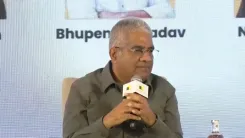
Tharoor flags Kerala's fiscal strain under Ayushman Vay Vandana

Synopsis
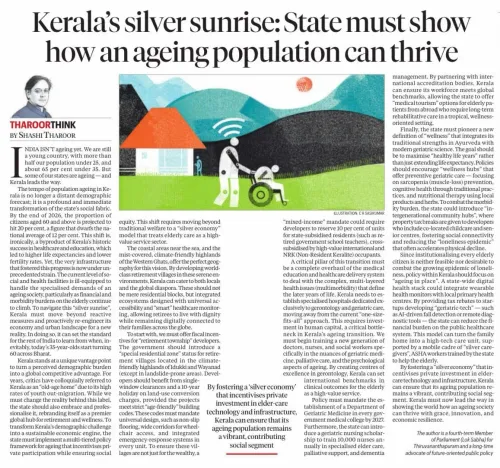
Congress MP Dr. Shashi Tharoor has flagged in Parliament that Ayushman Vay Vandana's 60:40 Centre-State funding formula places a disproportionate fiscal burden on Kerala, which has India's highest share of elderly citizens, and urged the Finance Minister to introduce a demographically sensitive financing mechanism.
Key Takeaways
Shashi Tharoor submitted a Rule 377 note in Parliament on August 11, 2026 raising concerns about Ayushman Vay Vandana 's cost-sharing structure.
The scheme operates on a 60:40 Centre-State funding ratio with central assistance capped per beneficiary family, leaving states with older populations to absorb higher residual costs.
Kerala has the country's highest proportion of elderly citizens, making it the most exposed state under the current flat-rate formula.
Tharoor urged the Union Finance Minister to evolve a financing mechanism that accounts for demographic differences across states.
The intervention extends a recurring federal debate about health insurance formulas that do not adjust for interstate variation in age structure or disease burden.
A formal Finance Ministry response — or a Budget-level revision — remains the key development to watch.
A state that leads the country in longevity is also the one that pays the steepest price for it — and Congress MP Dr. Shashi Tharoor took that argument to Parliament on Tuesday, August 11, 2026, urging the Union Finance Minister to rethink how Ayushman Vay Vandana's funding is split between the Centre and the states.
The Rule 377 submission and what it argued
Tharoor's submission, laid on the Table of the House under Rule 377, targeted the scheme's 60:40 Centre-State cost-sharing ratio. His core argument: a flat funding formula cannot be fair when the demographic reality on the ground is anything but flat. With central assistance capped per beneficiary family, states that house a larger share of elderly citizens — who visit hospitals more often and rack up higher bills — are left absorbing costs the formula was never designed to cover.
The MP called on the Union Finance Minister to 'revisit the funding pattern under Ayushman Vay Vandana and evolve a financing mechanism that adequately accounts for demographic differences across States.'
Why Kerala's ageing curve makes this urgent
Kerala carries the country's highest proportion of elderly citizens — a product of decades of low fertility, high life expectancy, and significant out-migration of working-age adults. That demographic success story now translates directly into greater geriatric care demand and, under a capped central contribution, a disproportionate fiscal burden on the state exchequer.
The tension is structural, not incidental. Health insurance schemes in India have historically applied standardised cost-sharing ratios that do not adjust for interstate differences in age structure or disease burden. Kerala's advanced demographic transition simply makes the gap more visible — and more expensive — than anywhere else.
A recurring fault line in federal health financing
This is not the first time Parliament has heard arguments about the mismatch between uniform Centre-State health financing and uneven state demographics. Ayushman Bharat PM-JAY, launched in 2018 as the flagship national health insurance scheme, set the template for shared financing — but the model was built for breadth of coverage, not for the granular actuarial reality of states with older, costlier populations.
Tharoor's intervention sits within a longer pattern of federal fiscal debates in the health sector, where southern and smaller states with stronger human development indicators often find themselves penalised by formulas calibrated to a national average they have long surpassed.
Whether the Finance Ministry responds during the monsoon session or signals any revision in the next Union Budget health allocations will tell us whether Parliament's table received more than just a piece of paper.
Point of View
But the underlying flaw — capped central transfers against uncapped geriatric demand — will surface in other demographically advanced states as India ages rapidly over the next two decades. The political salience of the argument is real: if the Finance Ministry does not respond, it hands the Opposition a durable, evidence-backed federalism grievance heading into budget season.
NationPress
25 Sept 2026
Frequently Asked Questions
What is Ayushman Vay Vandana and how is it funded?
Ayushman Vay Vandana is a central health coverage initiative for senior citizens that operates on a 60:40 Centre-State cost-sharing ratio, with central assistance capped per beneficiary family.
Why is Kerala particularly affected by the Ayushman Vay Vandana funding formula?
Kerala has India's highest proportion of elderly citizens, meaning its senior population requires more frequent and costlier medical care — costs that exceed what the capped central contribution covers, placing extra pressure on the state budget.
What did Shashi Tharoor say in Parliament about Ayushman Vay Vandana?
In a Rule 377 submission laid on the Table of the House on August 11, 2026, Tharoor argued the 60:40 funding pattern places a disproportionate fiscal burden on states with ageing populations and urged the Finance Minister to create a demographically sensitive financing mechanism.
What is a Rule 377 submission in the Indian Parliament?
Rule 377 allows members of the Lok Sabha to raise matters of urgent public importance that cannot be raised under other procedural rules; submissions are laid on the Table of the House for the record.
What is the broader policy problem Tharoor's submission points to?
India's health insurance schemes have historically used standardised Centre-State cost-sharing ratios that do not adjust for interstate differences in age structure or disease burden, a flaw that becomes more acute as states like Kerala complete their demographic transitions ahead of the national average.