Tharoor Credits Kerala Literacy for Electing Well-Read MPs

Synopsis
Congress MP Dr. Shashi Tharoor on 22 June 2026 credited Kerala's status as India's most literate state for producing an electorate that elects well-read politicians, in a pointed remark addressed to novelist Amitav Ghosh on X.
Key Takeaways
Shashi Tharoor posted on 22 June 2026 linking Kerala's high literacy to its tendency to elect well-read political representatives.
The post was addressed to acclaimed novelist Amitav Ghosh , a rare public exchange between a sitting MP and a leading literary figure.
Kerala holds India's highest literacy rate, a distinction rooted in 19th-century Travancore princely-state policies, missionary schools and social reform movements.
The Total Literacy Campaign of the late 1980s–early 1990s consolidated Kerala's lead, which was confirmed in the 1991 Census and maintained since.
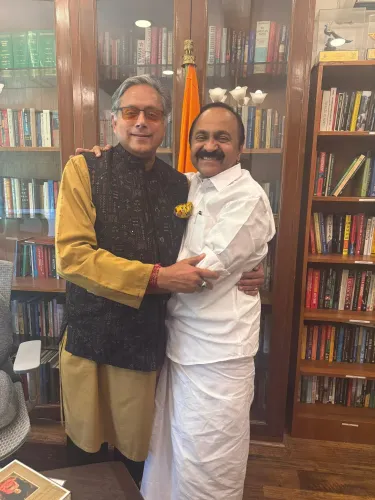
Tharoor, himself a prolific author, represents Thiruvananthapuram — Kerala's capital — in the Lok Sabha, making him a direct example of the trend he describes.
The remark feeds into broader debates about the 'Kerala Model' and whether mass education shapes a more discerning, accountability-focused electorate.
Congress MP Dr. Shashi Tharoor on Monday, 22 June 2026 took to X to celebrate Kerala's status as India's most literate state, linking it directly to the kind of political representatives the state tends to send to Parliament — in a light-hearted but pointed exchange with celebrated novelist Amitav Ghosh.
Context
Tharoor's post was addressed to Amitav Ghosh, one of India's most internationally recognised literary figures, best known for works that weave together colonialism, migration and climate. Replying to or tagging Ghosh, Tharoor wrote: 'It's not for nothing that Kerala is the most literate state, @GhoshAmitav! An electorate of readers will elect a politician who reads (and even sometimes one who writes)!'
The remark carries a dual edge — a genuine tribute to Kerala's educational achievement and a wry acknowledgement that Tharoor himself, a prolific author of books on history, politics and culture, is a product of exactly the dynamic he describes. He represents Thiruvananthapuram, Kerala's capital, in the Lok Sabha.
Policy Backdrop
Kerala's near-universal literacy is not accidental. The state's educational foundation was laid in the 19th and early 20th centuries through the progressive policies of the Travancore princely state, missionary school networks and successive social reform movements that emphasised access to education regardless of caste or gender.
The landmark Total Literacy Campaign of the late 1980s and early 1990s — a grassroots adult-literacy drive — consolidated these gains and helped Kerala record the country's highest literacy rate in the 1991 Census, a position it has retained ever since. This sustained investment in mass education underpins what scholars and policymakers frequently call the 'Kerala Model' of human development, in which social indicators such as life expectancy, infant mortality and educational attainment diverge sharply from the national average.
Stakeholders and Impact
The observation resonates beyond political wit. Kerala's highly literate electorate has historically rewarded candidates who demonstrate intellectual engagement — lawyers, academics, writers and public intellectuals have found a receptive voter base in the state. Tharoor's own electoral history in Thiruvananthapuram, where he has won multiple Lok Sabha terms, is often cited as a case study in this phenomenon.
For the Indian literary community, the exchange between a sitting MP and a Booker-shortlisted novelist underscores a cultural conversation about whether democratic systems reward learning and articulation. Amitav Ghosh's Ibis trilogy and his non-fiction work on climate and empire have made him a prominent voice on global platforms, and his engagement with a politician of Tharoor's profile signals an overlap between India's literary and political spheres that is rarely so openly celebrated.
What's Next
With Kerala's 2026 Assembly elections on the horizon, candidate profiles and voter preferences will come under renewed scrutiny. Analysts and civil society groups tracking literacy and civic participation will watch whether Kerala's educational edge continues to translate into a distinct electoral culture. Tharoor's post, however casual in tone, adds to a long-running argument that an informed citizenry and accountable representation are two sides of the same coin — and that Kerala may offer a replicable model for the rest of India.
Point of View
One that rewards intellectual engagement at the ballot box. It is also quietly self-referential — Tharoor is among the most prolific author-politicians in India, and his repeated electoral success in Thiruvananthapuram is frequently held up as evidence of precisely the dynamic he describes. The post arrives ahead of Kerala's 2026 Assembly elections, lending it a timely subtext about what voters in the state value in their representatives. More broadly, it frames literacy not merely as a welfare indicator but as a driver of democratic quality — a framing that challenges purely economic readings of electoral behaviour across India.
NationPress
22 Jun 2026
Frequently Asked Questions
Why is Kerala the most literate state in India?
Kerala's high literacy stems from progressive education policies under the Travancore princely state in the 19th and early 20th centuries, a strong missionary school network, social reform movements and the Total Literacy Campaign of the late 1980s and early 1990s, which together produced near-universal literacy confirmed by the 1991 Census .
What did Shashi Tharoor say to Amitav Ghosh on X?
On 22 June 2026 , Tharoor told Ghosh: 'It's not for nothing that Kerala is the most literate state, @GhoshAmitav! An electorate of readers will elect a politician who reads (and even sometimes one who writes)!'
Who is Amitav Ghosh and why did Tharoor address him?
Amitav Ghosh is one of India's most celebrated novelists, known for the Ibis trilogy and works on colonialism, migration and climate. Tharoor addressed him directly on X, apparently in the context of a conversation about Kerala's literary culture and its link to electoral politics.
Is Shashi Tharoor himself an author?
Yes. Dr. Shashi Tharoor is a prolific writer with multiple books on Indian history, politics, culture and foreign policy to his name, in addition to his career as a Congress MP from Thiruvananthapuram and his earlier tenure as a UN Under-Secretary-General .
What is the Kerala Model of development?
The Kerala Model refers to the state's achievement of high human-development indicators — including literacy, life expectancy and low infant mortality — at relatively modest per-capita income levels, making it a frequently cited example in debates on social investment versus purely economic growth strategies.