Tharoor joins UN University Tokyo panel on geopolitics and education
Synopsis
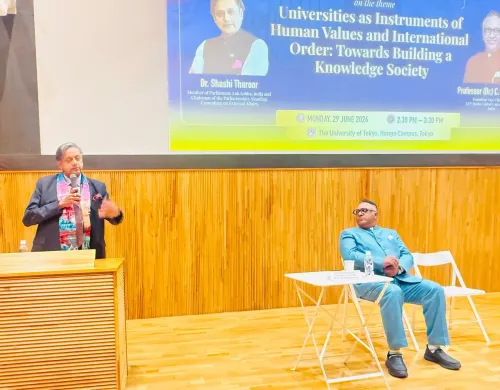
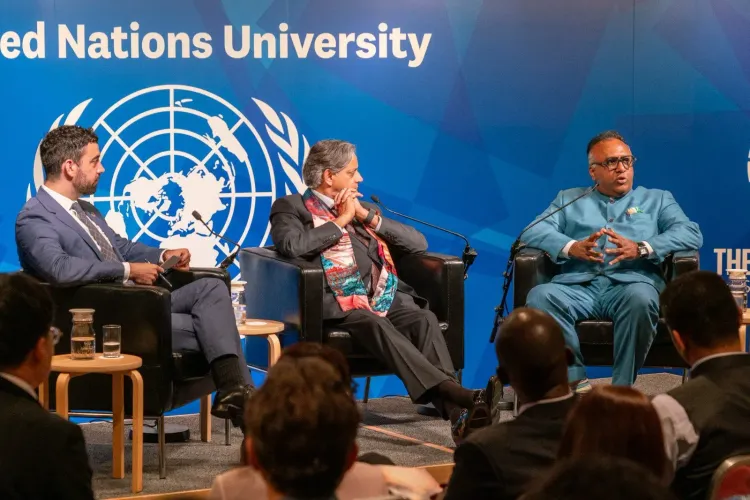
Congress MP Dr. Shashi Tharoor attended a UN University Tokyo panel on 1 July 2026, discussing geopolitics, the end of 'doux commerce', and education's role in the contemporary world, alongside Jindal Global University Vice-Chancellor C. RajKumar and UN moderator Mike Baldock.
Key Takeaways
Shashi Tharoor participated in a panel at the UN University, Tokyo on 1 July 2026 .
The discussion was moderated by Mike Baldock of the United Nations and covered geopolitics, liberal trade theory, and education.
RajKumar , Vice-Chancellor of O.P.
Jindal Global University , co-panelled alongside Tharoor.
The panel addressed the decline of 'doux commerce' — the theory that trade promotes peace — amid rising great-power rivalry.
Tharoor, a 29-year UN veteran , returned to a UN forum in his capacity as a sitting Indian parliamentarian.
Congress MP Dr. Shashi Tharoor participated in a high-level discussion at the United Nations University (UNU) in Tokyo on Wednesday, 1 July 2026, engaging with global scholars on themes ranging from geopolitics to the decline of liberal trade theory and the evolving role of education in the contemporary world.
Context
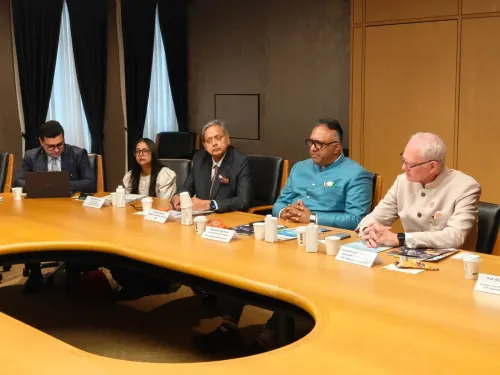
Tharoor, a former UN Under-Secretary-General with decades of multilateral experience, described the event as 'a marvellous discussion' moderated by Mike Baldock of the United Nations. The panel also featured C. RajKumar, Vice-Chancellor of O.P. Jindal Global University, whom Tharoor praised as having 'held forth ably.' The session covered a broad intellectual sweep, from shifting geopolitical alignments to what scholars call the end of 'doux commerce' — the Enlightenment-era idea that trade between nations naturally promotes peace and mutual restraint.
Policy Backdrop
The concept of 'doux commerce', associated with 18th-century philosopher Montesquieu and later elaborated by Adam Smith, has gained renewed scholarly attention as economic nationalism, supply-chain decoupling, and great-power rivalry have strained the post-1990s globalisation consensus. Panels at UN-affiliated institutions increasingly grapple with whether trade interdependence still functions as a brake on conflict, or whether that assumption has been overtaken by strategic competition between major powers. The UN University, headquartered in Tokyo, serves as the academic and research arm of the United Nations system, convening exactly these kinds of cross-disciplinary dialogues on global governance.
O.P. Jindal Global University, a private deemed university based in Sonipat, Haryana, has cultivated a strong international profile under Vice-Chancellor C. RajKumar, with active partnerships across UN agencies and global academic institutions. RajKumar's presence alongside Tharoor at a UN forum underscores the university's positioning at the intersection of Indian higher education and multilateral policy discourse.
Stakeholders and Impact
For India, the optics of a sitting parliamentarian and former senior UN official participating in a Tokyo-based UN academic forum carries diplomatic weight at a moment when New Delhi is deepening its engagement with multilateral institutions and positioning itself as a voice of the Global South. Tharoor's return to a UN platform — he served the organisation for 29 years before entering Indian politics — reinforces his distinct profile as a bridge between domestic legislative work and international intellectual discourse. The discussion's focus on education's role in a fractured geopolitical order is also directly relevant to ongoing debates in India about internationalising its universities under the National Education Policy 2020.
What's Next
Tharoor's post indicates the conversation extended beyond the formal panel, suggesting continued engagement with UNU scholars and UN officials on the sidelines. As geopolitical fault lines deepen globally, forums like this one at the UN University Tokyo are likely to gain prominence as spaces where policymakers, academics, and international civil servants attempt to rebuild shared frameworks for cooperation — and India's participation in those conversations, both through its parliamentarians and its universities, will shape how the country is perceived in multilateral settings in the years ahead.
Point of View
At least in certain quarters, is actively re-entering multilateral intellectual spaces at a time when the rules-based international order is under pressure. The pairing with Jindal Global University's Vice-Chancellor reflects a broader effort by Indian private universities to anchor themselves in UN-linked networks, lending institutional credibility to their global ambitions. The choice of 'doux commerce' as a thematic anchor is pointed: it implicitly frames current great-power economic decoupling as a civilisational regression, a framing that aligns with India's stated preference for dialogue-based multilateralism over bloc politics. For Tharoor personally, the Tokyo visit reinforces a dual identity — Indian legislator and global policy intellectual — that distinguishes him within the Congress party's foreign-policy bench.
NationPress
1 Jul 2026
Frequently Asked Questions
What did Shashi Tharoor do at the UN University in Tokyo?
Shashi Tharoor participated in a panel discussion at the UN University in Tokyo on 1 July 2026, covering topics including geopolitics, the decline of 'doux commerce', and the role of education in the contemporary world.
Who is C. RajKumar and why was he at the UN forum?
C. RajKumar is the Vice-Chancellor of O.P. Jindal Global University in Sonipat, Haryana. He participated in the UN University Tokyo panel alongside Tharoor, reflecting Jindal Global University's active engagement with international academic and UN-affiliated forums.
What does 'doux commerce' mean?
'Doux commerce' is an Enlightenment-era theory, associated with philosophers like Montesquieu, holding that trade between nations naturally fosters peace and mutual restraint. The concept is being re-examined as economic nationalism and geopolitical rivalry have strained globalisation.
What is the UN University in Tokyo?
The United Nations University (UNU), headquartered in Tokyo, is the academic and research arm of the UN system. It convenes scholars, policymakers, and international civil servants to address global governance challenges.
Has Shashi Tharoor worked with the UN before?
Yes. Before entering Indian politics, Tharoor served the United Nations for 29 years, rising to the position of Under-Secretary-General. His return to a UN forum in Tokyo marks a continuation of his engagement with multilateral institutions as a sitting MP.