Tharoor Compares Iran-US Negotiating Styles in New Column
Synopsis
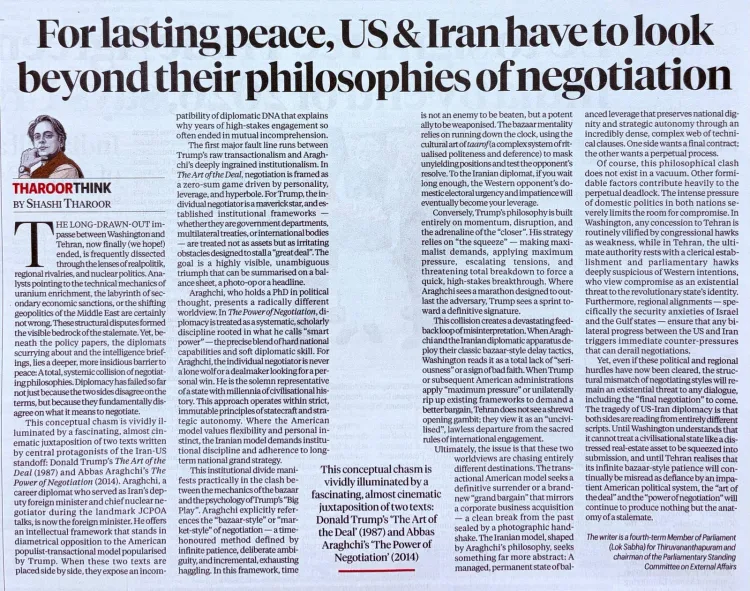
Congress MP Dr. Shashi Tharoor's latest TharoorThink column contrasts the negotiating philosophies of the US and Iran through Trump's 'The Art of the Deal' and Iranian FM Abbas Araghchi's 'The Power of Negotiation', asking whether the two sides can ever truly bridge their conceptual divide.
Key Takeaways
Shashi Tharoor published a new TharoorThink column on June 19, 2026 comparing US and Iranian negotiating doctrines.
The column draws on Donald Trump 's The Art of the Deal ( 2017 ) and Abbas Araghchi 's The Power of Negotiation ( 2014 ).
Tharoor describes the difference as a 'conceptual chasm', questioning whether the two sides can reach a durable agreement.
The JCPOA , signed in 2015 , collapsed after the US withdrew in 2018 and imposed maximum-pressure sanctions on Iran .
The analysis is relevant to India , which has significant energy and trade ties with both Iran and the United States .
Future IAEA Board of Governors meetings and back-channel diplomacy remain the key arenas to watch for any renewed engagement.
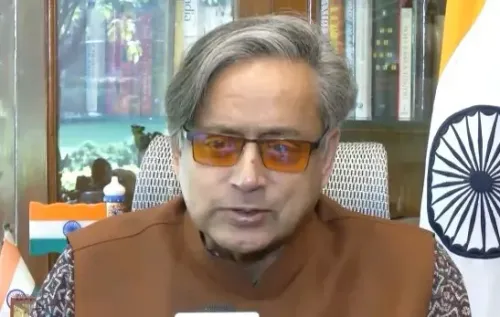
Congress MP Dr. Shashi Tharoor published his latest TharoorThink column on Friday, June 19, 2026, drawing a sharp contrast between the negotiating philosophies of Iran and the United States through the lens of two books — Donald Trump's The Art of the Deal (2017) and Iranian Foreign Minister Abbas Araghchi's The Power of Negotiation (2014).
Context
In his post on X, Dr. Tharoor described the comparison as exploring a 'conceptual chasm' between the two sides' approaches to deal-making, asking pointedly: 'Can the twain truly meet?' The column arrives at a moment when US-Iran nuclear diplomacy remains in a fragile and uncertain phase, with no formal framework currently binding the two sides.
Trump's The Art of the Deal is widely read as a manifesto of transactional, leverage-first negotiation — a style that shaped US foreign policy during his first term and has re-emerged as a defining feature of his current administration's posture. Araghchi's book, written while he was deeply involved in nuclear talks, reflects Iran's own diplomatic doctrine: sovereignty-centred, resistance to coercion, and rooted in a long-term strategic patience.
Policy Backdrop
The conceptual gap Dr. Tharoor identifies has concrete policy consequences. The Joint Comprehensive Plan of Action (JCPOA), signed in 2015 between Iran and the P5+1 powers, represented a multilateral attempt to bridge exactly this divide — placing verifiable limits on Iran's nuclear programme in exchange for phased sanctions relief.
That architecture collapsed when the United States withdrew from the JCPOA in 2018 and imposed a 'maximum-pressure' sanctions regime. Iran responded by progressively rolling back its nuclear commitments, and the gap between the two sides' opening positions has widened considerably since. The fundamental disagreement is not merely tactical: it reflects divergent assumptions about what makes an agreement legitimate and durable.
Stakeholders and Impact
Dr. Tharoor, a former UN Under-Secretary-General with direct experience in multilateral diplomacy, brings an unusual vantage point to this comparison. His TharoorThink column series has consistently engaged with global affairs from an Indian perspective, and this instalment places India — a country with significant trade, energy, and diaspora ties to both Iran and the United States — implicitly in the audience of a negotiation whose outcome matters far beyond the two principals.
The stakes extend to P5+1 partners, regional powers in West Asia, and global energy markets. A breakdown in diplomacy has historically tightened Iranian oil sanctions, affecting Indian refiners who have at times been among Tehran's largest crude customers. Non-proliferation watchdogs and the IAEA Board of Governors also watch each diplomatic signal closely.
What's Next
Any resumption of direct or indirect nuclear talks — whether through back-channel diplomacy or at IAEA Board of Governors meetings — will test whether the philosophical distance Dr. Tharoor maps in his column can be bridged in practice. His framing suggests that without a shared understanding of what a 'deal' means, technical agreements risk remaining structurally unstable.
As US-Iran tensions continue to define the non-proliferation landscape, Dr. Tharoor's literary comparison offers a reminder that negotiating styles are not merely rhetorical — they encode fundamentally different visions of power, sovereignty, and legitimacy that any durable agreement must ultimately reconcile.
Point of View
He surfaces a structural obstacle that outlasts any single administration. For India, which has historically sought strategic autonomy between Washington and Tehran, this framing matters: it suggests that a durable settlement will require both sides to move beyond their foundational assumptions about what constitutes a fair deal. The column fits a broader pattern in Tharoor's commentary — using comparative intellectual analysis to illuminate geopolitical fault lines that conventional policy coverage tends to flatten.
NationPress
18 Sept 2026
Frequently Asked Questions
What is Shashi Tharoor's TharoorThink column about this week?
Dr. Tharoor's latest TharoorThink column, published on June 19, 2026, compares the negotiating philosophies of the United States and Iran, using Donald Trump's 'The Art of the Deal' and Iranian Foreign Minister Abbas Araghchi's 'The Power of Negotiation' as the analytical framework.
Who is Abbas Araghchi and what is his book about?
Abbas Araghchi is Iran's Foreign Minister and a veteran nuclear negotiator who was centrally involved in the JCPOA talks. His 2014 book 'The Power of Negotiation' is understood to reflect Iran's diplomatic doctrine of sovereignty, strategic patience, and resistance to coercion.
What is the JCPOA and why did it collapse?
The Joint Comprehensive Plan of Action (JCPOA) was a 2015 multilateral nuclear agreement between Iran and the P5+1 powers that limited Iran's nuclear programme in exchange for sanctions relief. It collapsed after the United States withdrew in 2018 and reimposed a maximum-pressure sanctions regime.
Why does the US-Iran negotiating style difference matter for India?
India has significant energy and trade ties with both Iran and the United States, and has at times been a major buyer of Iranian crude oil. Any breakdown or breakthrough in US-Iran diplomacy directly affects Indian foreign policy choices and energy security.
What is Trump's 'Art of the Deal' approach to diplomacy?
Trump's 'The Art of the Deal' outlines a transactional, leverage-first negotiating style that prioritises maximum pressure, public posturing, and bilateral deal-making over multilateral frameworks — an approach that shaped US foreign policy during his first term and has re-emerged in his current administration.