Tharoor Decodes UN Chief Race as Grynspan Leads First Poll
Synopsis
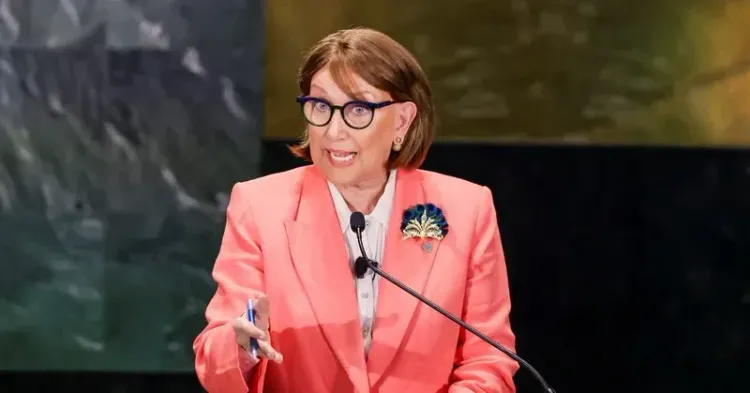
Congress MP Dr. Shashi Tharoor, drawing on his UN experience, has analysed the Security Council's first informal straw poll for the next Secretary-General. UNCTAD chief Rebeca Grynspan leads, but a potential P5 veto and multiple 'discourage' votes across the top three candidates could produce a deadlock and open the door to a compromise nominee.
Key Takeaways
Rebeca Grynspan , UNCTAD Secretary-General from Costa Rica , emerged as the frontrunner in the Security Council's first informal straw poll for the next UN chief.
A single 'discourage' vote in the poll could constitute a P5 veto if cast by a Permanent Member — the critical unknown Tharoor flagged.
Grynspan's alleged 'third worldist' orientation has been cited as a potential source of Western P5 resistance.
Two other leading candidates also received 'discourage' votes, raising the prospect of a multi-candidate stalemate if different P5 members block different names.
A deadlock would force intense back-channel negotiations and could elevate a compromise candidate with less initial momentum.
Current Secretary-General António Guterres ends his second term in December 2026 , making the succession timeline pressing.
The race to lead the United Nations from January 2027 has produced its first concrete signal — and it comes loaded with the kind of P5 veto arithmetic that can unravel a frontrunner overnight. Congress MP Dr. Shashi Tharoor, himself a former UN Under-Secretary-General, broke down the results of the Security Council's first informal straw poll on Friday, July 31, 2026, flagging that the outcome is far less settled than the headline number suggests.
Grynspan's Lead and the Veto Shadow
Rebeca Grynspan, the Costa Rican economist who currently heads UNCTAD (the UN Conference on Trade and Development), emerged from the first ballot as the apparent frontrunner. But Tharoor immediately zeroed in on the detail that matters most: a single 'discourage' vote in the straw poll. 'A lot depends on whether the sole discourage vote was from a Permanent Member,' he wrote, 'in which case it would be a veto.'
The concern is not procedural hair-splitting. In the Security Council's selection mechanism, an 'encourage' or 'discourage' ballot from any of the Permanent Five — the United States, United Kingdom, France, Russia, and China — carries categorically more weight than the same vote from an elected member. One P5 'discourage' is, in effect, a veto signal. Tharoor noted that Grynspan has been labelled by some as a 'third worldist' — shorthand for a development-first orientation that certain Western powers have historically viewed with suspicion.
The Stalemate Scenario
The arithmetic gets more complicated when the other leading candidates are folded in. Tharoor observed that two additional frontrunners also drew 'discourage' votes. If different P5 members are each blocking a different candidate — one power vetoing Grynspan, another blocking a second name, a third blocking the third — the process hits a wall. 'We could have a stalemate,' he wrote, 'requiring intense negotiations and possibly opening the door to a compromise candidate.'
This is not a hypothetical scenario. The Security Council's informal straw-poll mechanism — which has governed Secretary-General selection since the mid-20th century — has produced exactly this kind of gridlock before. Successive rounds of polling are designed to surface and, ideally, wear down opposition. But when P5 members dig in, back-channel diplomacy becomes the only way through, sometimes producing a consensus name that entered the race late or with little initial momentum.
Why Tharoor's Reading Carries Weight
Dr. Tharoor served as UN Under-Secretary-General for Communications and Public Information and ran for the Secretary-General post himself in 2006, making him one of the few Indian voices with firsthand knowledge of how the selection machinery actually works. His analysis is not punditry from the outside — it is an insider's map of a process most observers find opaque.
The current Secretary-General, António Guterres, was first elected in 2016 and re-elected in 2021; his second term concludes in December 2026, making the succession timeline urgent. Developing countries and China rallying behind Grynspan could create significant pressure, but as Tharoor's note makes clear, pressure alone does not dissolve a P5 veto.
The next straw-poll rounds will tell the real story — whether the blocking votes hold, soften, or trigger the kind of quiet corridor deal that has historically defined who ends up with the world's most watched diplomatic job.
Point of View
Which is the question that actually decides the outcome. If a stalemate materialises, it would reinforce the long-running critique that the Secretary-General selection process privileges P5 consensus over global representativeness — a tension that has never been structurally resolved.
NationPress
14 Sept 2026
Frequently Asked Questions
Who is the frontrunner for UN Secretary-General in 2026?
Rebeca Grynspan, the Costa Rican economist and current UNCTAD Secretary-General, emerged as the frontrunner after the Security Council's first informal straw poll in the 2026 selection process.
What is a straw poll in the UN Secretary-General selection?
A straw poll is an informal, non-binding ballot conducted in the Security Council where members vote 'encourage', 'discourage', or 'no opinion' on each candidate. It is used to test viability and surface potential vetoes before a formal recommendation is made to the General Assembly.
Can a P5 country veto the UN Secretary-General?
Yes. A 'discourage' vote from any of the five Permanent Members — the US, UK, France, Russia, or China — effectively signals a veto and can block a candidate from advancing, as the final Security Council recommendation requires P5 consensus.
Why did Shashi Tharoor comment on the UN Secretary-General race?
Dr. Shashi Tharoor is a former UN Under-Secretary-General who ran for the Secretary-General post in 2006, giving him direct insider knowledge of the selection process. He regularly analyses UN affairs as a Congress MP and public intellectual.
When does António Guterres's term as UN Secretary-General end?
António Guterres's second term as UN Secretary-General concludes in December 2026, making the selection of his successor an urgent diplomatic priority for the Security Council in 2026.