Tharoor Pushes Back on Politicisation of Indian Sailors' Deaths

Synopsis
Congress MP Dr. Shashi Tharoor on June 20, 2026, rejected accusations that his remarks on three Indian sailors' deaths were partisan, reaffirming that civilian seafarers must never be military targets and urging political unity on citizen safety.
Key Takeaways
Three Indian civilian sailors lost their lives in an incident that has triggered domestic political debate.
Shashi Tharoor stated his original remarks were about the principle that civilian seafarers must not be targets of military action.
Tharoor described the politicisation of his statement as 'extraordinary' and said critics' conduct 'says more about them than it does about me.' The post was tagged to Indian National Congress , signalling formal party backing for his position.
India's stance on protecting seafarers has precedent in the 2012 Enrica Lexie incident and longstanding international humanitarian law commitments.
Parliamentary questions and MEA briefings on maritime security protocols are expected to follow.
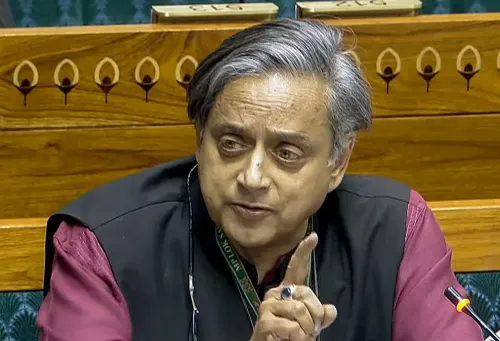
Congress MP Dr. Shashi Tharoor on Saturday, June 20, 2026, sharply rebuked critics who framed his remarks on the deaths of three Indian civilian sailors as a partisan attack, insisting that concern for Indian lives must be a matter of national unity rather than political point-scoring.
Context
In a post on X, Tharoor stated he found it 'extraordinary that a statement about protecting Indian civilian sailors is being twisted into a partisan political controversy.' The Thiruvananthapuram MP clarified that his original remarks were directed at the principle that 'civilian seafarers should never be targets of military action' — not at any political adversary. He added pointedly: 'If some people are more interested in scoring political points than addressing that concern, that says more about them than it does about me.'
The post, tagged to the Indian National Congress official handle, signals that the party is prepared to defend Tharoor's position publicly while framing the issue as one of citizen safety rather than opposition politics.
Policy Backdrop
India has long maintained a firm stance on the protection of its seafarers in international waters, a position reinforced after the 2012 Enrica Lexie incident involving Italian marines and Indian fishermen off the Kerala coast. That episode underscored the vulnerability of civilian maritime workers and India's insistence on jurisdiction and accountability in such cases.
International humanitarian law, to which India is a signatory, prohibits the deliberate targeting of civilians — a principle Tharoor invoked implicitly in his defence. The Ministry of External Affairs and the Indian Navy have historically coordinated responses when Indian nationals are imperilled in conflict-prone sea lanes, from the Gulf of Aden to the Red Sea corridor.
Stakeholders and Impact
Indian merchant mariners number in the hundreds of thousands and are among the country's most significant sources of foreign remittance. Their safety in high-risk maritime zones is a standing concern for families, shipping companies, and the government alike. When fatalities occur, the pressure on New Delhi to respond diplomatically — and to be seen responding — intensifies rapidly.
The exchange also reflects a recurring pattern in Indian politics: casualties involving citizens abroad or at sea quickly become a lens through which the opposition scrutinises government diplomacy, while the ruling establishment emphasises institutional responses. Tharoor's pushback suggests the controversy over his original statement had grown sufficiently heated to warrant a direct, public clarification.
What's Next
Parliamentary questions on maritime security protocols and the specific circumstances surrounding the three sailors' deaths are likely to follow, particularly if the matter is raised during the next session. MEA briefings on any diplomatic engagement with parties involved in the incident will be closely watched by opposition benches and maritime industry stakeholders alike. How the ruling side responds to Tharoor's rebuttal will indicate whether this episode escalates into a sustained parliamentary confrontation or subsides once official channels provide clarity on the sailors' fate and the government's response.
Point of View
Not merely a personal defence, raising the political stakes for both sides. The episode fits a well-worn pattern in Indian politics where citizen casualties abroad become proxy battles over diplomatic credibility, with the opposition demanding accountability and the government pointing to institutional action. How the ruling establishment responds will determine whether this becomes a sustained foreign-policy flashpoint or a short-lived social-media skirmish.
NationPress
20 Jun 2026
Frequently Asked Questions
What did Shashi Tharoor say about Indian sailors?
Tharoor stated that three Indians lost their lives and that his remarks were about protecting civilian seafarers from military targeting, not about partisan politics.
Why is Tharoor's statement on Indian sailors controversial?
Critics accused him of using the deaths of three Indian sailors to make a political attack; Tharoor rejected this, saying concern for Indian lives should unite the country.
What is India's policy on protecting Indian seafarers abroad?
India has a long-standing policy of safeguarding its maritime workers in international waters, reinforced by incidents like the 2012 Enrica Lexie case and guided by international humanitarian law.
What action is expected from the Indian government on the sailors' deaths?
MEA briefings and parliamentary questions on maritime security protocols and diplomatic engagement with involved parties are anticipated in the coming days.
Who is Shashi Tharoor?
Dr. Shashi Tharoor is the Congress MP from Thiruvananthapuram, a former Union Minister, and a former UN Under-Secretary-General who frequently speaks on India's foreign policy and citizen welfare.