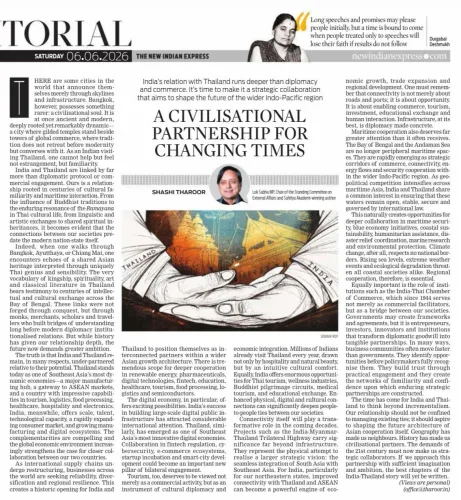
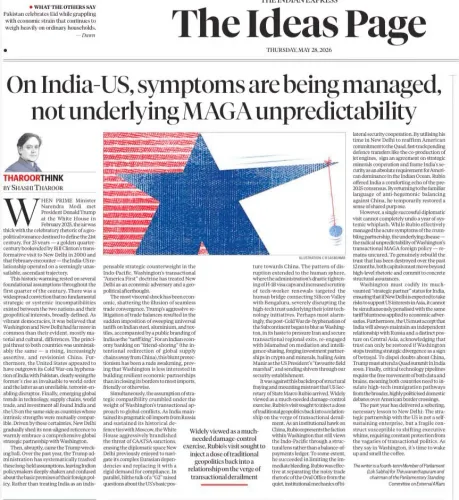
Tharoor writes on India-US ties after US midterms
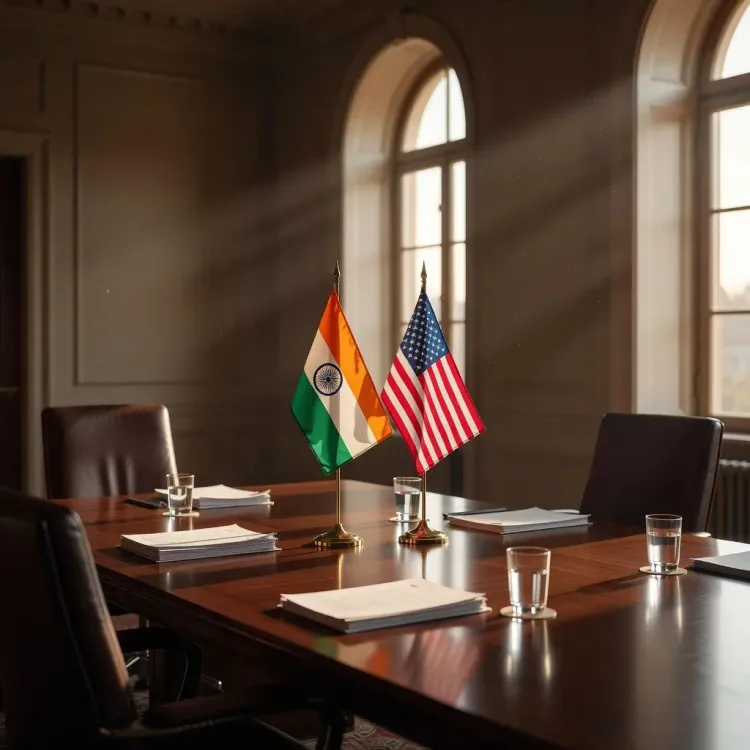
Synopsis
Congress MP Dr. Shashi Tharoor published an opinion piece in Kerala daily Mathrubhumi on 9 November 2026, offering his analysis of India-US bilateral relations in the aftermath of the US midterm congressional elections, flagging how the new Capitol Hill balance of power could shape defence, trade, and technology cooperation.
Key Takeaways
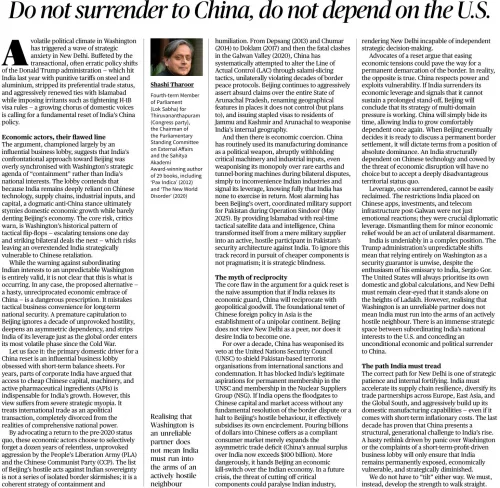
Shashi Tharoor published a foreign-policy opinion piece in Mathrubhumi on 9 November 2026 .
The article analyses India-US relations in light of the latest US midterm congressional elections .
Midterm results affect committee leadership in the House and Senate , directly influencing legislative support for India-US defence, trade, and technology frameworks.
The 2008 India-US Civil Nuclear Agreement and the Quadrilateral Security Dialogue (revived 2017 ) form the structural backbone of the bilateral relationship.
Tharoor, MP from Thiruvananthapuram and former UN Under-Secretary-General , is one of India's most prominent parliamentary voices on international affairs.
Parliamentary foreign-policy debates and upcoming India-US bilateral meetings will be key indicators of how the new congressional arithmetic reshapes cooperation.
When a former UN Under-Secretary-General and sitting Congress MP puts pen to paper on India-America relations the morning after a consequential US midterm cycle, it is worth pausing to understand why the timing matters. Congress MP Dr. Shashi Tharoor published an opinion piece in Mathrubhumi on Monday, 9 November 2026, laying out his assessment of where the India-United States relationship stands in the wake of the latest midterm congressional elections.
Why midterms ripple into New Delhi's calculations
US midterm elections are not merely a domestic American affair — they reshuffle committee chairmanships, alter legislative calendars, and can stall or accelerate everything from defence procurement approvals to trade frameworks that touch Indian industry. The balance of power in the House and Senate directly shapes how much legislative bandwidth exists for the kind of bipartisan India-friendly legislation that has underpinned the relationship's steady growth across successive administrations.
That growth has deep structural roots. The landmark 2008 India-US Civil Nuclear Agreement opened a new chapter in strategic trust, and the revival of the Quadrilateral Security Dialogue in 2017 — bringing together India, the United States, Japan, and Australia — embedded New Delhi more firmly in the Indo-Pacific security architecture. Each of those milestones required sustained political will on both sides of the Pacific, and both are sensitive to shifts in Washington's internal power dynamics.
Tharoor's platform and why the Kerala readership matters
Mathrubhumi, the Kerala-based Malayalam-language daily where the piece appeared, commands a large and politically engaged readership in a state that sends significant numbers of its citizens to work in the United States and the Gulf. When an MP with Tharoor's biography — Thiruvananthapuram constituency, two terms as a Union Minister, decades at the United Nations — writes for that audience on the state of India-America ties, it functions simultaneously as analysis, constituency communication, and a signal to Delhi's diplomatic community about how the opposition reads the moment.
Tharoor has long been one of the most visible Indian parliamentarians on foreign-policy commentary, frequently bridging academic rigour and political accessibility in his public writing. His choice to frame the piece around the midterm results underscores a broader point that Indian policymakers across party lines have absorbed: the India-US partnership is now robust enough to survive administration changes, but granular congressional support still determines how fast and how deep cooperation can go on any given issue.
What New Delhi will be watching next
Parliamentary debates on foreign policy and any forthcoming India-US bilateral meetings or trade negotiation sessions will now carry extra significance as the new congressional arithmetic settles. Diplomats, the defence industry, and technology-sector stakeholders on both sides will be reading the committee rosters carefully. Tharoor's public take, arriving the same morning the dust settles on the midterm results, ensures the conversation has already started in Kerala's living rooms — and, by extension, in the broader Indian public square.
India-US relations have proven durable across political cycles on both sides; the real question after every midterm is not whether the partnership endures, but which specific files move fastest in the session ahead.
Point of View
Shared increasingly across Indian party lines, that Washington's internal power shifts carry real downstream consequences for New Delhi's strategic agenda. At a moment when the Quad architecture and defence procurement pipelines demand sustained bipartisan American support, an opposition MP's public audit of where things stand serves as both political accountability and genuine public education. It also underscores how foreign policy, once the near-exclusive province of the executive, has become a live arena for parliamentary voices in India's evolving democratic discourse.
NationPress
9 Nov 2026
Frequently Asked Questions
What did Shashi Tharoor write about India-US relations?
Dr. Shashi Tharoor wrote an opinion piece in Mathrubhumi on 9 November 2026 analysing the state of India-America bilateral relations following the US midterm congressional elections. The article examines how the new balance of power in the House and Senate could affect defence, trade, and technology cooperation between the two countries.
How do US midterm elections affect India?
US midterm elections reshape congressional committee leadership and legislative priorities, which can accelerate or slow down India-friendly legislation on defence procurement, trade frameworks, and technology partnerships. India-US cooperation milestones such as the Civil Nuclear Agreement and the Quad revival required sustained bipartisan support in Washington.
What is Mathrubhumi and why did Tharoor write for it?
Mathrubhumi is a major Kerala-based Malayalam-language daily newspaper with a large and politically engaged readership. As MP from Thiruvananthapuram in Kerala, Tharoor regularly contributes to regional media to communicate policy positions to his constituency, many of whom have direct ties to the United States.
What is Shashi Tharoor's background in foreign affairs?
Dr. Shashi Tharoor is a Congress MP from Thiruvananthapuram, a former Union Minister of State for External Affairs, and a former UN Under-Secretary-General. His decades of experience at the United Nations make him one of India's most credentialled parliamentary voices on international relations.
What is the Quadrilateral Security Dialogue that shapes India-US ties?
The Quadrilateral Security Dialogue, commonly known as the Quad, is a strategic grouping of India, the United States, Japan, and Australia focused on Indo-Pacific security. It was revived in 2017 and has since become a central pillar of India's engagement with Washington across defence, technology, and maritime cooperation.