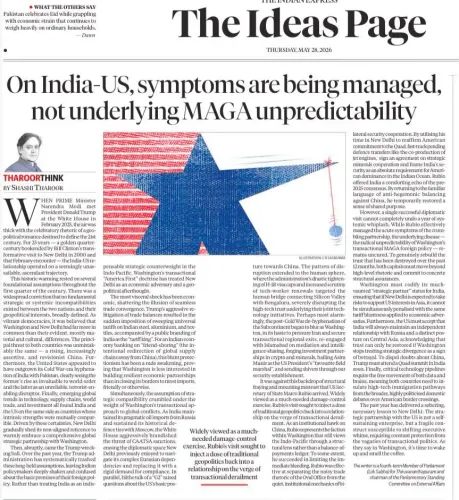
Tharoor Analyses Four State Election Results in Global Column

Synopsis
Congress MP Dr. Shashi Tharoor has written a column for Project Syndicate analysing election results in four principal Indian states, bringing Indian electoral dynamics to a global readership on June 1, 2026.
Key Takeaways
Shashi Tharoor published a new column for Project Syndicate on June 1, 2026 .
The column analyses recent election results in four principal Indian states .
Project Syndicate is an international non-profit platform with a global expert-opinion readership.
Tharoor is a former UN Under-Secretary-General and Union Minister representing Thiruvananthapuram .
State elections in India function as mid-term tests of national parties between Lok Sabha elections.
Further state assembly elections are expected through 2026-2027 , sustaining the electoral cycle.
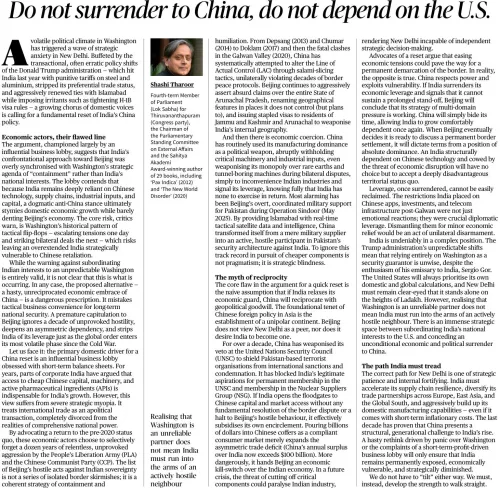
Congress MP Dr. Shashi Tharoor has published a new column for Project Syndicate, the international non-profit media platform, analysing the recent election results in four principal Indian states, he announced on Monday, June 1, 2026. The piece is addressed to Project Syndicate's global readership, extending Indian electoral analysis to an international audience.
Context
In his post, Tharoor described the column as analysing 'the recent election results in the four principal states,' without naming the states in the post itself. Project Syndicate is a widely read platform that publishes expert commentary on politics, economics, and global affairs, giving Tharoor's analysis reach well beyond India's domestic news cycle.
Tharoor, who represents Thiruvananthapuram in the Lok Sabha and previously served as a UN Under-Secretary-General and Union Minister, is among the Indian opposition's most prominent voices on global platforms. His columns regularly situate Indian political developments within a broader democratic and comparative framework.
Policy Backdrop
Under India's Constitution, state legislative assemblies must face elections every five years, producing a near-continuous cycle of state-level verdicts that serve as barometers of national party strength. These elections are widely read as mid-term tests of the ruling and opposition parties' organisational reach and policy appeal between general elections.
State assembly results have historically influenced the national political narrative, shaping coalition dynamics, party leadership decisions, and policy priorities ahead of the next Lok Sabha election. International commentary on these results, such as Tharoor's Project Syndicate piece, helps frame India's federal democratic complexity for foreign policymakers, investors, and academics.
Stakeholders and Impact
The primary stakeholders in any multi-state electoral cycle are the state electorates themselves, whose verdicts reflect regional variations in voter priorities — from governance and welfare delivery to identity and economic concerns. National parties, including the Indian National Congress and its rivals, scrutinise these outcomes to recalibrate strategy.
For international audiences, columns by senior opposition figures such as Tharoor offer an interpretive lens on India's diverse political landscape that official government communications rarely provide. Such analyses can influence foreign perceptions of India's democratic health and the competitive balance between its major parties.
What's Next
Several state assembly elections are scheduled through 2026 and 2027, which will continue to test party machinery across India's regions. Discussions around electoral reforms and delimitation of constituencies remain live issues in parliamentary circles, and international commentary of this kind may feed into those broader conversations.
Tharoor's continued engagement with global platforms signals that the Congress party's interpretive narrative on Indian elections will be actively projected abroad as the country moves through its next political cycle.
Point of View
Positioning the Congress party's reading of state verdicts for foreign policymakers, academics, and investors. It reflects a broader pattern among senior opposition figures of contesting the government's narrative on India's democratic trajectory in global arenas. The column also underscores how state elections, often treated as local events, carry weight in shaping international perceptions of India's political stability and federal vitality. As the 2026-2027 election calendar fills up, such interventions are likely to become more frequent and more pointed.
NationPress
15 Oct 2026
Frequently Asked Questions
What did Shashi Tharoor write about in his latest column?
Tharoor's latest column for Project Syndicate analyses the recent election results in four principal Indian states, offering his interpretation for a global readership.
What is Project Syndicate?
Project Syndicate is an international non-profit media organisation that publishes expert opinion columns on economics, politics, and global affairs, read by audiences worldwide.
Why does Shashi Tharoor write for international platforms?
As a former UN Under-Secretary-General and Congress MP, Tharoor regularly contributes to global platforms to bring Indian political and policy perspectives to international audiences.
How do Indian state elections relate to national politics?
State assembly elections are held every five years under India's Constitution and are widely regarded as mid-term tests of national parties' strength and policy appeal ahead of Lok Sabha elections.
Which states did Tharoor's column cover?
Tharoor's post referred to 'four principal states' but did not name them; the specific states are detailed in the full column published on Project Syndicate.