Tamil Nadu delimitation row: BJP says DMK, TVK on same side after CM Vijay's resolution
Synopsis
Tamil Nadu's Assembly has passed a resolution demanding the Lok Sabha seat count stay frozen at 543 — and the political fallout is immediate. BJP accuses DMK and CM Vijay's TVK of an opportunistic alliance, DMK warns southern states could be left with just 170 MPs against the north's 680, and PMK says the Centre's parliamentary assurance is enough. The delimitation battle is no longer just a policy debate — it is becoming a full-scale regional fault line.
Key Takeaways
The Tamil Nadu Legislative Assembly passed a special resolution on 12 August urging the Centre to freeze Lok Sabha seats at 543 .
The resolution was moved by Chief Minister C.
Joseph Vijay of the TVK ; the DMK supported it while the BJP and PMK opposed it.
BJP spokesperson Narayanan Thirupathy said DMK and TVK are 'sailing in the same boat' on delimitation.
Elangovan warned that delimitation could leave all four southern states with only 170 MPs against the north's 680 MPs .
PMK MLA Sowmiya Anbumani cited Home Minister Amit Shah 's parliamentary assurance that every state's seat count would rise by around 50 per cent while protecting southern states' proportional share.
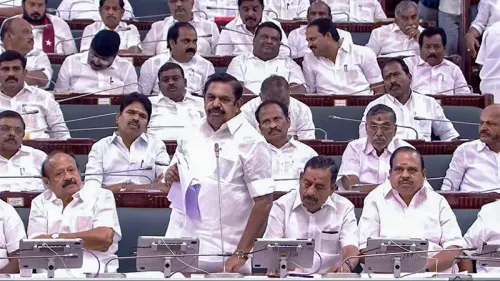
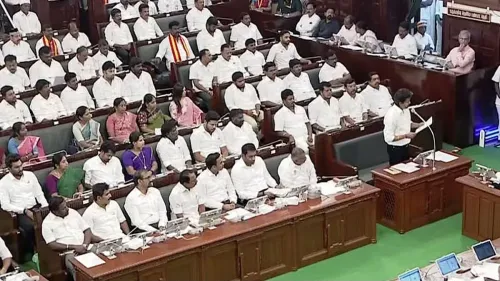
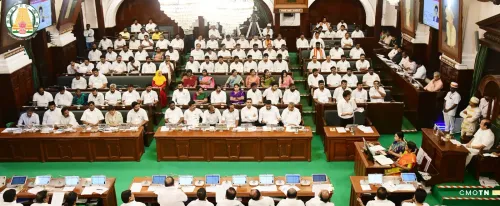
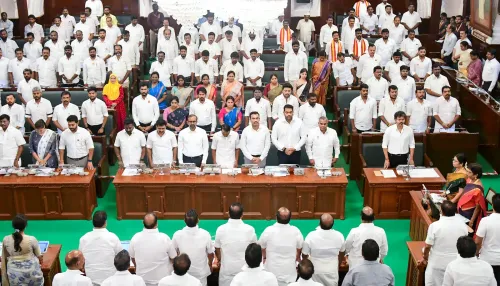
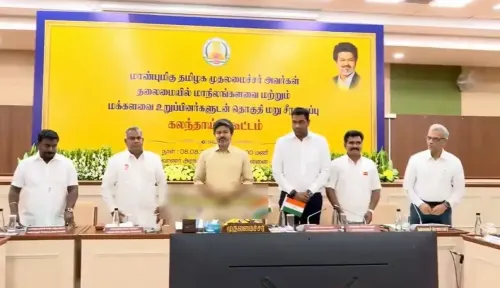
The Tamil Nadu Legislative Assembly on Wednesday, 12 August passed a special resolution moved by Chief Minister C. Joseph Vijay urging the Centre to permanently freeze the strength of the Lok Sabha at 543 seats and protect the existing distribution of Parliamentary seats among states, amid mounting concerns over a future delimitation exercise. The move drew sharp reactions from across the political spectrum, with the Bharatiya Janata Party (BJP) and the Pattali Makkal Katchi (PMK) opposing the resolution while the Dravida Munnetra Kazhagam (DMK) extended its support.
BJP's Reaction: DMK and TVK in the Same Corner
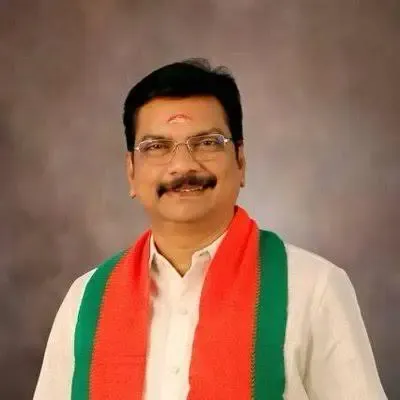
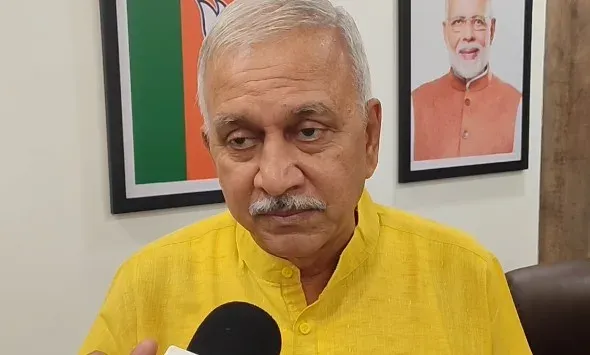
Tamil Nadu BJP spokesperson Narayanan Thirupathy said the DMK and the Tamilaga Vettri Kazhagam (TVK) — the party led by Chief Minister Vijay — are 'sailing in the same boat' on the delimitation question. He argued that the DMK's position has been contradictory, noting that the party first insisted not a single seat should be lost, and is now reportedly assured that Tamil Nadu will retain more than 20 seats.
Thirupathy also pushed back against the framing of delimitation as a north-south conflict, pointing out that key constitutional posts are currently held by leaders from different regions. 'The President of India (Droupadi Murmu) is from Odisha, the eastern part of the country. The Vice-President (C.P. Radhakrishnan) is from the southern part, particularly from Tamil Nadu, and the Prime Minister (Narendra Modi) is from the western part, that is Gujarat. So, no North Indian is occupying the highest post in the country,' he said.
BJP MLA Bhojarajan added that delimitation is necessary to increase the number of public representatives so they can serve citizens more effectively, and cautioned against casting the issue as a regional divide. 'We are one nation despite having different cultures and languages, and we should not make excuses and allegations that the Central government will create divisions between North and South India,' he said.
DMK Defends Its Stand
DMK spokesperson T.K.S. Elangovan maintained that delimitation 'isn't necessary' and defended the party's decision to back the resolution. He argued that if the delimitation exercise proceeds with an expansion to 850 seats — as reportedly proposed — all four southern states combined would get around 170 MPs, while the remaining northern states would command 680 MPs. 'The southern states will be ignored by the government, whoever comes into power,' Elangovan alleged.
He clarified that the DMK's core demand has been for existing constituencies to continue without alteration, and that the party's support for the resolution stems from protecting the proportional representation of Tamil Nadu and other southern states.
PMK Cites Amit Shah's Parliamentary Assurance
PMK MLA Sowmiya Anbumani, whose party opposed the anti-delimitation resolution, invoked Union Home Minister Amit Shah's statement in Parliament, in which Shah had reportedly assured that a fresh delimitation exercise would increase the absolute number of Lok Sabha seats for every state by around 50 per cent while protecting the proportional share of southern states. 'When a minister makes an announcement in Parliament, it is an assurance to citizens. So, we have to take it that way,' Anbumani told reporters.
What's at Stake
The delimitation debate has become one of the most politically charged issues in southern India, with critics arguing that states which performed better on population control — including Tamil Nadu, Kerala, Karnataka, Andhra Pradesh, and Telangana — stand to lose parliamentary representation relative to more populous northern states. The current freeze on seat allocation has been in place since the 1971 Census, and any revision tied to the upcoming Census could redraw the political map significantly. How the Centre responds to the Tamil Nadu Assembly's resolution, and whether other southern state legislatures follow suit, will shape the next phase of this debate.
Point of View
And that the delimitation question can mobilise cross-party consensus in ways few other issues can. The BJP's 'same boat' taunt is tactically clever but strategically thin: the real question is whether the Centre will engage with the proportional representation arithmetic that the DMK has laid out, or dismiss it as regionalism. Home Minister Shah's 50-per-cent-increase assurance, cited by PMK, has not been backed by a formal legislative commitment, which leaves it open to interpretation. If the Centre does not respond with specificity, more southern assemblies are likely to follow Tamil Nadu's lead — and the delimitation debate will harden into a north-south narrative that no party in power can afford ahead of a general election.
NationPress
27 Sept 2026
Frequently Asked Questions
What did the Tamil Nadu Assembly resolve on delimitation?
The Tamil Nadu Legislative Assembly passed a special resolution on 12 August urging the Centre to permanently freeze the Lok Sabha's strength at 543 seats and protect the existing distribution of Parliamentary seats among states. The resolution was moved by Chief Minister C. Joseph Vijay.
Why does the DMK oppose delimitation?
The DMK argues that a fresh delimitation exercise would disadvantage southern states that achieved better population control. DMK spokesperson T.K.S. Elangovan warned that all four southern states could end up with only around 170 MPs against approximately 680 MPs for northern states, effectively reducing their political voice at the Centre.
What is the BJP's position on the Tamil Nadu resolution?
The BJP opposed the resolution. Spokesperson Narayanan Thirupathy accused the DMK and CM Vijay's TVK of political opportunism, while BJP MLA Bhojarajan argued that delimitation is necessary to increase the number of public representatives and should not be framed as a north-south conflict.
What did Home Minister Amit Shah say about delimitation?
According to PMK MLA Sowmiya Anbumani, Union Home Minister Amit Shah had stated in Parliament that a fresh delimitation exercise would increase the absolute number of Lok Sabha seats for every state by around 50 per cent while protecting the proportional share of southern states. PMK cited this as sufficient assurance and opposed the resolution.
Why does delimitation matter more for southern states?
Southern states like Tamil Nadu, Kerala, Karnataka, Andhra Pradesh, and Telangana have historically recorded lower population growth rates. Under a delimitation exercise linked to recent Census data, states with higher populations — predominantly in the north — would gain more seats, potentially diluting the parliamentary weight of southern states that controlled their demographics.