Tamil Nadu MPs demand LS stay at 543, oppose fresh delimitation
Synopsis
Nineteen MPs gathered in Chennai on 8 August and spoke in one voice: no fresh delimitation, and the Lok Sabha must stay at 543 seats. But the DMK and AIADMK — Tamil Nadu's two biggest parties — stayed away, exposing the limits of Chief Minister Vijay's attempt to build a unified state front on an issue that could reshape India's political map.
Key Takeaways
19 MPs from Tamil Nadu met at Kalaivanar Arangam, Chennai on 8 August , convened by Chief Minister C.
MPs unanimously demanded the Lok Sabha remain at 543 constituencies and that any fresh delimitation exercise be abandoned.
The core concern: population-based redistribution would penalise southern states like Tamil Nadu that successfully controlled population growth.
Congress MP Manickam Tagore alleged the delimitation push was a political strategy by the BJP and RSS .
DMK and AIADMK boycotted the consultation, highlighting divisions over Chief Minister Vijay's initiative.
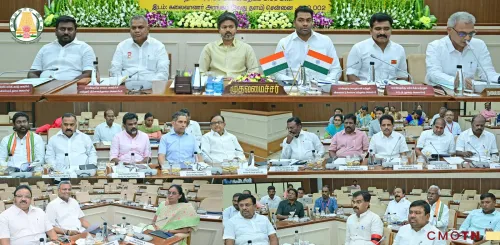
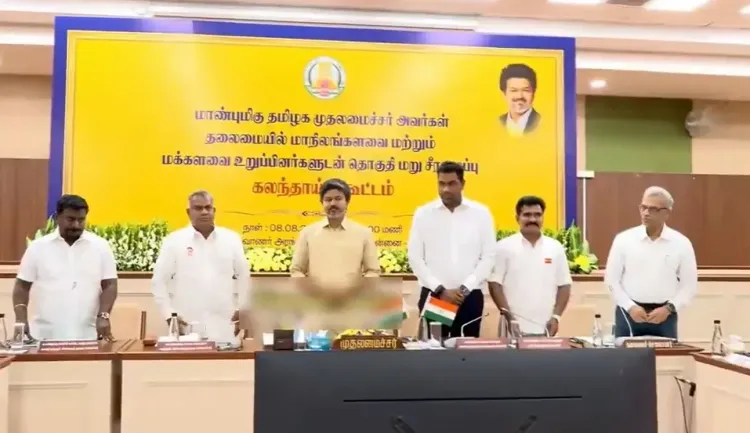
Members of Parliament from Tamil Nadu on 8 August unanimously called for scrapping any fresh delimitation exercise, warning that a population-based redistribution of Lok Sabha seats could severely erode the parliamentary representation of Tamil Nadu and other southern states that have successfully controlled population growth. The consultation, convened by Tamil Nadu Chief Minister C. Joseph Vijay, brought together 19 MPs from across party lines at Kalaivanar Arangam in Chepauk, Chennai.
What the MPs Decided
The participating MPs were unanimous in their demand: the total strength of the Lok Sabha must remain unchanged at 543 constituencies, and no fresh delimitation should be undertaken. Thol Thirumavalavan, leader of the Viduthalai Chiruthaigal Katchi (VCK), conveyed the consensus after the nearly two-hour meeting. He said, 'Delimitation should be abandoned. The number of constituencies should continue at the present level of 543. All the MPs who participated in the meeting insisted on this in one voice.'
Why Southern States Fear Delimitation
At the heart of the opposition is a structural concern: states such as Tamil Nadu that diligently implemented national population-control policies over several decades could end up losing seats to states with higher population growth rates if delimitation is carried out on a population basis. The MPs argued this would effectively penalise states for complying with national policy — a position that has broad resonance across southern India. This comes amid speculation that the Union government could move towards redrawing parliamentary constituency boundaries, though no formal announcement has been made.
Political Allegations and Congress Warning
Congress MP Manickam Tagore went further, alleging that the proposed delimitation exercise was part of a political strategy by the Bharatiya Janata Party (BJP) and the Rashtriya Swayamsevak Sangh (RSS). He warned that Tamil Nadu could face a significant reduction in its national representation and called on the state to mount strong resistance to any such move. Congress MP Sudha was absent from the meeting, as she was attending a party event in Karnataka.
DMK and AIADMK Boycott Clouds the Initiative
Notably, two of Tamil Nadu's most powerful parties — the ruling Dravida Munnetra Kazhagam (DMK) and the principal opposition All India Anna Dravida Munnetra Kazhagam (AIADMK) — boycotted the consultation entirely. Their absence exposed political fault lines around Chief Minister Vijay's initiative, even as the underlying concern about delimitation's impact on the state commands near-universal agreement across Tamil Nadu's political spectrum. The 19 MPs who did attend represented the Indian National Congress (Congress), VCK, Left parties, Indian Union Muslim League (IUML), and Marumalarchi Dravida Munnetra Kazhagam (MDMK).
What Happens Next
Chief Minister Vijay convened the meeting with the stated aim of forging a unified Tamil Nadu position on an issue with long-term consequences for the state's political weight in Parliament. Whether the DMK and AIADMK can be brought into a broader coalition on this issue remains to be seen. With the delimitation debate likely to intensify nationally, the pressure on all Tamil Nadu parties to present a common front will only grow.
Point of View
But no political unity on who should lead the resistance. The DMK and AIADMK's boycott is not simply a snub to Chief Minister Vijay — it signals a deeper contest over ownership of the anti-delimitation narrative ahead of what could be a defining national debate. The real risk for southern states is that fragmented opposition hands the Centre room to manoeuvre. A population-based redraw would be the most consequential structural shift in Indian parliamentary democracy since the 1971 freeze — and the states most affected are walking into it divided.
NationPress
23 Sept 2026
Frequently Asked Questions
What is the delimitation controversy involving Tamil Nadu?
Delimitation refers to the redrawing of parliamentary constituency boundaries, potentially based on updated population data. Tamil Nadu and other southern states fear that a population-based redistribution of Lok Sabha seats would reduce their representation because they have lower population growth rates than several northern states, effectively penalising them for implementing population-control policies.
Why did MPs demand the Lok Sabha remain at 543 seats?
The MPs argued that increasing the total number of seats or redistributing existing ones on population lines would disproportionately benefit high-population states at the expense of southern states like Tamil Nadu. Keeping the Lok Sabha at 543 seats with the current distribution would prevent any erosion of Tamil Nadu's parliamentary weight.
Who attended the delimitation consultation in Chennai?
Nineteen MPs from the Congress, VCK, Left parties, IUML, and MDMK attended the nearly two-hour meeting at Kalaivanar Arangam in Chepauk on 8 August. The DMK and AIADMK boycotted the consultation.
Why did the DMK and AIADMK boycott the meeting?
Neither party gave a detailed public explanation, but their absence highlighted political divisions over Chief Minister C. Joseph Vijay's initiative to lead the anti-delimitation effort in Tamil Nadu. Both parties broadly share the concern about delimitation's impact but chose not to participate in this particular forum.
What has the Union government said about delimitation?
As of the date of the consultation, no formal announcement of a fresh delimitation exercise had been made by the Union government. The meeting was called amid speculation that such a move could be forthcoming, and the Centre has not publicly confirmed or denied its intentions.