TN CM Vijay writes to PM Modi on Mekedatu dam, Cauvery water
Synopsis
Tamil Nadu Chief Minister Joseph Vijay has written to Prime Minister Narendra Modi opposing a Union officials' site visit to the proposed Mekedatu dam location, demanding no legal or administrative clearance be granted without consent from downstream states, and urging guaranteed Cauvery water flows for Tamil Nadu.
Key Takeaways
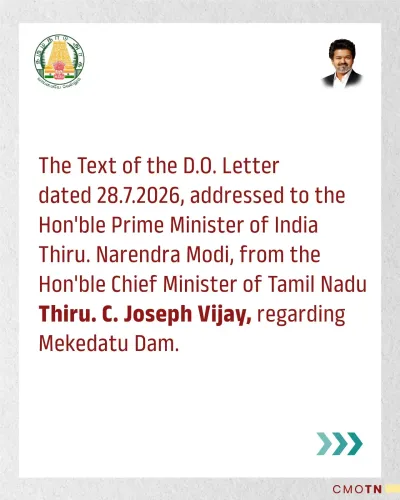
CM Joseph Vijay wrote to PM Narendra Modi on 7 November 2026 on the Cauvery water and Mekedatu dam issue.
The letter calls the site visit by Union government officials to the Mekedatu dam location 'inappropriate' and a threat to Tamil Nadu farmers' livelihoods.
The CM demanded no legal or administrative clearance for Mekedatu without the explicit approval of downstream states.
The Mekedatu project has been opposed by Tamil Nadu since it was announced by Karnataka around 2017 .
The Cauvery Water Disputes Tribunal (1991) and a Supreme Court order (2018) govern water allocations between the two states.
The Cauvery Water Management Authority's next steps and any PMO response will determine the project's immediate trajectory.
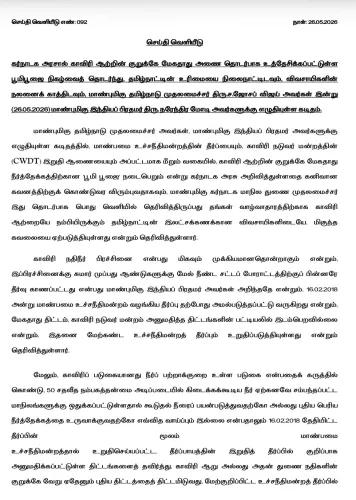
A letter from Tamil Nadu Chief Minister Joseph Vijay has landed on the desk of Prime Minister Narendra Modi, pressing the Centre on two urgent fronts: securing uninterrupted Cauvery water flows for Tamil Nadu and pushing back hard against a site visit by Union government officials to the proposed Mekedatu dam location in Karnataka. The Chief Minister's Office of Tamil Nadu announced the letter on 7 November 2026, making the state's position unmistakably clear.
What the CM's letter demands from PM Modi
The letter carries three distinct demands. First, the Chief Minister urged the Prime Minister to ensure Tamil Nadu continues to receive its rightful share of Cauvery water. Second, he called the site visit by Union government officials to the proposed Mekedatu dam location 'inappropriate' — framing it as an act that threatens the livelihoods of Tamil Nadu's farming communities. Third, and most pointedly, he demanded that no legal or administrative clearance be granted for the Mekedatu project without the explicit consent of downstream states.
The Tamil original states the CM's view that the site visit by central officials was 'சரியல்ல' — meaning 'not right' or 'improper' — a direct rebuke of the Union's perceived tilt toward Karnataka's position.
Decades of dispute behind one proposed dam
The Mekedatu project — a proposed balancing reservoir on the Cauvery river near the Karnataka-Tamil Nadu border — has been a flashpoint since Karnataka announced it around 2017. Tamil Nadu has consistently argued that any storage structure upstream would choke flows to its delta farmers, who depend on the river for paddy and other crops across the Cauvery basin.
The legal architecture governing this river is already dense. The Cauvery Water Disputes Tribunal issued its final award in 1991; the Supreme Court revised allocations in 2018, giving Tamil Nadu a defined share. A Cauvery Water Management Authority was subsequently constituted to enforce those flows. Tamil Nadu's argument is straightforward: any new infrastructure that could alter those flows must require downstream consent — and the Centre must not quietly facilitate Karnataka's ambitions through site visits or technical approvals.
Why the site visit triggered alarm in Chennai
Interstate river disputes in India routinely see upper riparian states move faster on infrastructure while lower riparian states scramble to block clearances. A site visit by Union government officials to the Mekedatu location — even if framed as routine — signals to Tamil Nadu that the project is advancing through administrative channels. Chennai's calculation is that once technical surveys and site assessments are complete, environmental and project clearances become harder to stop.
Tamil Nadu farmers in the Cauvery delta, already vulnerable to erratic monsoon patterns and upstream storage, see Mekedatu as an existential threat. The CM's letter is as much a political signal to that constituency as it is a formal communication to New Delhi.
The Centre's response will define what comes next
The immediate watch is whether the Prime Minister's Office or the Union Jal Shakti Ministry issues any formal response — and whether the Cauvery Water Management Authority is directed to weigh in on the legality of proceeding without downstream consent. Tamil Nadu has deployed this letter-writing strategy before; what makes this iteration consequential is the explicit objection to a Union official's physical presence at the site, raising the diplomatic temperature between the state and the Centre.
For Tamil Nadu's farmers, the Cauvery is not a policy file. It is a lifeline — and their Chief Minister has just served notice that he intends to fight for every drop.
Point of View
And places the Centre in an awkward position between two states it cannot afford to alienate. For a CM who is relatively new to office, staking out a firm position on Cauvery water is also smart domestic politics in a state where the river carries enormous emotional and agricultural weight. The real test will be whether this letter produces a formal freeze on site assessments or disappears into bureaucratic silence.
NationPress
7 Nov 2026
Frequently Asked Questions
What is the Mekedatu dam project and why does Tamil Nadu oppose it?
The Mekedatu project is a proposed balancing reservoir on the Cauvery river in Karnataka. Tamil Nadu opposes it because, as a downstream state, it fears the dam will reduce water flows to its farmers and violate the water-sharing allocations set by the Cauvery Water Disputes Tribunal and the Supreme Court.
What did Tamil Nadu CM Joseph Vijay write to PM Modi about?
CM Vijay wrote to PM Modi urging him to ensure Tamil Nadu receives its Cauvery water share, objecting to Union government officials visiting the Mekedatu site, and demanding that no legal or administrative clearance be granted for the project without downstream state consent.
What is the Cauvery water-sharing arrangement between Tamil Nadu and Karnataka?
The Cauvery Water Disputes Tribunal issued its final award in 1991, and the Supreme Court revised the allocations in 2018, specifying each state's share. A Cauvery Water Management Authority was set up to oversee compliance with these orders.
Why is the Union officials' site visit to Mekedatu significant?
A site visit by central government officials is seen by Tamil Nadu as a signal that the Mekedatu project is advancing through administrative and technical channels, which could make it harder to block future environmental or project clearances.
What happens next in the Mekedatu dam dispute?
The key developments to watch are any formal response from the Prime Minister's Office or the Union Jal Shakti Ministry, and whether the Cauvery Water Management Authority is asked to rule on the legality of proceeding without downstream state approval.