CM Vijay writes to PM Modi over Karnataka's Mekedatu dam plan
Synopsis
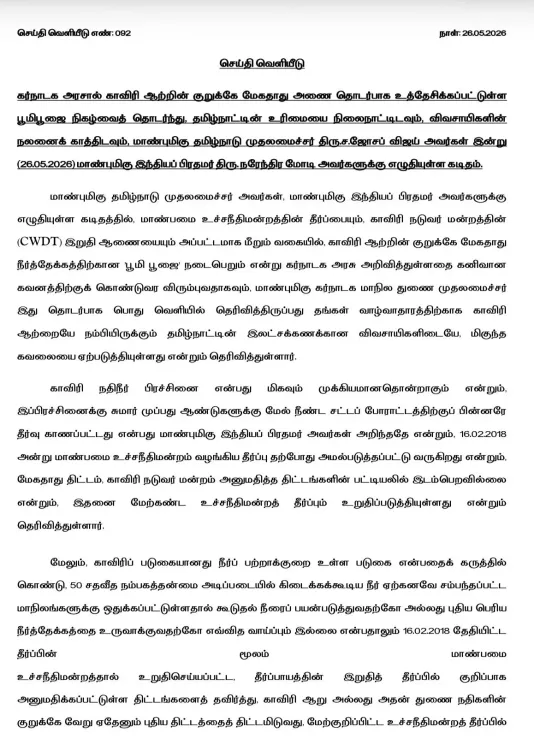
Tamil Nadu Chief Minister C. Joseph Vijay wrote to Prime Minister Narendra Modi on 26 May 2026, opposing Karnataka's planned ground-breaking for the Mekedatu dam on the Cauvery river and urging the Centre to protect Tamil Nadu's water rights and farmer interests.
Key Takeaways
Joseph Vijay wrote to PM Narendra Modi on 26 May 2026 over the Mekedatu dam proposal.
Karnataka announced a Bhoomi Puja for the dam, triggering the letter from Tamil Nadu .
The letter calls on the Centre to uphold Tamil Nadu 's rights under existing Cauvery water-sharing orders.
The Cauvery Water Disputes Tribunal award ( 2007 ) and Supreme Court modification ( 2018 ) form the legal basis of Tamil Nadu 's claim.
Farmers in the Cauvery delta districts of Thanjavur , Tiruvarur , and Nagapattinam are the primary stakeholders.
The Ministry of Jal Shakti and the Cauvery Water Management Authority are expected to respond next.
The Chief Minister's Office of Tamil Nadu announced on Tuesday, 26 May 2026 that Chief Minister C. Joseph Vijay has written to Prime Minister Narendra Modi, urging the Centre to protect Tamil Nadu's rights over Cauvery waters and safeguard the interests of farmers in the state, following Karnataka's announcement of a Bhoomi Puja (ground-breaking ceremony) for the proposed Mekedatu dam across the Cauvery river.
Context
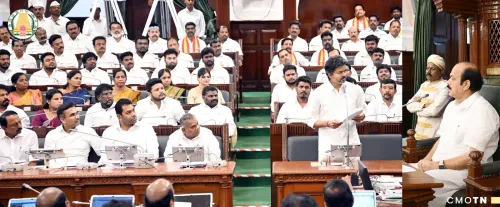
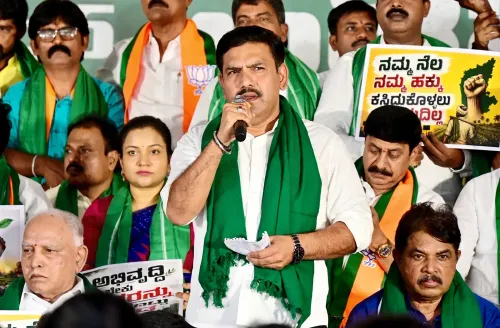
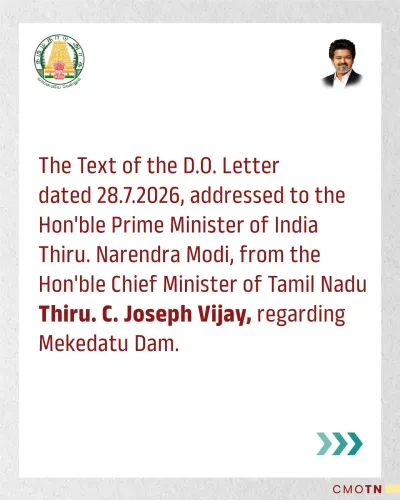
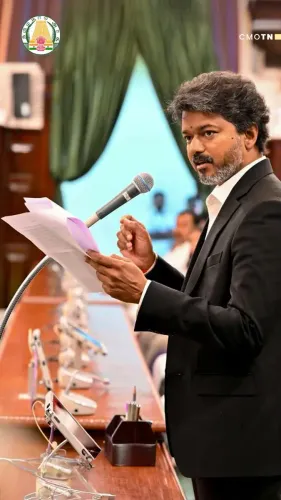
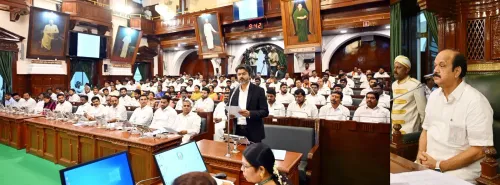
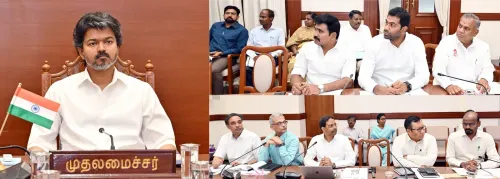
The Chief Minister's Office shared the letter on X (formerly Twitter), stating in Tamil that the correspondence was prompted by Karnataka's plan to hold a ground-breaking ceremony for the Mekedatu dam. The letter, dated 26 May 2026, calls on the Prime Minister to assert Tamil Nadu's legal entitlements and protect the livelihood of farmers who depend on Cauvery waters. The post was accompanied by four images, believed to include the text of the letter.
The Mekedatu project envisages a balancing reservoir at the confluence of the Cauvery and Arkavathi rivers in Karnataka, at a site roughly 100 kilometres upstream of the Tamil Nadu border. Tamil Nadu has consistently opposed the project, arguing that any new storage structure upstream would imperil the water allocations guaranteed to the state under judicial and tribunal orders.
Policy Backdrop
The Cauvery Water Disputes Tribunal issued its final award in February 2007, allocating shares among Karnataka, Tamil Nadu, Kerala, and Puducherry. The Supreme Court of India modified those allocations in 2018, and in the same year the Centre constituted the Cauvery Water Management Authority (CWMA) to oversee compliance and resolve seasonal disputes.
Karnataka first formally advanced the Mekedatu proposal in the mid-2010s. Tamil Nadu has since filed objections before the CWMA, the Supreme Court, and through diplomatic correspondence with New Delhi. Each time Karnataka has revived the project, Tamil Nadu has responded with a combination of legal challenges and political appeals to the Centre — a pattern that the latest letter continues.
Stakeholders and Impact
Farmers in the Cauvery delta districts — including Thanjavur, Tiruvarur, and Nagapattinam — are the most directly affected stakeholders. These districts rely on Cauvery flows for paddy cultivation across two cropping seasons, and any reduction in downstream releases can translate directly into crop losses and rural distress.
Farmer organisations in the Cauvery basin have historically mobilised quickly whenever the Mekedatu project gains momentum in Karnataka, pressuring the Tamil Nadu government to take visible political and legal action. CM Vijay's letter to the Prime Minister is in keeping with that political dynamic, signalling the state government's intent to contest the project at the highest level before any construction activity commences.
What's Next
Attention will now shift to the Prime Minister's Office and the Ministry of Jal Shakti, which oversees inter-state river disputes, for any formal response to CM Vijay's letter. The next scheduled sitting of the Cauvery Water Management Authority will be closely watched for any directive on Karnataka's proposed ground-breaking. Tamil Nadu may also approach the Supreme Court with a fresh petition seeking a stay on any construction-related activity at the Mekedatu site.
The episode underscores the enduring tension in Indian federalism over shared river resources — a tension that judicial awards and regulatory authorities have moderated but not resolved. How the Centre responds will set the tone for Cauvery politics ahead of the next agricultural season.
Point of View
The other escalates through legal and political channels before a single brick is laid. By writing directly to the Prime Minister rather than only approaching the courts, CM Vijay is staking a political claim as much as a legal one — signalling to farmers and opposition parties at home that the state government is acting decisively. The Centre's response, or silence, will itself become a political variable that both state governments will exploit. This episode also highlights the limits of the Cauvery Water Management Authority: despite its mandate, inter-state water disputes still routinely escalate to prime ministerial correspondence, suggesting the regulatory architecture has yet to build sufficient political trust.
NationPress
10 Oct 2026
Frequently Asked Questions
What is the Mekedatu dam project and why does Tamil Nadu oppose it?
The Mekedatu project proposes a balancing reservoir on the Cauvery river in Karnataka , near the confluence with the Arkavathi . Tamil Nadu opposes it because the dam would allow Karnataka to store water upstream, potentially reducing the flows that reach Tamil Nadu under the Cauvery Water Disputes Tribunal award and the Supreme Court 's 2018 modification.
Why did CM Joseph Vijay write to PM Modi about Mekedatu?
CM C. Joseph Vijay wrote to PM Narendra Modi on 26 May 2026 after Karnataka announced a Bhoomi Puja (ground-breaking ceremony) for the Mekedatu dam . The letter urges the Prime Minister to protect Tamil Nadu 's water rights and the interests of farmers who depend on Cauvery flows.
What is the Cauvery Water Management Authority?
The Cauvery Water Management Authority (CWMA) is a body constituted by the Central Government in 2018 to supervise the implementation of the Supreme Court 's modified Cauvery water-sharing order. It monitors releases, resolves seasonal disputes, and coordinates among the four basin states: Karnataka , Tamil Nadu , Kerala , and Puducherry .
What did the Supreme Court say about Cauvery water sharing?
The Supreme Court of India in 2018 modified the Cauvery Water Disputes Tribunal 's 2007 final award, marginally increasing Karnataka 's share while reducing Tamil Nadu 's allocation slightly. The court also directed the Centre to constitute the Cauvery Water Management Authority within a month to ensure compliance.
Which Tamil Nadu districts are most affected by Cauvery water disputes?
The Cauvery delta districts of Thanjavur , Tiruvarur , and Nagapattinam are the most directly affected, as paddy cultivation across two cropping seasons in these districts depends heavily on regulated Cauvery flows from upstream releases in Karnataka .