TN salt producers urge CM Vijay to fast-track lease renewals on 3,500-acre govt land
Synopsis
Salt manufacturers on 900 of the original 3,500 acres of Tamil Nadu government land near Kalpakkam are facing an operational crisis as lease renewals stall — with units in Kovalam and Kelambakkam already shut. With 150 families at stake and unions warning against multinational takeovers, CM C. Joseph Vijay now faces pressure to act before the season closes entirely.
Key Takeaways
Salt producers on state government land in Thirukazhukundram taluk near Kalpakkam have sought intervention from Tamil Nadu CM C.
Joseph Vijay to expedite lease renewals.
Of the original 3,500 acres leased for salt production, active operations are now limited to about 900 acres .
Nearly 150 families depend directly or indirectly on these salt pans for their livelihood.
Salt pans in Kovalam and Kelambakkam have reportedly already shut down due to non-renewal of leases.
The lease crisis extends to Ramanathapuram , Nagapattinam , and Thoothukudi districts as well.
Trade unions in Thoothukudi have raised concerns over reports of salt pan lands being leased to multinational companies.
Salt manufacturers operating on state government-owned land in Thirukazhukundram taluk near Kalpakkam and at Kadambadi have urged Tamil Nadu Chief Minister C. Joseph Vijay to intervene and expedite the renewal of their leases, warning that prolonged delays could threaten the livelihoods of hundreds of families dependent on the traditional industry. The appeal comes amid growing uncertainty over the continuation of operations across the region.
Scale of the Crisis
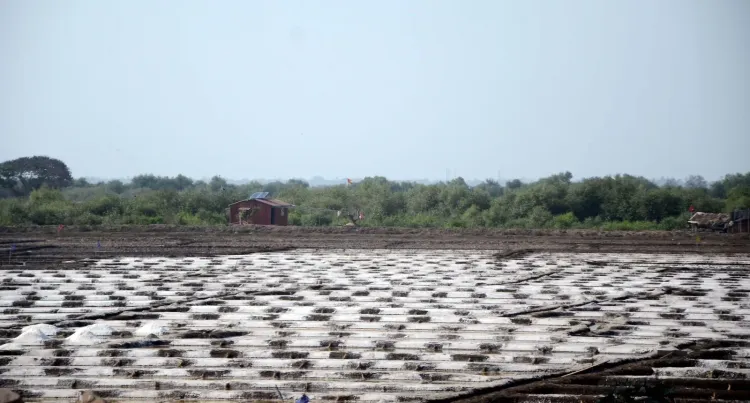
Around 3,500 acres of government land in the region was originally leased for salt production. Active production is now confined to roughly 900 acres, with nearly 150 families depending directly or indirectly on the salt pans for their income. Industry representatives noted that the Commissioner of Land Administration had already directed the respective district Collectors to process lease renewals — but the procedure has stalled in several areas, leaving producers and workers in a state of uncertainty.
Shutdowns Already Underway
Several smaller salt pans operated by individuals in areas such as Kovalam and Kelambakkam have reportedly shut down following the non-extension of leases. Industry representatives fear more units could face a similar fate unless pending renewals are cleared without further delay. Salt production is seasonal and heavily dependent on favourable weather; workers noted that better conditions this year had extended the production window by a few days, offering a brief reprieve for earnings before the season closes.
Why These Lands Cannot Easily Switch Use
Salt pan operators pointed out that many of these tracts have been used for salt manufacturing for several decades and have limited scope for alternative activities. The groundwater beneath the land carries high salinity concentrations, and large portions are also flooded by inland water during the monsoon — making them structurally unsuited for most other commercial uses. This geographic reality makes lease renewal, rather than land repurposing, the only viable path for the communities involved.
A Statewide Problem
The lease renewal crisis is not confined to the Kalpakkam region. Similar state government-owned salt pan lands exist in Ramanathapuram, Nagapattinam, and Thoothukudi districts, where small producers and workers are also seeking greater operational security. Trade union representatives in Thoothukudi are reportedly planning to approach the state government with a demand that such lands be transferred directly to the individual operators currently working on them.
Concerns Over Multinational Leasing and Union Demands
Unions have also raised alarm over reports that some salt pan lands could be leased to multinational companies. They have maintained that any decision on the future of these properties must safeguard the interests of small leaseholders and workers. Separately, Tamil Nadu also has salt pan lands owned by the Union government; the question of lease renewal for those properties is currently under arbitration.
Point of View
Suggesting the bottleneck is administrative, not policy. What makes this particularly acute is the irreversibility: high-salinity groundwater and monsoon flooding mean these lands cannot pivot to alternative uses, so delayed renewals are effectively shutdowns by default. The concern over multinational leasing adds a political dimension that the state government cannot afford to ignore, especially in coastal districts where salt pan communities carry electoral weight.
NationPress
25 Sept 2026
Frequently Asked Questions
Why are Tamil Nadu salt producers seeking CM C. Joseph Vijay's intervention?
Salt manufacturers on state government land near Kalpakkam and Kadambadi are seeking Chief Minister C. Joseph Vijay's intervention because lease renewals have stalled despite directives from the Commissioner of Land Administration, threatening the livelihoods of around 150 families. Several units in Kovalam and Kelambakkam have already shut down due to non-renewal.
How much land is involved in the Tamil Nadu salt pan lease dispute?
Around 3,500 acres of government land in the Thirukazhukundram taluk region was originally leased for salt production. Active production is now confined to approximately 900 acres, reflecting the significant contraction of the industry over time.
Which districts in Tamil Nadu are affected by the salt pan lease renewal issue?
The problem extends beyond Kalpakkam to Ramanathapuram, Nagapattinam, and Thoothukudi districts, where small producers and workers are also seeking greater security over their lease arrangements.
What are trade unions demanding regarding Tamil Nadu salt pan lands?
Trade union representatives in Thoothukudi are planning to approach the state government with a demand that salt pan lands be transferred to the individual operators currently working on them. Unions have also raised concern over reports that some of these lands could be leased to multinational companies, calling for decisions that protect small leaseholders and workers.
What is the status of Union government-owned salt pan lands in Tamil Nadu?
Tamil Nadu also has salt pan lands owned by the Union government, separate from state-owned tracts. The issue of lease renewal for those properties is currently under arbitration.