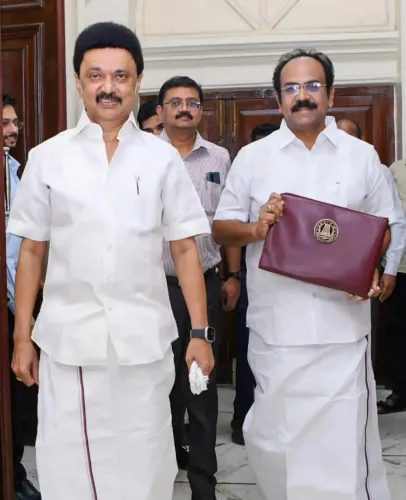
Tamil Nadu GST growth at 3% in October, far behind southern peers: Thangam Thennarasu
Synopsis
Tamil Nadu's GST revenue grew just 3% in October — while every major southern neighbour posted double-digit gains. Former Finance Minister Thangam Thennarasu argues the headline figure is propped up by import taxes, not home-grown production, raising questions about the TVK government's stewardship of one of India's largest state economies.
Key Takeaways
Tamil Nadu recorded GST revenue growth of just 3% in October 2026 , according to figures cited by former Finance Minister Thangam Thennarasu .
By comparison, Andhra Pradesh grew 24% , Kerala 23% , Karnataka 18% , and Telangana 14% in the same period.
Thennarasu argued that the marginal overall revenue increase was driven by taxes on imported goods , not by domestic production activity.
He accused the TVK government of allowing Tamil Nadu's growth momentum to weaken, calling the figures a warning signal.
The government had not publicly responded to the specific claims as of the date of the statement.
Former Tamil Nadu Finance Minister Thangam Thennarasu on 2 November 2026 raised an alarm over the state's Goods and Services Tax (GST) revenue performance, pointing to 3% growth in October — a figure that trails every major southern neighbour by a wide margin. Thennarasu accused the TVK government of allowing Tamil Nadu's economic momentum to erode, warning that the revenue data reflected deeper stagnation in the state's productive base.
The Numbers Behind the Concern
According to figures cited by Thennarasu, Andhra Pradesh recorded GST revenue growth of 24% in October, Kerala posted 23%, Karnataka clocked 18%, and Telangana registered 14%. Against this backdrop, Tamil Nadu's 3% growth stands out as a significant underperformance among states that share broadly similar industrial and services-driven economic profiles.
Import Taxes Versus Domestic Production
Thennarasu drew a pointed distinction between the sources of Tamil Nadu's tax receipts. He acknowledged a marginal overall increase in revenue but argued that this uptick was largely driven by taxes collected on certain major imported commodities — not by production activity within the state. In his assessment, GST revenue rooted in domestic manufacturing and services is a far more reliable gauge of economic vitality than collections boosted by import flows. He contended that once import-linked receipts are set aside, the state's underlying production revenue has been declining.
A State Once at the Forefront
Tamil Nadu has historically ranked among India's leading states on economic output and industrial expansion. Thennarasu's criticism carries that context: a state that once set the benchmark for southern growth is now, according to him, trailing peers it previously led. This comes amid broader scrutiny of regional growth divergences in India's southern states, where Andhra Pradesh and Karnataka have ramped up capital expenditure and investment facilitation in recent years.
What the Government Has Not Said
As of the time of the statement, the TVK government had not publicly responded to Thennarasu's specific claims about October GST figures or the composition of tax receipts. The absence of an official rebuttal leaves the former minister's reading of the data — that import-driven revenue is masking a production slowdown — uncontested in the public domain for now.
What to Watch Next
Analysts and opposition leaders are likely to track November and December GST data closely to determine whether October's 3% figure represents a one-month anomaly or a sustained trend. If the production-linked revenue weakness Thennarasu flagged persists into the second half of the fiscal year, it could intensify pressure on the state government ahead of its budget cycle. How Tamil Nadu responds — through industrial incentives, investment outreach, or revised fiscal strategy — will be the next significant indicator of how seriously it treats the warning.
Point of View
But the numbers he cites — if accurate — deserve an official response rather than silence. The more substantive argument is not the headline GST figure but its composition: an economy propped by import-tax windfalls while domestic manufacturing slows is fundamentally different from one generating organic growth. Tamil Nadu has long leveraged its industrial base and skilled workforce as competitive advantages over other southern states; if that productive engine is losing revs, no amount of import-driven revenue optics changes the underlying story. The TVK government's next budget will be the real test of whether it has a credible answer to this critique.
NationPress
2 Nov 2026
Frequently Asked Questions
What did Thangam Thennarasu say about Tamil Nadu's GST growth?
Thennarasu stated that Tamil Nadu recorded GST revenue growth of just 3% in October, well below the double-digit growth posted by Andhra Pradesh, Kerala, Karnataka, and Telangana. He accused the TVK government of letting the state's economic momentum weaken.
How does Tamil Nadu's GST growth compare with other southern states?
In October, Andhra Pradesh led with 24% GST growth, followed by Kerala at 23%, Karnataka at 18%, and Telangana at 14%. Tamil Nadu's 3% growth was the lowest among the major southern states cited.
Why did Thennarasu distinguish between import taxes and production revenue?
He argued that a portion of Tamil Nadu's revenue increase came from taxes on imported commodities, not from economic activity within the state. In his view, GST generated by domestic production is a more meaningful indicator of economic health than import-linked collections.
Has the TVK government responded to these allegations?
As of 2 November 2026, the TVK government had not publicly responded to Thennarasu's specific claims about October GST figures or the distinction he drew between import and production revenue.
Why does Tamil Nadu's GST performance matter?
Tamil Nadu is one of India's largest state economies and has historically ranked among its top-performing states. A sustained slowdown in its production-linked tax revenue could signal broader economic stagnation and affect investment confidence and fiscal planning ahead of the state's budget cycle.