Are Trinamool and CPI-M Challenging ECI's Authority on Citizenship Status?
Synopsis
In a pivotal meeting, the Trinamool Congress and CPI-M questioned the authority of the Election Commission of India regarding citizenship determinations. As the Special Intensive Revision of electoral rolls approaches, tensions rise over the implications for voter identification and electoral integrity.
Key Takeaways
Trinamool Congress and CPI-M challenge ECI's authority.
The meeting focused on the Special Intensive Revision of electoral rolls.
Concerns over defining citizenship status were raised.
Potential public unrest over labeling of voters as infiltrators.
Three-phase process for electoral roll revision outlined.
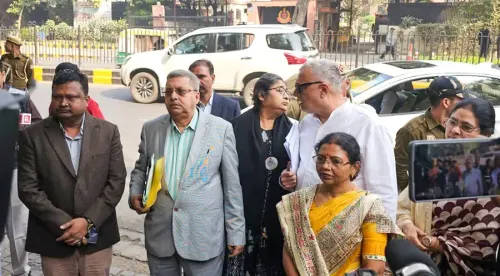
Kolkata, Oct 28 (NationPress) During an all-party meeting on Tuesday, the Trinamool Congress and CPI-M raised concerns about the Election Commission of India's (ECI) authority to ascertain the citizenship status of individuals. The meeting, led by West Bengal Chief Electoral Officer (CEO) Manoj Kumar Agarwal in Kolkata, was organized to deliberate on the Special Intensive Revision (SIR) of electoral rolls in the state.
Officials in attendance reported that delegates from both parties argued the ECI’s constitutional responsibilities are limited to creating an error-free voters' list and do not extend to deciding who qualifies as an Indian citizen.
“Both the Trinamool Congress and CPI-M representatives asserted that the task of determining citizenship status lies beyond the ECI’s jurisdiction,” stated a source from the CEO’s office familiar with the discussions.
The CPI-M representatives contended that interpreting constitutional provisions on citizenship is not within the commission’s remit, insisting it falls under the authority of the Union Home Ministry and the judiciary.
The Trinamool Congress went further, accusing the ECI of “exceeding its constitutional boundaries” by allegedly trying to classify a certain voter segment as illegal Bangladeshi immigrants.
They also challenged the credibility and origins of data used to brand voters as suspected infiltrators, cautioning that such actions could incite public unrest and erode trust in the electoral process.
“It is the commission’s duty to verify voter eligibility, not to adjudicate citizenship. Labeling voters without proper legal process is unconstitutional,” a Trinamool representative was quoted as saying.
Sources indicated that CEO Manoj Kumar Agarwal addressed inquiries from the political parties, clarifying that the SIR aims solely to enhance accuracy and transparency in the state's voter rolls.
The CEO is slated to conduct a virtual meeting on Wednesday morning with all District Electoral Officers (DEOs), Electoral Registration Officers (EROs), and Booth-Level Officers (BLOs) to provide final guidance before the statewide voter revision initiative begins on November 4.
The SIR will occur in three phases: during the first phase, BLOs will visit every household to gather voter information and draft the electoral roll. In the second phase, political parties and individuals can file objections or corrections. In the third and final phase, EROs will resolve all complaints, after which the definitive voter list will be published.
This comprehensive exercise is expected to wrap up by March 2026, in advance of Assembly elections in West Bengal, Tamil Nadu, Kerala, and Assam, alongside one Union Territory next year.
The last Special Intensive Revision in West Bengal took place in 2002.
Point of View
The concerns raised by the Trinamool Congress and CPI-M reflect a crucial debate regarding the boundaries of electoral authority in India. The ECI's role must be clearly defined, especially in sensitive matters like citizenship, to maintain public trust in the electoral process.
NationPress
21 Sept 2026
Frequently Asked Questions
What is the purpose of the Special Intensive Revision?
The Special Intensive Revision aims to ensure accuracy and transparency in electoral rolls, with a focus on updating voter information.
Why are Trinamool and CPI-M questioning the ECI?
They argue that determining citizenship status is beyond the ECI's constitutional mandate, which should focus on preparing voter lists.
What could be the consequences of mislabeling voters?
Mislabeling could lead to public unrest and diminished trust in the electoral process, undermining democracy.