Tripura gets full-fledged electric train ops as NFR completes successful trials
Synopsis
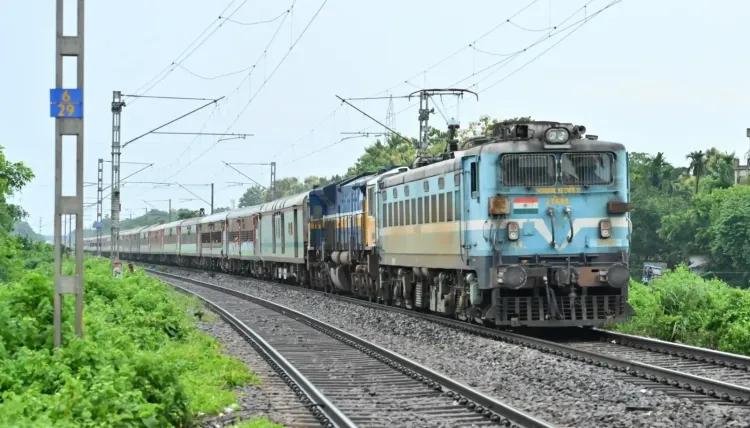
Tripura has crossed a historic rail milestone — full electric traction is now operational across its 271-km network, with the Tejas Rajdhani Express becoming the first long-distance train to run end-to-end on electric power. The state joins Assam as only the second in the Northeast to achieve this, capping a decades-long transformation from metre-gauge isolation to a modern electrified broad-gauge corridor.
Key Takeaways
Tripura becomes the second state in Northeast India after Assam to operate full-fledged electric train services.
The Anand Vihar–Agartala Tejas Rajdhani Express (20502) successfully ran on electric traction end-to-end last week.
TSECL has completed 100% electrification of Tripura's 271-km broad-gauge railway network.
The first-ever MEMU service in the Northeast was launched on 4 July , linking Agartala with Karimganj, Assam, with a capacity of 3,600 passengers .
Redevelopment under the Amrit Bharat Station Scheme is underway at 4 stations : Agartala, Udaipur, Kumarghat, and Dharmanagar.
The Lumding–Badarpur section in Assam remains the sole rail link connecting Tripura and three other Northeastern states to the rest of India.
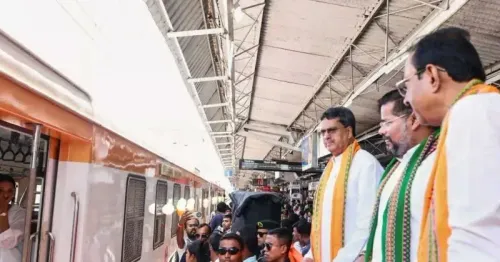
The Northeast Frontier Railway (NFR) has launched full-fledged electric train operations in Tripura following the successful completion of multiple trial runs of electric locomotives in the state, officials confirmed on Monday, 9 November 2026. The development makes Tripura the second state in the Northeastern region after Assam to operate electric traction-based train services.
Key Developments
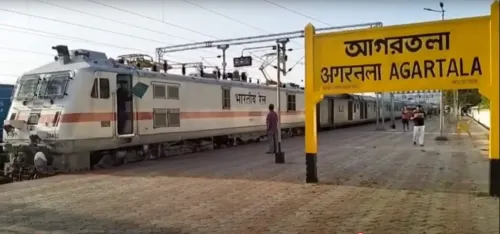
In a significant milestone, train number 20502 Anand Vihar–Agartala Tejas Rajdhani Express ran successfully on electric traction from end to end last week, according to an NFR official. In a phased manner, long-distance express trains hauled by electric locomotives will now operate across Tripura's rail network.
Notably, on 4 July, the NFR had introduced the first-ever Mainline Electric Multiple Unit (MEMU) train service in the entire Northeast region, connecting Tripura with southern Assam. The MEMU train, which was earlier operating as a Diesel Electric Multiple Unit (DEMU), has been successfully upgraded following the electrification of the railway route — a shift that officials describe as a significant technological advancement.
What the MEMU Service Offers
The MEMU service operates on electric traction, making it more environmentally friendly, energy-efficient, and economical compared to diesel-run predecessors. The train has a carrying capacity of 3,600 passengers and connects Agartala with Karimganj in neighbouring Assam.
The train is equipped with 12 stainless steel coaches, LED lighting, bio-toilets, a GPS-based passenger information system displaying details of the next station and platform, a public address system, and CCTV surveillance, among other modern amenities.
Electrification and Infrastructure Build-Up
Tripura Power Minister Ratan Lal Nath stated that the Tripura State Electricity Corporation Ltd. (TSECL) has completed 100 per cent electrification of the state's 271-km railway network. He noted that the broad-gauge railway corridor from Churaibari, along the Tripura–Assam border, to Sabroom, near the India–Bangladesh border, was developed in its entirety within seven years.
Nath recalled the state's railway history: the first train reached Dharmanagar in northern Tripura in 1964, while railway connectivity took another 44 years to reach the state capital Agartala in 2008. Rail connectivity was further extended to Sabroom in southern Tripura in 2019. The international railway link connecting Agartala with Akhaura in Bangladesh was completed in 2023.
Under the Centre's Amrit Bharat Station Scheme, redevelopment work is currently underway at four railway stations in the state — Agartala, Udaipur, Kumarghat, and Dharmanagar.
Strategic Importance of the Corridor
Tripura is presently connected to several major Indian cities including Delhi, Kolkata, Mumbai, Firozpur, and Patna through long-distance express services. The Lumding–Badarpur mountainous section in Assam remains the only rail link connecting Tripura, Mizoram, Manipur, and southern Assam with the rest of the country, underscoring its strategic and logistical importance for the region.
The transition to electric traction represents a broader push to modernise Northeast India's rail infrastructure, with further expansion of electric services expected as the phased rollout continues.
Point of View
Broad-gauge conversion, and an international rail link to Bangladesh within roughly 15 years. Yet the region's vulnerability remains: the entire rail lifeline for Tripura, Mizoram, and Manipur still runs through a single mountainous section at Lumding–Badarpur. Any disruption there — weather, security, or infrastructure failure — cuts off four states simultaneously. Electric trains are a welcome modernisation, but redundancy in connectivity remains the unfinished strategic imperative.
NationPress
9 Nov 2026
Frequently Asked Questions
What is the significance of electric train operations starting in Tripura?
Tripura has become the second state in Northeast India after Assam to operate full-fledged electric train services, following the completion of 100% electrification of its 271-km broad-gauge railway network. The shift from diesel to electric traction makes services more energy-efficient, environmentally friendly, and cost-effective.
Which train first ran on full electric traction in Tripura?
The Anand Vihar–Agartala Tejas Rajdhani Express (train number 20502) successfully ran on electric traction from end to end last week, marking the first long-distance electric locomotive run in Tripura.
What is the MEMU train service connecting Agartala and Karimganj?
The Mainline Electric Multiple Unit (MEMU) is a modern electric train service launched on 4 July, connecting Agartala in Tripura with Karimganj in Assam — the first such service in the entire Northeast region. It has a passenger capacity of 3,600 and is equipped with LED lighting, GPS-based information systems, bio-toilets, and CCTV surveillance.
How long did Tripura's railway electrification project take?
According to Tripura Power Minister Ratan Lal Nath, the entire 271-km broad-gauge network from Churaibari to Sabroom was developed and electrified within seven years, with TSECL completing 100% electrification of the route.
Which railway stations in Tripura are being redeveloped under Amrit Bharat Station Scheme?
Four stations in Tripura are currently undergoing redevelopment under the Centre's Amrit Bharat Station Scheme — Agartala, Udaipur, Kumarghat, and Dharmanagar.