Karnataka's Deputy CM Announces Full Replacement of Crest Gates at Tungabhadra Dam by May
Synopsis
Karnataka's Deputy Chief Minister D.K. Shivakumar revealed that all crest gates at the Tungabhadra dam will be replaced by May. This significant infrastructure upgrade is crucial for effective water management. Stay informed about the progress and implications of this project.
Key Takeaways
All crest gates at Tungabhadra dam to be replaced by May.
14 gates have been replaced as of March 10.
The project costs Rs 34.48 crore .
New public toilets are being constructed in Bengaluru.
Shivakumar emphasizes the need for research on artificial intelligence in governance.
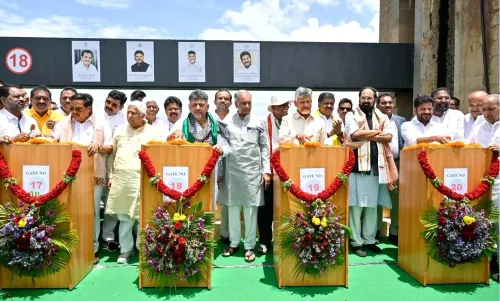
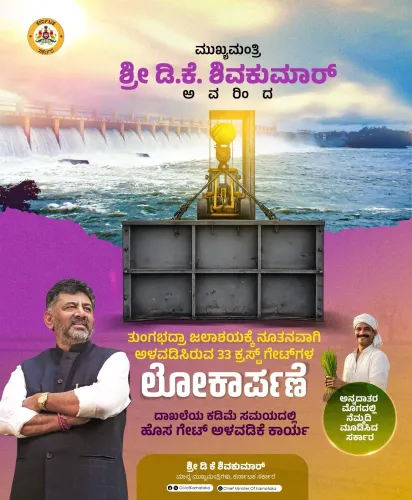
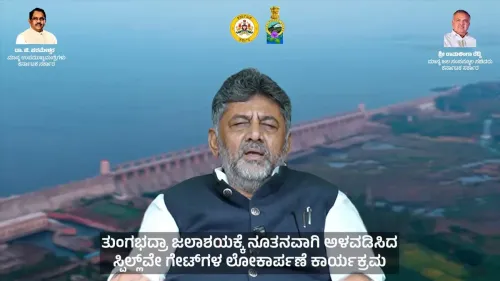
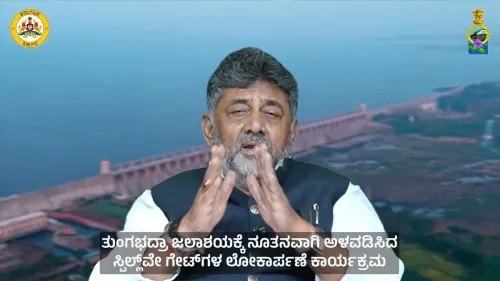
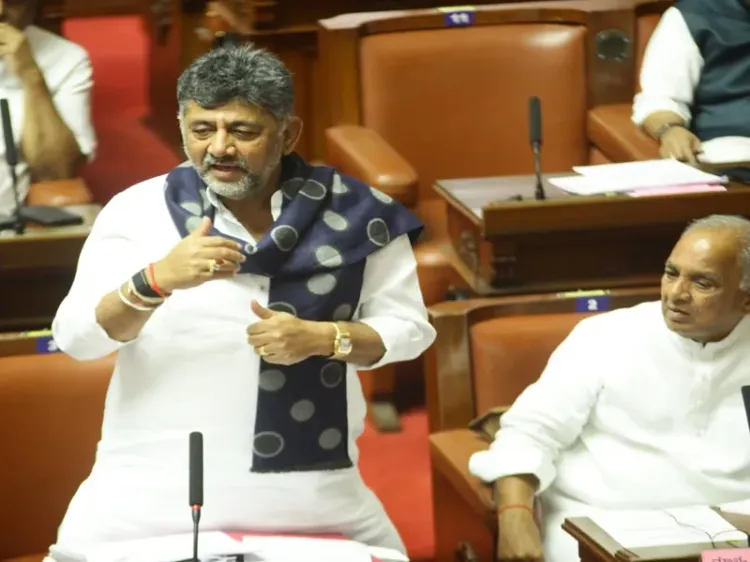
Bengaluru, March 12 (NationPress) The Deputy Chief Minister of Karnataka, D.K. Shivakumar, announced in the Legislative Council on Thursday that the complete replacement of all crest gates at the Tungabhadra dam is scheduled for completion by May this year.
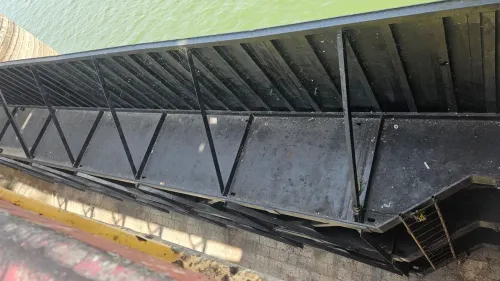
In response to a query from JD(S) MLC T.A. Sharavana regarding the status of the crest gate replacements during the Zero Hour session, Shivakumar, who also oversees the Irrigation portfolio, stated: “We are in the process of replacing every gate at the Tungabhadra dam. Each crest gate replacement takes approximately seven days. As of March 10, reports indicate that 14 gates have been successfully replaced. We are on track to finish the replacements as planned.”
“An agreement was made with an Ahmedabad-based company, Hardware Tool and Machinery Project Company, on June 10, 2025, to replace all crest gates at the dam for a total cost of Rs 34.48 crore within a 15-month timeframe. Work has been completed on 25 gates, with two additional gates currently in fabrication. Replacement efforts for three more gates are ongoing, and we are committed to completing this project by May,” he elaborated.
Shivakumar expressed concerns about the lack of cooperation from the Andhra Pradesh government regarding discussions on the Navali balancing reservoir. “There have been alternative proposals from some circles, but the Chief Minister of Andhra Pradesh has not allocated time for discussions. Any decisions regarding this matter cannot be made unilaterally; they must involve all three riparian states. Currently, water is flowing into the sea, and with political support, we could harness it more effectively,” he added.
When BJP MLC B.G. Patil brought up a report regarding the non-payment of compensation to landowners, Shivakumar assured: “I will consult our officials to retrieve the files on this matter and ensure prompt action.”
During the Question Hour, in response to Congress member Aarthi Krishna's concerns regarding the usability and cleanliness of many public toilets within the Greater Bengaluru Authority limits, Shivakumar acknowledged the need for improvement. He mentioned plans to construct 441 new toilets alongside the existing 388 toilets in the area.
“Currently, there are 380 public toilets in the city. Of these, 65 are managed by retired civic workers, and 20 are operated by individuals with disabilities. Under the Shubhra Bengaluru initiative, 60 new toilets will be built. Additionally, 191 toilets are under construction,” he said.
He highlighted that the Central Government has allocated Rs 13.5 crore under the Swachh Bharat Mission, which will fund the construction of 90 toilets. Furthermore, 100 toilets are being built under the Brand Bengaluru initiative, primarily aimed at serving women.
“In total, there will be 441 new toilets combined with the existing 388. If the public identifies specific areas needing toilets, we encourage them to notify us, and we will evaluate land availability for additional constructions,” he stated.
During discussions, BJP member Bharathi Shetty inquired about the incorporation of artificial intelligence in state administrative reforms.
Shivakumar responded, stating, “We are entering a new era of artificial intelligence, a topic currently under global discussion. The Prime Minister has also convened a significant conference on this matter. Courts are exploring AI usage, and the CBSE has been advised to integrate this subject into the curriculum for Classes 3 to 8.”
However, he emphasized the necessity of thorough research before implementing AI in governance. “Decisions regarding AI in administration require substantial investigation. It is challenging to proceed without a comprehensive study. Even in the Legislative Council, documents must be scanned and uploaded into computers for digital access,” he clarified.
He remarked that AI cannot generate entirely new content independently, stating, “It produces outcomes based on the data it receives.”
Shivakumar shared a personal experience, saying: “Once, while preparing a speech, I asked my personal assistant for information, but my daughter suggested I use ChatGPT instead. I found it to be informative, although its accuracy still requires enhancement.”
He reiterated that unless documents are digitized, retrieving information digitally is not feasible. “In courts, for instance, information becomes accessible only after previous judgments are uploaded. However, judgments cannot be based solely on these records,” he concluded.
Frequently Asked Questions
What is the timeline for the replacement of crest gates at Tungabhadra dam?
The replacement of all crest gates at the Tungabhadra dam is expected to be completed by May this year.
How many gates have been replaced so far?
As of March 10, 14 gates have been successfully replaced at the Tungabhadra dam.
What is the cost of the project?
The total cost for replacing all crest gates is Rs 34.48 crore.
Which company is responsible for the replacement project?
The project is being executed by Ahmedabad-based Hardware Tool and Machinery Project Company.
Are there any additional toilet facilities being constructed in Bengaluru?
Yes, 441 new toilets are being constructed alongside the existing 388 toilets within the Greater Bengaluru Authority limits.