CM Siddaramaiah inaugurates all 33 new gates at Tungabhadra Dam
Synopsis
Karnataka CM D. K. Shivakumar has announced completion of new gate installation across all 33 crest positions at the Tungabhadra Reservoir, a year after the 19th gate was washed away. A formal inauguration with Union Minister C. R. Patil and the CMs of Andhra Pradesh and Telangana is scheduled for 25 June 2026.
Key Takeaways
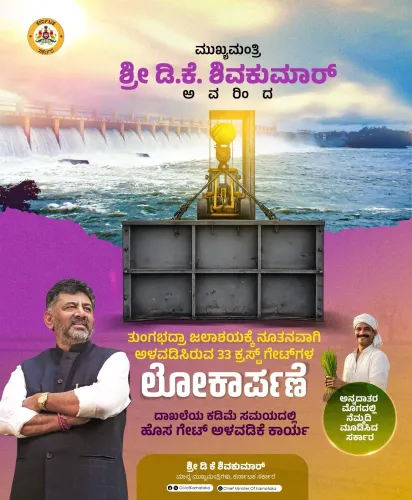
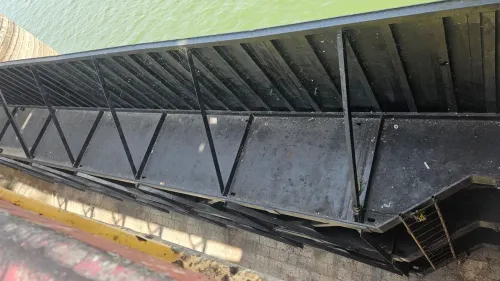
The Karnataka government has replaced all 33 crest gates at the Tungabhadra Reservoir , completing a full structural rehabilitation of the dam's flood-control infrastructure.
The project was triggered by the washout of the 19th gate last year; the government replaced that single gate within six days and then resolved to renew all gates.
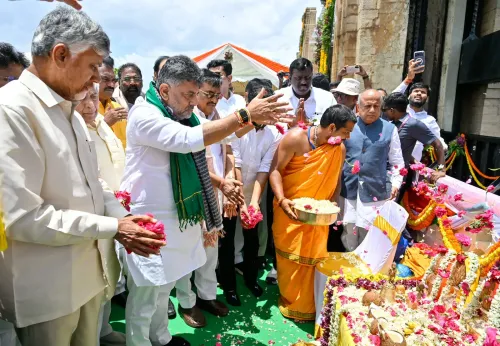
The formal inauguration is set for 25 June 2026 , to be performed jointly by CM D.
Shivakumar , Union Minister C.
Chandrababu Naidu , and Telangana CM A.
The Tungabhadra Reservoir , built between 1949 and 1953 , serves lakhs of farmers and crores of people across Karnataka , Andhra Pradesh , and Telangana .
The rehabilitation aligns with the Dam Safety Act, 2021 and central programmes for ageing dam renewal ahead of the southwest monsoon.
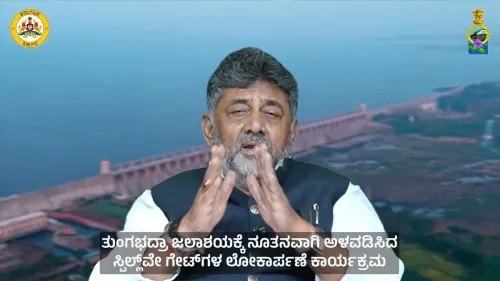
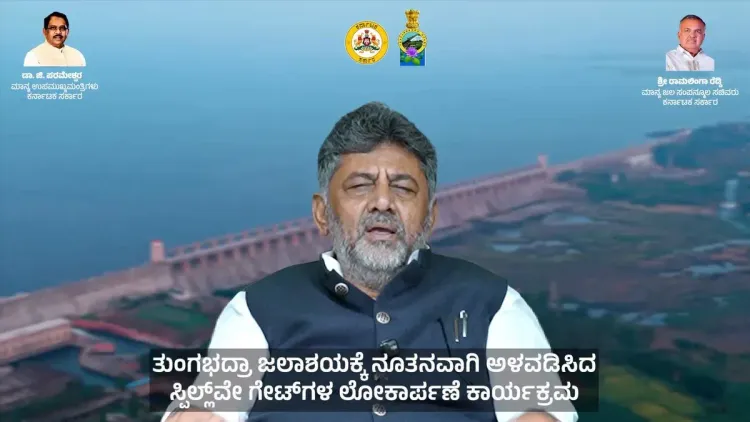
The Chief Minister's Office of Karnataka shared a video message on Wednesday, 24 June 2026, announcing that the Karnataka government has completed replacement of all 33 crest gates at the Tungabhadra Reservoir, with a formal inauguration ceremony scheduled for 25 June 2026.
In the message, Chief Minister D. K. Shivakumar conveyed what he called 'sweet news' (sihisuddi) to farmers and residents of the Tungabhadra basin. He recalled that last year, when the 19th gate of the reservoir was washed away, his government installed a replacement gate within six days, preventing further water loss and protecting farmers' interests. 'That very day, we resolved never to allow such an incident again,' he stated, adding that the government has now completed new gate installation across all 33 positions at the dam.
Context
The Tungabhadra Reservoir, constructed between 1949 and 1953 as one of India's first major post-independence irrigation projects, straddles the Tungabhadra river and serves the states of Karnataka, Andhra Pradesh, and Telangana. The dam supports irrigation for lakhs of farmers and provides drinking water to crores of people across the Krishna basin. The failure of a crest gate — a critical flood-control and water-retention structure — can lead to rapid, uncontrolled drawdown of reservoir storage, directly threatening the upcoming kharif irrigation cycle. The gate-wash incident last year highlighted the vulnerability of ageing infrastructure at a dam now over seven decades old. The Karnataka government's emergency response at the time drew attention to the broader need for systematic rehabilitation across all gates.Policy Backdrop
The Dam Safety Act, 2021 mandates regular inspection and rehabilitation of ageing dams across India, including Tungabhadra. Centrally supported programmes such as the Dam Rehabilitation and Improvement Project (DRIP) have channelled funds to states for exactly this kind of structural renewal. Indian states have accelerated gate-replacement programmes since 2020, following a series of gate failures at reservoirs across the country, with the central government pressing riparian states to prioritise pre-monsoon readiness. The Tungabhadra project's interstate character makes any maintenance or rehabilitation exercise a matter of coordination among Karnataka, Andhra Pradesh, and Telangana — the three beneficiary states — as well as the Union government, which holds oversight through the Jal Shakti Ministry.Stakeholders and Impact
The inauguration on 25 June 2026 will be jointly performed by Chief Minister Shivakumar alongside Union Minister C. R. Patil, Andhra Pradesh Chief Minister N. Chandrababu Naidu, and Telangana Chief Minister A. Revanth Reddy. The multi-state, multi-level participation signals the shared stakes in the reservoir's operational integrity ahead of the 2026 southwest monsoon. For farmers dependent on Tungabhadra's canal network, the replacement of all 33 gates means the reservoir can now be filled to its operational capacity without the risk of a structural failure forcing premature water releases. Downstream communities in all three states stand to benefit from more predictable water availability through the kharif and rabi seasons. Chief Minister Shivakumar described the reservoir as 'a legacy bequeathed to us by our predecessors' and framed its upkeep as a duty to future generations: 'Keeping it in good condition and ensuring the next generations also benefit from it is our responsibility. We have done this with utmost dedication.'What's Next
With the pre-monsoon gate-replacement work now declared complete, attention will shift to the reservoir's water-filling schedule once the southwest monsoon arrives over Bellary and the upper catchment areas. Any further announcements on dam modernisation — including hydropower unit upgrades or canal lining works — are likely to follow. The event also sets a political marker: visible, multi-state infrastructure delivery just before the monsoon season, when reservoir performance directly affects millions of farm households across the Krishna basin.Point of View
Technically, a maintenance exercise — and that is precisely the point. CM Shivakumar is converting an infrastructure upkeep milestone into a multi-state political moment, projecting Karnataka's administrative efficiency to an audience that spans two neighbouring states and the Union government. The gate-washout last year was a reputational vulnerability; the 33-gate replacement reframes the same episode as proof of crisis-to-completion governance. With the monsoon weeks away, the timing also pre-empts any opposition narrative about irrigation neglect, anchoring the Congress government's record on a visible, tangible deliverable that directly touches the livelihoods of the Tungabhadra basin's farming communities.
NationPress
23 Sept 2026
Frequently Asked Questions
Why were all 33 gates of Tungabhadra dam replaced?
The Karnataka government decided to replace all 33 crest gates at the Tungabhadra Reservoir after the 19th gate was washed away last year, exposing the risk of ageing gate infrastructure across the entire dam. The full replacement ensures the reservoir can retain water safely through the monsoon season.
When is the inauguration of the new Tungabhadra dam gates?
The new gates are scheduled to be inaugurated on 25 June 2026 in a joint ceremony involving Karnataka CM D. K. Shivakumar, Union Minister C. R. Patil, Andhra Pradesh CM N. Chandrababu Naidu, and Telangana CM A. Revanth Reddy.
Which states benefit from the Tungabhadra Reservoir?
The Tungabhadra Reservoir serves three states: Karnataka , Andhra Pradesh , and Telangana . It provides irrigation water to lakhs of farmers and drinking water to crores of people across the Krishna river basin.
What happened to the 19th gate of Tungabhadra dam?
The 19th crest gate of the Tungabhadra Reservoir was washed away last year during high water levels. The Karnataka government installed a replacement gate within six days to stop water loss, and subsequently undertook replacement of all 33 gates.
What is the Dam Safety Act 2021 and how does it apply to Tungabhadra?
The Dam Safety Act, 2021 is a central law that mandates regular inspection and structural rehabilitation of ageing dams across India. The Tungabhadra dam, built in the early 1950s, falls under its purview, and the gate-replacement project aligns with both the Act's requirements and central dam rehabilitation funding programmes.