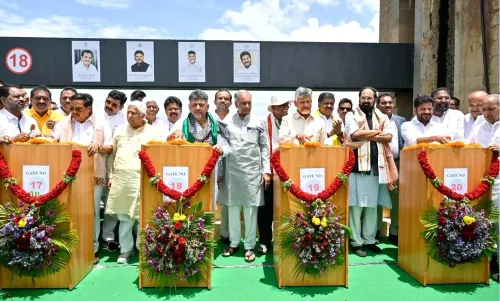
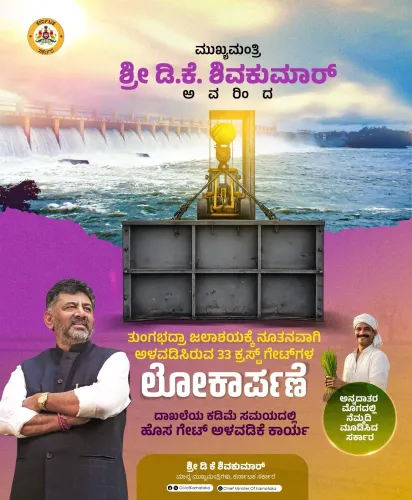
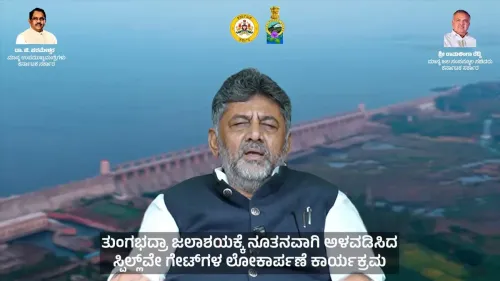
Siddaramaiah inaugurates new Tungabhadra dam gates worth Rs 51 cr
Synopsis
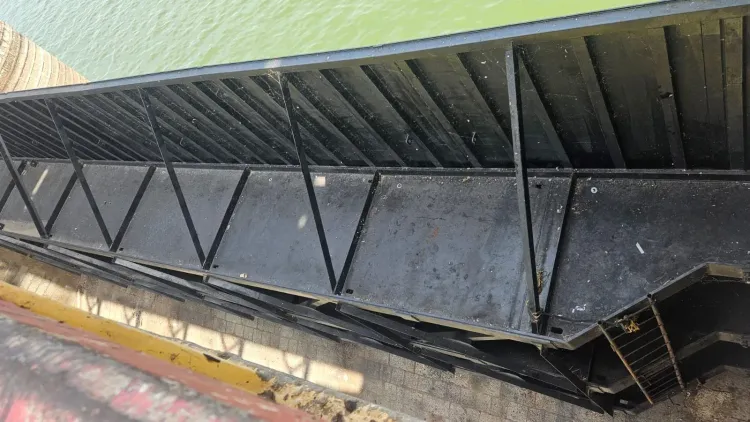
Karnataka Chief Minister Siddaramaiah announced the completion of new crest gate installation at the 70-year-old Tungabhadra Reservoir at a cost of Rs 51 crore. The project, triggered by the collapse of the 19th gate in December 2025, was completed ahead of the 2026 monsoon to secure water storage for basin farmers.
Key Takeaways
The 19th crest gate of the Tungabhadra Reservoir was washed away in December 2025 , threatening water security for basin farmers.
An emergency replacement gate was installed within 6 days to stop water loss, but was deemed a temporary fix.
An expert committee reviewed all remaining gates and recommended full replacement, given the dam's age of approximately 70 years .
The Karnataka government sanctioned the work at a cost of approximately Rs 51 crore .
Installation was completed ahead of the 2026 monsoon season , with inauguration scheduled for 25 June 2026 .
CM Siddaramaiah credited the Karnataka Irrigation Department , engineers, contractor, and ministers for the timely completion.
Karnataka Chief Minister Siddaramaiah announced on Wednesday, 24 June 2026 that the installation of new crest gates at the Tungabhadra Reservoir — a project costing approximately Rs 51 crore — has been completed and will be inaugurated the following day, marking the end of a months-long effort to secure water storage for the basin's farming communities ahead of the 2026 monsoon season.
Context
The urgency traces back to December 2025, when the 19th crest gate of the Tungabhadra Reservoir was swept away by the force of floodwaters, throwing the agricultural future of farmers across the Tungabhadra basin into uncertainty. Siddaramaiah wrote that the incident pushed the farming community into anxiety (ರೈತರ ಆತಂಕ — 'farmers' fear'), prompting him to immediately direct concerned department officials and district in-charge ministers to install a replacement gate and prevent further water loss.
A temporary fix was executed within six days, stopping the uncontrolled outflow of reservoir water. However, the government recognised this was not a permanent solution and commissioned an expert committee to assess the condition of all remaining gates at the reservoir.
Policy Backdrop
The Tungabhadra Dam, completed in 1953 as a joint irrigation project between the then Mysore and Andhra states, is a cornerstone of agriculture across large parts of northern Karnataka. Its crest gates, now approximately 70 years old, were flagged by the expert panel as being due for replacement — a recommendation that Siddaramaiah said he acted on without hesitation, stating he directed officials to proceed 'regardless of the cost' (ಎಷ್ಟೇ ಹಣ ಖರ್ಚಾದರೂ ಪರವಾಗಿಲ್ಲ).
Indian states have in recent years stepped up safety audits and gate replacements on dams built six to seven decades ago, following repeated incidents of structural failure during heavy monsoon inflows. Karnataka's swift response in this case fits a broader pattern of prioritising pre-monsoon restoration works to minimise water loss and protect irrigation schedules.
Stakeholders and Impact
The primary beneficiaries are the farmers of the Tungabhadra catchment area, who depend on the reservoir for irrigation water across multiple cropping seasons. Secure water storage heading into the 2026 monsoon means reduced risk of water scarcity for kharif cultivation in the region.
Siddaramaiah thanked officials and staff of the Karnataka Irrigation Department, the contractor company, engineers, and state ministers for completing the work in a short timeframe. He described the successful inauguration as giving him a sense of fulfilment (ಸಾರ್ಥಕಭಾವ — 'a feeling of having done something worthwhile').
What's Next
The operational performance of the newly installed gates during the 2026 monsoon season will be a critical test of the project's success. Any follow-up recommendations from the expert committee on other ageing gates at the Tungabhadra Reservoir or at similar vintage dams elsewhere in Karnataka are likely to shape the state's medium-term irrigation infrastructure agenda.
With the inauguration set for 25 June 2026, attention will turn to whether the new gates hold up under peak inflow conditions — and whether the government moves quickly to act on any remaining structural vulnerabilities identified in the expert panel's report.
Point of View
A constituency central to Congress's hold on Karnataka. By publicly narrating the sequence from emergency repair to expert study to full replacement, he is constructing a governance narrative of responsiveness and long-term planning. The Rs 51 crore outlay, framed as 'whatever it costs,' signals a willingness to spend on rural water security ahead of what could be a politically sensitive monsoon. The real test, however, is whether the new gates perform under peak inflow pressure and whether the government follows through on any remaining structural recommendations for this ageing dam.
NationPress
23 Sept 2026
Frequently Asked Questions
What happened to the Tungabhadra Reservoir crest gate in December 2025?
The 19th crest gate of the Tungabhadra Reservoir was swept away by floodwaters in December 2025, causing uncontrolled water outflow and threatening irrigation supplies for farmers in the Tungabhadra basin.
How much did the new Tungabhadra dam gates cost?
The installation of new crest gates at the Tungabhadra Reservoir cost approximately Rs 51 crore, according to Karnataka Chief Minister Siddaramaiah's post.
When will the new Tungabhadra Reservoir gates be inaugurated?
CM Siddaramaiah announced on 24 June 2026 that the new gates would be inaugurated the following day, 25 June 2026.
Why did Karnataka replace all crest gates at Tungabhadra dam?
An expert committee commissioned by the Karnataka government found that the dam's gates, roughly 70 years old, were due for full replacement. The panel's recommendation led CM Siddaramaiah to order the work regardless of cost.
Who is responsible for maintaining the Tungabhadra Reservoir?
The Karnataka Irrigation Department is the state agency responsible for the operation and maintenance of the Tungabhadra Reservoir and its associated canal networks.