Times Now Navbharat sting exposes alleged regime change plot by radical groups
Synopsis
A Times Now Navbharat undercover operation has captured leaders of Jamiat-Ulema-e-Hind and student outfits on camera allegedly endorsing Bangladesh and Nepal-style violent street movements in India. The sting also reveals that the July 20 Sansad Chalo March cost roughly Rs 5 lakh per day and points to AAP-linked networks as a key support base, sharply escalating the Centre-Opposition standoff over the regime change controversy.
Key Takeaways
Times Now Navbharat aired a sting operation revealing alleged plans to replicate Bangladesh and Nepal -style violent protests in India.
Maulana Siraj Khan , Mumbai chief of Jamiat-Ulema-e-Hind , was captured on camera reportedly backing violent means for regime change.
Safwan , president of Muslim Students Federation at Delhi University , allegedly signalled that a Nepal-style upheaval was imminent if protests like the July 20 march recur.
An alleged tactic of placing women at the front of protests to restrain police action was described on camera.
Krantikari Yuva Sangathan convener Bhim disclosed that the July 20 rally cost approximately Rs 5 lakh per day , with most protesters reportedly linked to AAP .
The disclosures come amid a sharp Centre-Opposition confrontation over alleged regime change plotting.
A sting operation by Times Now Navbharat has surfaced what the channel describes as 'startling disclosures' about alleged plans by radical elements and student outfits to replicate Bangladesh and Nepal-style violent street movements in India, amid an intensifying showdown between the Centre and the Opposition over a purported 'regime change' plot.
What the Sting Revealed
Maulana Siraj Khan, the Mumbai chief of Jamiat-Ulema-e-Hind, was captured on camera reportedly backing violent means to bring about regime change. He was quoted as saying: 'The day the Momin (believer) stands up, no one will be able to contain him.' The channel described him as a known radical face with a history of inflammatory statements, including past remarks on Bhojshala, opposition to Waqf board reforms, and criticism of the RSS chief's comments on regime change.
Safwan, the president of the Muslim Students Federation (MSF) at Delhi University, told the channel's undercover reporter that 'something will certainly happen; nothing can remain secure forever,' when asked about the possibility of a Bangladesh or Nepal-style upheaval in India. He also said that if an event like the July 20 Sansad Chalo March were to recur, the situation could 'end up as it did in Nepal.'
Alleged Tactic: Women at the Front
Safwan also shed light on an alleged strategy to position women at the forefront of agitations. He reportedly said that placing women at the front was 'very much under consideration' as 'they stand like a fortress wall,' limiting the police's ability to take action. 'If a man confronts the police, they can easily subdue him. But if a woman confronts male police officers, it creates a negative image for the Delhi Police. And that is exactly what is happening,' he told the channel's reporters.
Funding and Logistics of the July 20 Rally
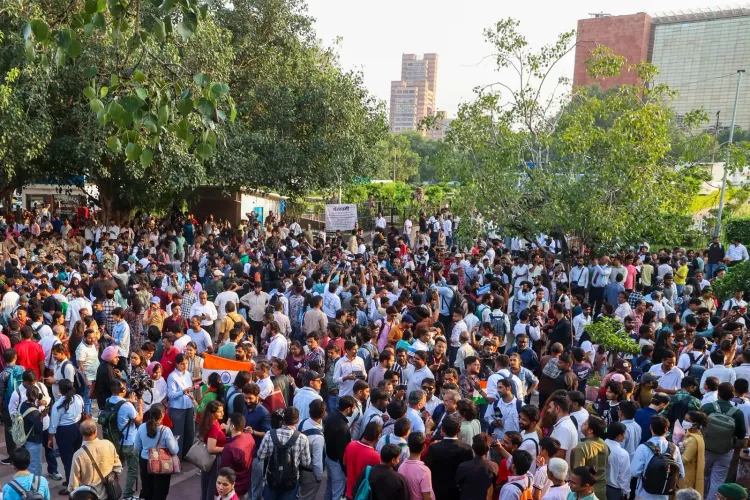
Bhim, the convener of Krantikari Yuva Sangathan (Revolutionary Youth Organization), provided an account of how resources and funds were mobilised for the July 20 rally, which he said snowballed into a national issue and resulted in a Union Minister's resignation. According to Bhim, the daily expenditure of the demonstration stood at approximately Rs 5 lakh. Without naming CJP founder Abhijeet Dipke directly, he reportedly indicated that most of the protesters were either Aam Aadmi Party (AAP) supporters or had connections with the party.
Mudita, spokesperson of Krantikari Yuva Sangathan, similarly backed the view that Bangladesh and Nepal-style operations were 'very much possible' in India.
Centre-Opposition Standoff
The sting comes against the backdrop of a charged political environment in which the Centre has accused Opposition-linked groups of orchestrating 'regime change' through anarchic means. The Opposition, for its part, has defended street protests as a 'rightful' democratic tool. The disclosures add a sharper edge to that debate. Notably, this is not the first time allegations of coordinated destabilisation have surfaced alongside major agitations. Whether the revelations prompt formal legal or investigative action remains to be seen, and the broader political implications are likely to unfold in the days ahead.
Point of View
By nature, a curated presentation — the selection of subjects, framing of questions, and editorial choices all shape what 'revelations' reach the viewer. That said, the on-camera statements, if authentic and unedited, raise substantive questions about whether organised networks are actively strategising for extra-constitutional disruption. What the sting does not settle — and what mainstream coverage tends to sidestep — is the chain of accountability: who funded the July 20 rally, whether those funders had knowledge of the alleged plan, and what law-enforcement agencies have done with prior intelligence. The Centre's political use of such material and the Opposition's reflexive dismissal both obscure the core question: is there a credible, verifiable threat to constitutional order, and if so, who bears responsibility for addressing it?
NationPress
3 Nov 2026
Frequently Asked Questions
What did the Times Now Navbharat sting operation reveal?
The sting captured leaders of Jamiat-Ulema-e-Hind and student outfits on camera allegedly endorsing Bangladesh and Nepal-style violent street movements to bring about regime change in India. It also disclosed that the July 20 Sansad Chalo March cost approximately Rs 5 lakh per day, with most participants reportedly linked to AAP.
Who is Maulana Siraj Khan and what did he say?
Maulana Siraj Khan is the Mumbai chief of Jamiat-Ulema-e-Hind. He was captured on camera reportedly stating that 'the day the Momin (believer) stands up, no one will be able to contain him,' which the channel characterised as backing violent means for regime change.
What is the alleged tactic involving women in protests?
According to the sting, MSF president Safwan described a strategy of placing women at the front of agitations to limit police action, arguing that a male police response to women creates a negative image for authorities. He said this approach was 'very much under consideration.'
What is the political context behind this sting operation?
The sting comes amid a charged Centre-Opposition standoff over an alleged regime change plot. The Centre has accused Opposition-linked groups of orchestrating destabilisation through anarchic street protests, while the Opposition has defended such protests as a democratic right.
What happens next after these disclosures?
Whether the sting prompts formal investigations or legal action has not been confirmed. The political and legal implications are likely to play out over the coming days, particularly given the ongoing Centre-Opposition confrontation over the regime change controversy.