Giriraj Singh hails two new space hubs approved for Gujarat, Tamil Nadu
Synopsis
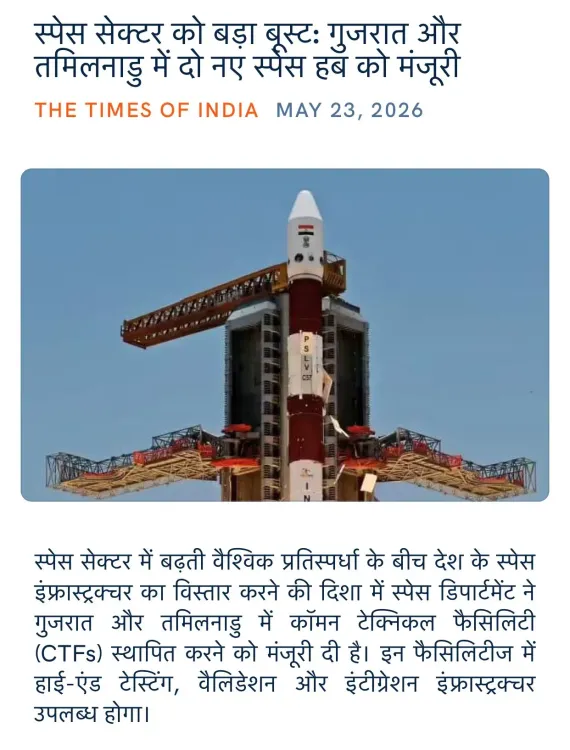
The Department of Space has approved two new space hubs in Gujarat and Tamil Nadu to manufacture rockets, payloads, and develop launch ecosystem capabilities, Union Textiles Minister Giriraj Singh announced on 23 May 2026, calling it a major boost to India's space sector.
Key Takeaways
The Department of Space has approved two new space hubs — one in Gujarat and one in Tamil Nadu .
The hubs are designed to build rockets, payloads, and launch ecosystem capabilities.
The approval aligns with the 2023 National Space Policy and the IN-SPACe framework established in 2020 .
ISRO is expected to coordinate alongside private-sector firms inducted under the liberalised space policy.
The move reflects India's strategy to geographically diversify space infrastructure beyond existing launch sites.
Next steps include land acquisition, construction timelines, and first operational launches from the new facilities.
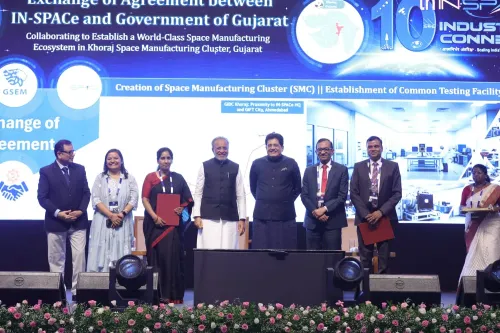
Union Textiles Minister Giriraj Singh on Saturday, 23 May 2026 shared news of a significant expansion in India's space infrastructure, highlighting the Department of Space's approval of two new space hubs — one each in Gujarat and Tamil Nadu — designed to build rockets, payloads, and a broader launch ecosystem.
Context
Posting via the NaMo App, Giriraj Singh described the development as a 'big boost' (bada boost) to the space sector, sharing the announcement with his followers. The two hubs, cleared by the Department of Space, are intended to strengthen India's capacity to manufacture launch vehicles and satellites while building out regional launch infrastructure. The move signals the central government's push to geographically diversify space activity beyond existing facilities.
Policy Backdrop
The approvals build on a sequence of policy reforms that began in 2020, when the government established IN-SPACe (Indian National Space Promotion and Authorisation Centre) to open the sector to non-governmental players. The 2023 National Space Policy went further, explicitly encouraging state-level infrastructure investment and private-sector participation in rocket manufacturing and launches. The selection of Gujarat and Tamil Nadu — both states with established industrial corridors and port connectivity — fits the framework's emphasis on building regional manufacturing clusters. ISRO is expected to play a coordinating role alongside private firms that have entered the sector under the liberalised regime.
Stakeholders and Impact
The two hubs are positioned to benefit a growing ecosystem of Indian private space companies that have been seeking dedicated manufacturing and testing facilities. Gujarat's hub is focused on rockets and payloads, while Tamil Nadu's facility is oriented toward developing launch ecosystem capabilities, according to the announcement. State governments in both states stand to gain in terms of investment inflows, skilled employment, and positioning within India's emerging space economy. Industry stakeholders have long argued that decentralised infrastructure is essential for India to raise its share of the global commercial space market, currently estimated at hundreds of billions of dollars.
What's Next
Attention will now turn to land acquisition, construction timelines, and the regulatory pathway for the first operational launches from these facilities. Parliamentary scrutiny — including questions on budget allocations for the Department of Space — is likely as the hubs move from approval to implementation. Analysts will also watch whether additional states submit proposals for similar hubs, given the competitive interest in hosting space infrastructure. The pace at which private players are formally inducted into the two new facilities will be an early indicator of whether the policy ambition translates into operational capacity.
Point of View
The government is effectively creating competitive regional poles that can attract private investment and reduce dependence on a single launch corridor. A senior minister from outside the space portfolio amplifying the announcement underscores how space has become a whole-of-government branding exercise, tightly linked to the ruling party's technology-and-growth narrative ahead of electoral cycles. The real test will be execution speed — India's space ambitions have historically outpaced ground-level infrastructure delivery.
NationPress
7 Oct 2026
Frequently Asked Questions
Where are the two new space hubs approved in India?
The two new space hubs have been approved in Gujarat and Tamil Nadu . The Gujarat hub focuses on rockets and payloads, while the Tamil Nadu hub is oriented toward developing launch ecosystem capabilities.
Which government body approved the new space hubs?
The Department of Space , the central government department overseeing India's civil space programme including ISRO, cleared the two new space hubs.
What is IN-SPACe and how does it relate to these hubs?
IN-SPACe (Indian National Space Promotion and Authorisation Centre) was established in 2020 to regulate and promote non-governmental participation in space activities. The new hubs are part of the broader infrastructure push enabled by IN-SPACe and the 2023 National Space Policy .
Why did Giriraj Singh, a Textiles Minister, post about space hubs?
As a senior BJP leader and Union Cabinet minister, Giriraj Singh regularly shares major government announcements across policy domains via social media platforms, including the NaMo App, even when they fall outside his direct portfolio.
What will the new space hubs in Gujarat and Tamil Nadu do?
The hubs are designed to manufacture rockets and payloads and build a launch ecosystem , supporting both public agencies like ISRO and private space companies entering the sector under India's liberalised space policy.