Is Global Interoperability Essential to Address AI Fragmentation Risks?

Synopsis
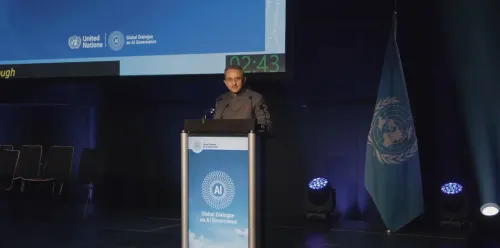
At the recent 'India AI Impact Summit 2026', UN Secretary-General Antonio Guterres raised alarms about the dangers of AI fragmentation. He called for global interoperability standards and science-led guardrails to ensure safe innovation. Guterres urged for a Global Fund to make AI accessible, emphasizing the importance of unity in tackling these challenges.
Key Takeaways
AI fragmentation poses significant risks to global cooperation.
Interoperability standards can facilitate safer and more effective innovation.
Science-led guardrails are essential for protecting rights and ensuring accountability.
The proposed Global Fund aims to democratize access to AI resources.
Reliable facts are crucial for informed policy-making in AI.
New Delhi, Feb 20 (NationPress) UN Secretary-General Antonio Guterres highlighted the risks of AI fragmentation during the ‘India AI Impact Summit 2026’, emphasizing the need for global interoperability standards to achieve better outcomes. Guterres expressed concerns about the challenges in international cooperation, stating, “Technological rivalry is escalating. Without a shared baseline, fragmentation prevails, leading to various regions and nations operating under conflicting policies and technical standards.”
In his address at the summit, he noted that establishing common testing protocols and risk measurement creates interoperability. “This allows a startup in New Delhi to scale globally with assurance, as shared benchmarks facilitate safe technological advancement,” he remarked.
Guterres also advocated for science-driven AI guardrails aimed at safeguarding individuals while fostering innovation. “By understanding the capabilities and limitations of AI systems, we can transition from rudimentary measures to more sophisticated, risk-based guardrails that protect human rights and autonomy,” he asserted.
The UN Secretary-General emphasized that these AI guardrails should inspire confidence and provide clarity for businesses, enabling rapid, positive innovation. “Governance based on scientific principles is not a hindrance to progress; it is a catalyst for solutions. It helps us identify where AI can be most beneficial and anticipates potential risks, enabling countries to prepare, protect, and invest in their populations,” he remarked.
With AI innovation advancing faster than our ability to comprehend or regulate it, Guterres argued that policy should not be based on speculation, hype, or misinformation. Instead, we require reliable facts that can be shared across nations and sectors.
He stressed the importance of making AI accessible to all. “However, without proper investment, numerous nations may find themselves excluded from the AI revolution. Therefore, I am advocating for a Global Fund on AI to facilitate skills development, data access, affordable computing resources, and the establishment of inclusive ecosystems worldwide,” he concluded.
Point of View
The insights from UN Secretary-General Antonio Guterres at the 'India AI Impact Summit 2026' are crucial. His emphasis on the importance of global cooperation and interoperability standards reflects a forward-thinking approach that seeks to unify efforts across nations. This call to action for equitable access to AI is a necessary step in ensuring that innovation benefits all, rather than leaving vulnerable nations behind.
NationPress
29 Sept 2026
Frequently Asked Questions
What are the risks of AI fragmentation?
AI fragmentation can lead to incompatible policies and technical standards across different regions, making international cooperation difficult and hindering innovation.
What did Guterres propose to mitigate these risks?
He proposed establishing global interoperability standards and science-led AI guardrails to ensure safe, equitable innovation.
What is the Global Fund on AI?
The Global Fund on AI is an initiative proposed by Guterres to provide resources for skills development, data access, and affordable computing power in order to create inclusive ecosystems worldwide.
Why is AI governance important?
Effective AI governance helps to protect human rights, uphold individual agency, and promote safe technological advancements.