CM Yogi Hails Ragauli as UP's First Zero-Poverty Panchayat
Synopsis
Ragauli Gram Panchayat in Jalaun, Bundelkhand, has become Uttar Pradesh's first Adarsh Panchayat to achieve Zero Poverty, lifting all residents above the poverty line. CM Yogi Adityanath's office announced the milestone on 25 July 2026, positioning Ragauli as a model for the state's 58,000-plus panchayats.
Key Takeaways
Ragauli Gram Panchayat in Jalaun district has been declared Uttar Pradesh's first Adarsh Panchayat to achieve the Zero Poverty goal.
The announcement was made by the Chief Minister's Office of Uttar Pradesh , quoting CM Yogi Adityanath , on 25 July 2026 .
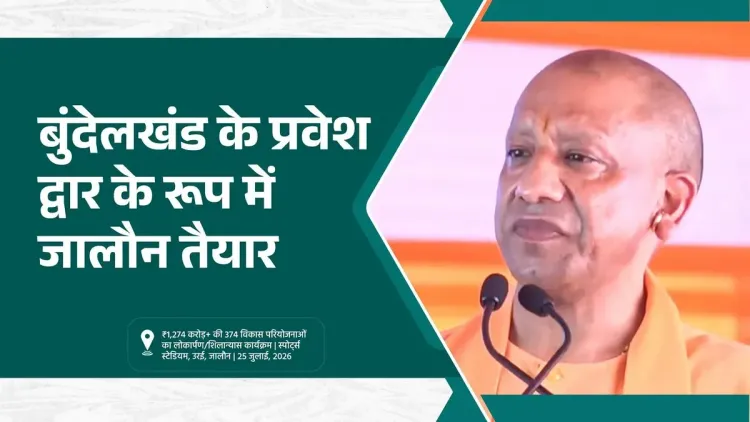
Jalaun is part of the historically under-developed Bundelkhand region, making the achievement especially significant.
The Adarsh Gram Panchayat framework, active since 2017 , converges housing, sanitation, and livelihood schemes to lift households above the poverty line.
The state has more than 58,000 gram panchayats , and Ragauli is intended to serve as a replicable model for others.
Independent verification of the specific poverty-line metrics and household count has not yet been publicly confirmed.
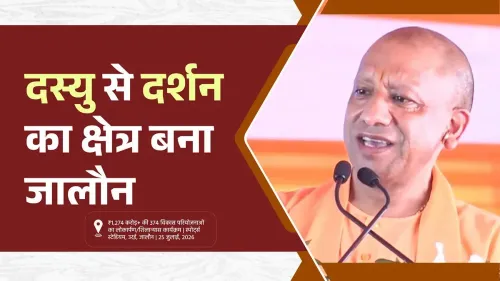
The Chief Minister's Office of Uttar Pradesh, citing Chief Minister Yogi Adityanath, announced on Saturday, 25 July 2026 that Ragauli Gram Panchayat in Jalaun district has become the state's first 'Adarsh Panchayat' (Model Panchayat) to fully achieve the 'Zero Poverty' goal, lifting all its residents above the poverty line.
Context
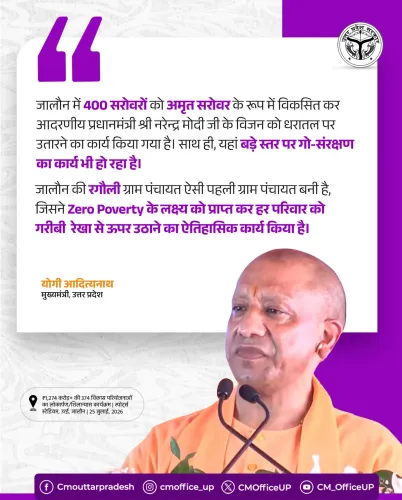
The Chief Minister's Office quoted CM Yogi Adityanath as saying: 'Jalaun ki Ragauli Gram Panchayat pehli Adarsh Panchayat hai, jisne Zero Poverty ke lakshya ko poora kar yahan ke logon ko garibi rekha se upar uthane ka karya kiya hai' — meaning, 'Ragauli Gram Panchayat of Jalaun is the first Adarsh Panchayat to have fulfilled the Zero Poverty goal and lifted its people above the poverty line.' The announcement positions Ragauli as a replicable benchmark for the state's more than 58,000 gram panchayats.
Jalaun is part of the historically under-developed Bundelkhand region of Uttar Pradesh, where agriculture-dependent rural communities have long faced economic vulnerability. Achieving zero poverty status in this region carries particular significance given Bundelkhand's track record of drought-related distress and migration.
Policy Backdrop
Since 2017, the Uttar Pradesh government has pursued gram panchayat-level poverty alleviation through the convergence of central and state welfare schemes spanning housing, sanitation, and livelihood support. The 'Adarsh Gram Panchayat' framework incentivises local bodies to meet outcome targets across these dimensions, with model villages then held up as examples for others to follow.
This approach mirrors national multidimensional poverty reduction efforts that rely on local self-governance bodies for last-mile delivery of entitlements. The focus on measurable outcomes — such as lifting every household above the official poverty line — reflects a shift from input-based to result-based rural development governance in the state.
Stakeholders and Impact
The immediate beneficiaries are the rural households of Ragauli Gram Panchayat whose members have been brought above the poverty line through the convergence of welfare schemes. Gram panchayat elected representatives and frontline functionaries across Uttar Pradesh are the secondary audience, as the state government signals that replication of the Ragauli model is a policy priority.
For the broader rural poor across Uttar Pradesh, the announcement sets a public benchmark. If the model is formally scaled, it could direct additional administrative attention and scheme resources toward panchayats that are close to achieving zero-poverty status, accelerating outcomes in similarly placed villages.
What's Next
The key question is whether the state will issue formal directives to scale the zero-poverty framework to additional gram panchayats, and how 'zero poverty' will be defined and independently verified in that process. Updates to Uttar Pradesh's poverty-line surveys and panchayat performance rankings will indicate whether Ragauli's achievement is institutionalised into a replicable state programme or remains a one-off milestone.
The announcement also sets the stage for CM Yogi Adityanath's government to use Ragauli as a centrepiece of its rural welfare narrative ahead of future electoral cycles, with Bundelkhand — a politically contested region — as the backdrop.
Point of View
The administration targets a region that has historically lagged on development indicators and carries electoral weight. The 'Zero Poverty' framing elevates the political stakes: it transforms a welfare metric into a governance brand that can be replicated or contested. How rigorously the poverty-line threshold is defined and audited will determine whether this becomes a durable policy template or a symbolic milestone.
NationPress
24 Oct 2026
Frequently Asked Questions
What is the Zero Poverty scheme in Uttar Pradesh?
The Zero Poverty initiative in Uttar Pradesh aims to lift every household in a gram panchayat above the official poverty line by converging central and state welfare schemes covering housing, sanitation, and livelihood support. Ragauli Gram Panchayat in Jalaun has become the first to be declared fully successful under this framework.
Which is UP's first zero poverty gram panchayat?
Ragauli Gram Panchayat in Jalaun district, located in the Bundelkhand region of Uttar Pradesh, has been declared the state's first Adarsh Panchayat to achieve the Zero Poverty goal, according to an announcement by CM Yogi Adityanath's office on 25 July 2026.
What is an Adarsh Gram Panchayat in Uttar Pradesh?
An Adarsh Gram Panchayat, or Model Gram Panchayat, in Uttar Pradesh is a local body that meets government-defined outcome targets in areas such as housing, sanitation, employment, and poverty reduction. These villages are highlighted by the state government as examples for other panchayats to emulate.
Where is Jalaun district located?
Jalaun is a district in the Bundelkhand region of Uttar Pradesh, characterised by a predominantly rural, agriculture-based economy. The region has historically faced challenges including drought and economic migration.
How many gram panchayats are there in Uttar Pradesh?
Uttar Pradesh has more than 58,000 gram panchayats. The state government is using Ragauli's Zero Poverty achievement as a model it hopes to replicate across these local bodies.