US AI curbs on Anthropic models make case for India's sovereign AI: Tejasvi Surya
Synopsis
The US government's overnight suspension of foreign access to Anthropic's Fable 5 and Mythos 5 AI models — with zero notice — has handed Indian sovereignty advocates a live case study. BJP MP Tejasvi Surya says no policy debate could have made the argument for indigenous AI more powerfully than this single directive did.
Key Takeaways
The US government issued an export control directive suspending all foreign national access to Anthropic's Fable 5 and Mythos 5 AI models, citing national security.
BJP Yuva Morcha President and Bengaluru South MP Tejasvi Surya cited the move as proof that India must build its own sovereign AI capability.
Surya described the suspension as happening 'overnight, without notice' — highlighting the unilateral risk of foreign AI dependence.
Anthropic confirmed it disabled both models for all customers to ensure compliance, while saying it believes the directive is 'a misunderstanding' and is working to restore access.
Access to all other Claude models was stated to be unaffected by the directive.
The episode intensifies the national debate around IndiaAI Mission and domestic frontier model development.
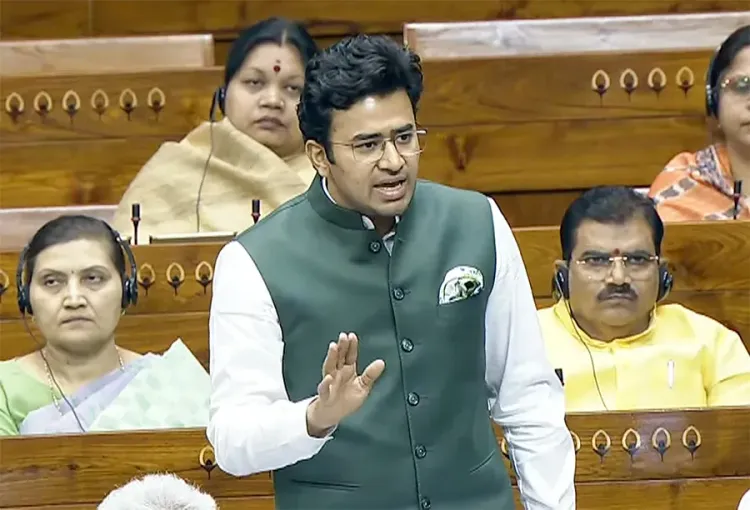
Bharatiya Janata Party (BJP) Yuva Morcha President and Bengaluru South MP Tejasvi Surya on Saturday, 13 June called for accelerated development of India's own sovereign artificial intelligence capabilities, citing the United States government's abrupt suspension of foreign nationals' access to Anthropic's most advanced AI models on national security grounds.
What Triggered the Remarks
The US government, invoking national security authorities, issued an export control directive suspending all access to Anthropic's Fable 5 and Mythos 5 models for any foreign national — whether inside or outside the United States, including foreign national Anthropic employees. In a statement, Anthropic confirmed: 'The net effect of this order is that we must abruptly disable Fable 5 and Mythos 5 for all our customers to ensure compliance. Access to all other Claude models is not affected. We apologise for this disruption to our customers. We believe this is a misunderstanding and are working to restore access as soon as possible.'
Surya's Position on Technological Sovereignty
Reacting to the development, Surya described the move as 'a stark reminder of the risks associated with dependence on foreign technology platforms.' He said the US had suspended access to its most advanced AI models 'overnight, without notice' for every foreign national on earth — a phrase that underscores the unilateral, non-negotiable nature of such restrictions.
'For a country of India's civilisational weight and geostrategic position, with its own unique security challenges, there is simply no alternative to building sovereign AI capability,' Surya said. He further argued that the episode 'makes that clearer than any policy argument ever could.'
Why This Matters for India
The incident highlights a structural vulnerability in countries that rely heavily on foreign-controlled AI infrastructure. For India — which has been scaling up AI adoption across defence, governance, and industry — the sudden inaccessibility of frontier models demonstrates the geopolitical risk embedded in technological dependence. This comes amid growing global debate on AI sovereignty, data security, and strategic self-reliance, as governments increasingly classify advanced AI systems as critical national assets.
Notably, India has made initial strides toward AI self-sufficiency through initiatives such as the IndiaAI Mission, but frontier model development at the level of Fable 5 or Mythos 5 remains a work in progress. The US action adds urgency to those efforts.
Broader Context
The US government's use of export control authority to restrict AI model access marks a significant escalation in the weaponisation of technology policy. It is the first known instance of a government invoking national security law to cut off a frontier AI model from all foreign users simultaneously. Anthropic indicated it is working to restore access, suggesting the directive may be contested or clarified, but the episode has already demonstrated how quickly access to critical AI infrastructure can be severed. For policymakers in New Delhi, the episode is likely to reinforce arguments for domestic compute capacity, indigenous large language model development, and reduced dependence on US-headquartered AI platforms.
Point of View
Not a right — one that can be revoked overnight by a foreign government. India's IndiaAI Mission has allocated compute and funding, but the country has no frontier model of its own that could substitute for Fable 5 or Mythos 5 in a crisis. The gap between India's AI ambition and its AI reality has never looked wider. The question is whether this episode accelerates serious investment in indigenous model development or remains another talking point in a debate that has so far produced more announcements than capabilities.
NationPress
15 Sept 2026
Frequently Asked Questions
Why did the US suspend access to Anthropic's AI models for foreign nationals?
The US government invoked national security authorities to issue an export control directive suspending all foreign national access to Anthropic's Fable 5 and Mythos 5 models. Anthropic said it believes the order is a misunderstanding and is working to restore access, but complied immediately to ensure legal compliance.
What did Tejasvi Surya say about the US AI restrictions?
Tejasvi Surya, BJP Yuva Morcha President and Bengaluru South MP, said the move underscores that India cannot afford to depend on foreign-controlled AI infrastructure. He argued that for a country of India's strategic and civilisational importance, building sovereign AI capability is the only viable path forward.
Which Anthropic AI models were suspended?
The models suspended under the US directive are Fable 5 and Mythos 5. Anthropic confirmed that access to all other Claude models remains unaffected by the order.
What is India's current position on sovereign AI development?
India has launched the IndiaAI Mission to build domestic AI infrastructure, including compute capacity. However, the country does not yet have a frontier AI model comparable to the models suspended by the US directive, making the case for accelerated indigenous development more urgent.
Why does foreign AI dependence pose a risk to India?
As the Anthropic episode illustrates, a foreign government can unilaterally cut off access to critical AI systems overnight without prior notice. For a country using AI in defence, governance, and industry, such a disruption could have serious operational and security consequences.