Uttarakhand CMO expands education in remote hill districts
Synopsis
The Uttarakhand Chief Minister's Office announced on 9 August 2026 that the state is expanding education facilities in remote, difficult-terrain districts, with Champawat highlighted as a key focus — addressing a long-standing access gap in the state's mountainous hinterland.
Key Takeaways
The Uttarakhand CMO announced on 9 August 2026 that the state government is expanding education facilities in remote and difficult-terrain districts.
Champawat district, a remote area in the Kumaon division bordering Nepal, was specifically named in the post.
Uttarakhand's mountainous geography has historically made uniform school access difficult, with scattered settlements and seasonal road closures compounding the problem.
Reducing student dropout rates linked to seasonal family migration is a key driver behind education infrastructure expansion in hill districts.
Specific project budgets, timelines, and schemes have not been detailed in the announcement.
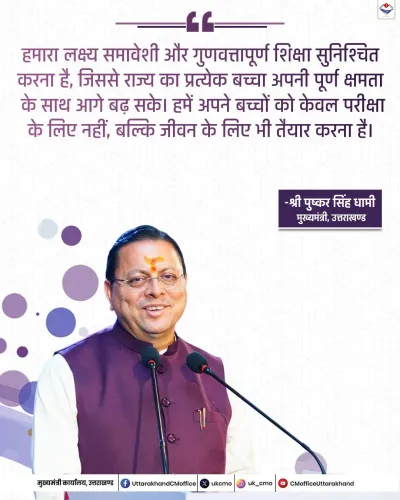
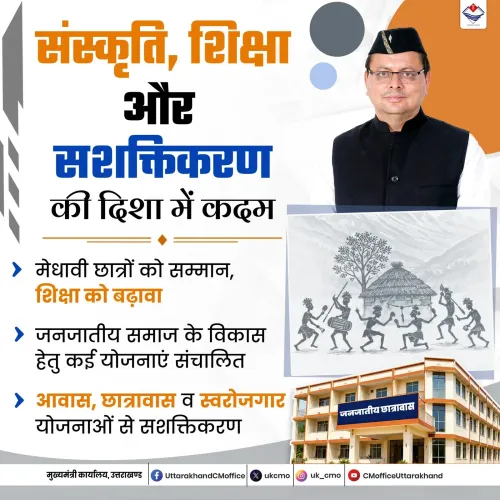
In the high-altitude folds of Uttarakhand, where roads thin out and settlements scatter across steep ridgelines, the state government is pushing to bring schooling closer to children who have long had to travel the farthest to reach it. The Chief Minister's Office of Uttarakhand announced on Sunday, 9 August 2026 that the state is actively expanding education facilities in its most inaccessible regions, with Champawat district named as a focus area.
Champawat and the geography of educational disadvantage
Champawat, tucked in the Kumaon division along the Nepal border, is among Uttarakhand's more remote districts — a patchwork of forested ridges and small villages where delivering any public service demands extra effort. For decades, children in such terrain have faced a stark choice: walk long distances to the nearest school or quietly drop out. The state government's post, reading 'durgam kshetron mein shiksha suvidhaon ka vistar' ('expansion of education facilities in remote areas'), signals an intent to close that gap.
A long-standing infrastructure deficit in mountain schooling
Uttarakhand's mountainous geography has historically made uniform school access difficult. Scattered settlements, seasonal road closures, and the challenge of retaining teachers in remote postings have together kept enrolment and retention rates under pressure across hilly districts. Successive state governments have responded by prioritising the physical expansion of school buildings and facilities — a pattern the current administration appears to be continuing and amplifying.
Reducing dropout rates tied to migration is a particularly urgent goal: when families move seasonally to lower-altitude towns, children often leave school mid-year, compounding learning gaps. Bringing facilities closer to where children actually live is the most direct intervention available.
What the expansion could mean for hill communities
The announcement does not specify project budgets or timelines — details the research block flags as unverified — but the directional commitment is clear. Analysts watching Uttarakhand's social sector note that meaningful progress in remote education typically requires a combination of new school infrastructure, guaranteed teacher postings, and, in some cases, transport or residential support for students. Whether all three are in play here will become clearer as implementation details emerge.
For communities in Champawat and similarly placed districts, the stakes are straightforward: a school within reach is the difference between a child who completes her education and one who doesn't.
The mountain classroom has always been the hardest one to build — and the most consequential one to get right.
Point of View
Where development deficits have historically driven out-migration. The real test will be whether this round of expansion pairs physical infrastructure with teacher retention — the persistent weak link in previous efforts. Until implementation specifics are public, the announcement is best read as a directional commitment rather than a completed programme.
NationPress
9 Aug 2026
Frequently Asked Questions
Which district in Uttarakhand is the government focusing on for education expansion?
Champawat district has been specifically named by the Uttarakhand CMO as a focus area for the expansion of education facilities in remote regions.
Why is education access difficult in remote Uttarakhand districts?
Uttarakhand's steep terrain, scattered hill settlements, seasonal road closures, and difficulty retaining teachers in remote postings have long made it hard to deliver consistent schooling across mountainous districts like Champawat .
What did the Uttarakhand Chief Minister's Office announce on 9 August 2026?
The Uttarakhand CMO announced that the state government is expanding education facilities in its most inaccessible and remote areas, with an emphasis on hilly districts including Champawat .
How does poor school access affect children in Uttarakhand's hill districts?
Children in remote Uttarakhand districts often face long distances to the nearest school, and those from families that migrate seasonally to lower-altitude towns frequently drop out mid-year, compounding long-term learning gaps.
What is needed beyond building schools to improve education in Uttarakhand's mountains?
Experts note that physical infrastructure alone is insufficient — guaranteed teacher postings in remote areas and, in some cases, student transport or residential support are also critical to reducing dropout rates in hill districts.