Uttarakhand declared fully literate under ULLAS programme
Synopsis
Uttarakhand was declared a 'Poorna Sakshara Rajya' on 8 July 2026 under the ULLAS-Nav Bharat Saksharta Programme. Union Education Minister Prahlad Joshi praised CM Pushkar Singh Dhami's leadership, calling the state an inspiration for others despite its challenging Himalayan terrain.
Key Takeaways
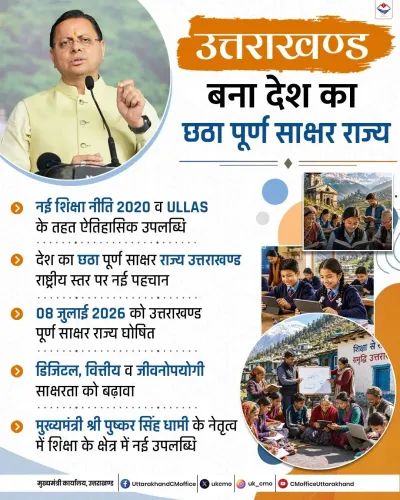
Uttarakhand was declared a fully literate state on 8 July 2026 under the ULLAS-Nav Bharat Saksharta Programme .
Union Education Minister Prahlad Joshi sent a formal congratulatory letter to Chief Minister Pushkar Singh Dhami crediting his 'visionary leadership.' The ULLAS programme , launched around 2022-23, targets adults excluded from formal schooling, providing foundational literacy, life skills, and digital competence.
The achievement is seen as particularly significant given Uttarakhand's difficult Himalayan geography and dispersed population.
CM Dhami stated the state's goal extends beyond literacy to digital literacy, quality education, and lifelong learning for every citizen.
Minister Joshi expressed confidence the milestone will inspire other states and Union Territories to accelerate their own ULLAS-linked literacy drives.
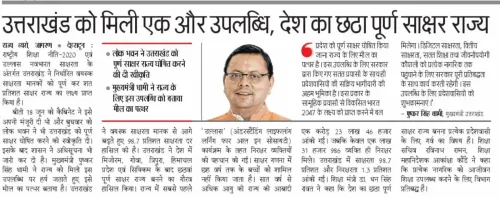
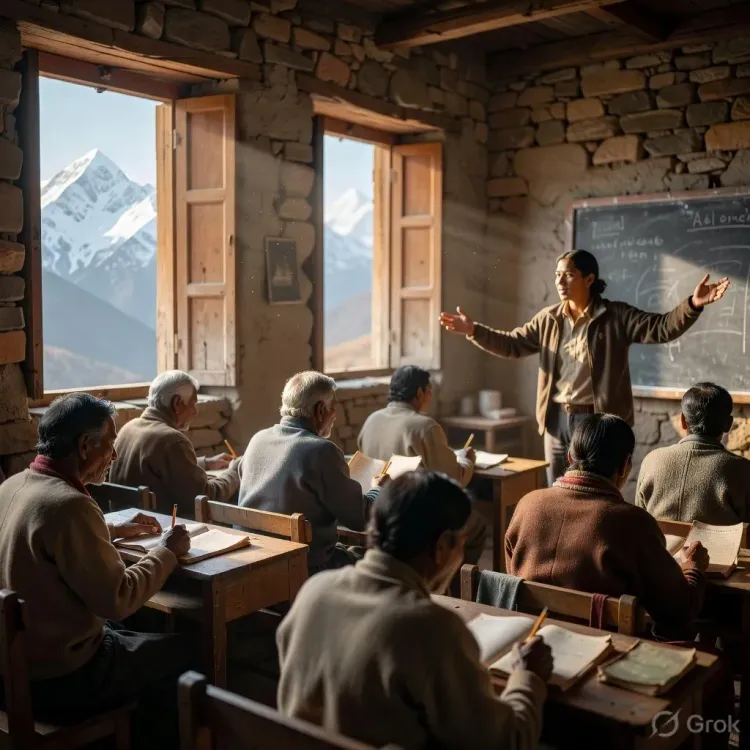
Despite some of India's most forbidding mountain terrain, Uttarakhand has crossed a milestone that eluded it for decades — the state was declared a 'Poorna Sakshara Rajya' (Fully Literate State) on 8 July 2026 under the Centre's ULLAS-Nav Bharat Saksharta Programme. Union Education Minister Prahlad Joshi formally conveyed the recognition in a congratulatory letter to Chief Minister Pushkar Singh Dhami, calling it an inspiration for every other state and Union Territory in the country.
What the Union Education Minister's letter said
In his letter, Minister Joshi credited the achievement to Dhami's 'visionary leadership, administrative commitment, and the collective efforts of the people of Uttarakhand.' He specifically noted that the state had set 'an inspiring example before the nation' by achieving full literacy despite difficult geographical conditions — a pointed acknowledgement that reaching remote Himalayan villages demands far more than a standard literacy drive.
The minister drew a clear distinction between two complementary pillars of India's education architecture: Samagra Shiksha, which strengthens school education from early childhood through Class 12, and the ULLAS programme, which targets adults who were left out of formal schooling — equipping them with foundational literacy, life skills, and digital competence. Both, he argued, must work in tandem for genuine educational equity.
ULLAS and the NEP 2020 connection
The ULLAS-Nav Bharat Saksharta Programme was launched by the Ministry of Education around 2022-23 as the principal vehicle for adult education under the National Education Policy 2020. NEP 2020 had explicitly mandated foundational literacy, numeracy, and adult learning as national priorities — a recognition that school enrolment alone cannot close India's literacy gap when millions of adults were already outside the system.
Uttarakhand's declaration continues a pattern of state-wise full-literacy milestones under successive central missions, now consolidated under ULLAS. What makes this one notable is geography: a Himalayan state with dispersed hill communities, seasonal road closures, and a large migrant population presents logistical challenges that flatland states simply do not face.
CM Dhami's response and the state's next ambition
Chief Minister Dhami accepted the recognition with a clear statement of what comes next. Thanking Minister Joshi, he said the achievement was 'a matter of pride' for the state and credited 'the collective commitment and public participation of the state government, education department officials, teachers, volunteers, and the people of Uttarakhand.'
Crucially, Dhami set a higher bar: the state government's goal, he said, is not to stop at literacy but to ensure every citizen has access to quality education, digital literacy, and lifelong learning opportunities. That framing — from basic literacy to digital and vocational empowerment — aligns directly with NEP 2020's vision and signals that Uttarakhand intends to use this milestone as a launchpad, not a finish line.
Minister Joshi echoed the same ambition, expressing confidence that Uttarakhand's role in advancing NEP 2020's objectives through continuing education, life skills, and vocational training would be significant — and that the state's example would push other states to accelerate their own inclusive literacy efforts.
Point of View
And it reinforces the Centre's ULLAS framework as a credible delivery mechanism. The emphasis on digital literacy and vocational training in both leaders' statements signals that the literacy mission is being deliberately repositioned as an economic-empowerment story, not just a social-welfare one — a framing that carries weight in a state with high out-migration and a growing services economy.
NationPress
26 Sept 2026
Frequently Asked Questions
When was Uttarakhand declared a fully literate state?
Uttarakhand was declared a fully literate state on 8 July 2026 under the ULLAS-Nav Bharat Saksharta Programme.
What is the ULLAS-Nav Bharat Saksharta Programme?
The ULLAS-Nav Bharat Saksharta Programme is a central government scheme launched around 2022-23 under the Ministry of Education to provide foundational literacy, life skills, and digital competence to adults who were excluded from formal schooling. It is a key pillar of the National Education Policy 2020.
Who congratulated Uttarakhand on achieving full literacy?
Union Education Minister Prahlad Joshi sent a formal congratulatory letter to Chief Minister Pushkar Singh Dhami , praising his leadership and the collective efforts of the state's people.
What makes Uttarakhand's literacy achievement significant?
Uttarakhand's difficult Himalayan terrain, dispersed hill communities, and seasonal road closures make achieving full literacy far more challenging than in flatland states, which is why Union Education Minister Joshi specifically highlighted it as 'an inspiring example before the nation.'
What is Uttarakhand's next goal after achieving full literacy?
Chief Minister Pushkar Singh Dhami stated that the state's goal goes beyond basic literacy — it aims to provide every citizen with access to quality education, digital literacy, and lifelong learning opportunities , aligned with NEP 2020 objectives.