Uttarakhand becomes India's 6th fully literate state under ULLAS
Synopsis
Uttarakhand has become India's sixth fully literate state under NEP 2020 and the ULLAS adult literacy programme. Governor's approval was granted on 8 July 2026. CM Pushkar Singh Dhami called it a milestone, pledging to extend digital and financial literacy to all citizens as part of the Viksit Bharat 2047 vision.
Key Takeaways
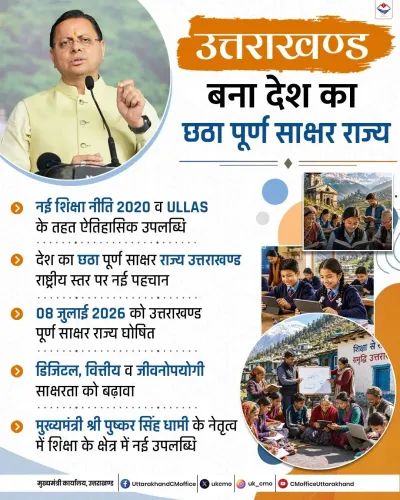
Uttarakhand was officially declared India's sixth fully literate state on 8 July 2026 after meeting all benchmarks set by the Ministry of Education.
The achievement falls under the ULLAS (Nav Bharat Saaksharta Karyakram) programme and New Education Policy 2020 , targeting adults aged 15 and above.
The five states that achieved full literacy status before Uttarakhand are Mizoram, Goa, Tripura, Himachal Pradesh, and Sikkim .
The Governor of Uttarakhand granted formal approval to declare the state fully literate on 8 July 2026 .
CM Pushkar Singh Dhami credited both government efforts and active public participation, linking the achievement to the Viksit Bharat 2047 goal.
The state has committed to expanding digital literacy, financial literacy, and vocational skills as the next phase of its education agenda.
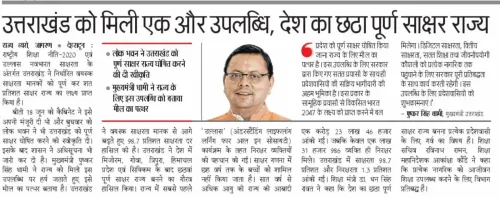
The Chief Minister's Office of Uttarakhand announced on 8 July 2026 that the state has achieved the status of India's sixth fully literate state under the New Education Policy 2020 and the ULLAS (Understanding of Lifelong Learning for All in Society) Nav Bharat Saaksharta Karyakram, marking a landmark in the state's education history. The Governor of Uttarakhand granted formal approval to declare the state fully literate on 8 July 2026, after the state met all literacy benchmarks set by the Department of School Education and Literacy, Ministry of Education, Government of India.
Context
The official post, written in Hindi, states: 'Uttarakhand ne shiksha ke kshetra mein ek aitihasik uplabdhi arjit karte hue' ('Uttarakhand has achieved a historic milestone in the field of education'), becoming the sixth state in the country to attain full literacy status. The state joins Mizoram, Goa, Tripura, Himachal Pradesh, and Sikkim — all of which had previously achieved this distinction under the same national standards. The achievement covers adult literacy targets aligned with prescribed benchmarks under the ULLAS programme, which targets citizens aged 15 years and above.
Policy Backdrop
The ULLAS programme is a central initiative under the Ministry of Education, designed to advance lifelong learning and functional literacy among adults as part of the broader NEP 2020 framework approved by the Union Cabinet in July 2020. It builds on earlier efforts such as the Saakshar Bharat Mission launched in 2009, which targeted rural and backward regions. The current programme expands the definition of literacy beyond reading and writing to include digital literacy, financial literacy, and vocational life skills — all identified as pillars of the Viksit Bharat 2047 roadmap.
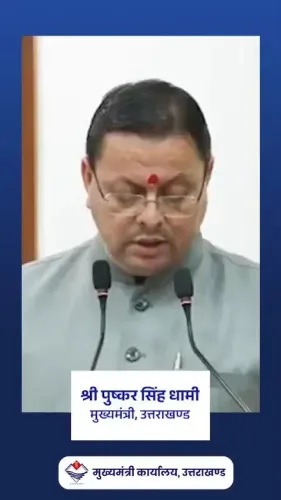
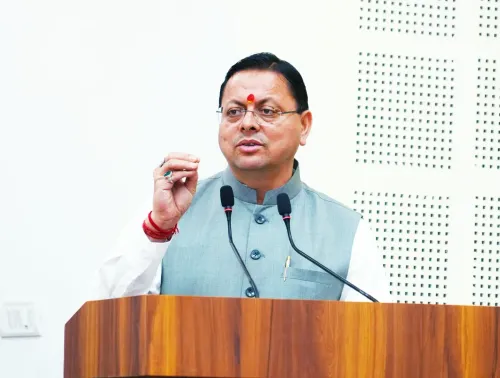
Chief Minister Pushkar Singh Dhami stated that this achievement is 'a milestone for the state,' crediting both sustained government efforts and the active participation of the people of Uttarakhand. He added that such collective efforts will strengthen the goal of achieving a Viksit Bharat by 2047, and that the government will continue working with full commitment to extend digital literacy, financial literacy, continuing education, and life-useful skills to every citizen.
Stakeholders and Impact
The declaration directly benefits adult learners across Uttarakhand's urban and rural populations, particularly in remote Himalayan districts where access to formal education has historically been limited. State education departments, local volunteers, and community-level literacy workers are among the key implementers who drove enrolment and assessment under the ULLAS framework. The achievement also positions Uttarakhand as a model among Himalayan states, where geographic challenges make literacy outreach particularly demanding.
The recognition carries implications for central funding allocations and the state's ranking in national education indices. Citizens who gained literacy through the programme gain improved access to digital government services, banking, and skill-development portals — outcomes aligned with the Centre's broader inclusion agenda.
What's Next
With the full literacy benchmark now met, the state government has signalled a pivot toward second-generation literacy goals — digital, financial, and vocational skills — for every citizen. The Ministry of Education is expected to monitor the rollout of these modules across remaining states still working toward full literacy under ULLAS. Uttarakhand's model of community participation and government coordination may serve as a reference point for states yet to achieve the milestone.
Point of View
With active state-level administration — are outpacing larger plains states in meeting NEP 2020's foundational targets. For CM Dhami, the milestone arrives as a significant political dividend, demonstrating tangible governance outcomes ahead of any future electoral cycle. The pivot toward digital and financial literacy signals that the state is positioning itself beyond basic benchmarks, aligning with the Centre's Viksit Bharat 2047 framework in a way that could attract additional central programme funding. The broader question is whether this momentum translates into measurable improvements in learning outcomes and economic participation, or remains a certification milestone.
NationPress
7 Oct 2026
Frequently Asked Questions
Which is the sixth fully literate state in India?
Uttarakhand became India's sixth fully literate state on 8 July 2026, joining Mizoram, Goa, Tripura, Himachal Pradesh, and Sikkim, which had achieved the status earlier.
What is the ULLAS programme in India?
ULLAS stands for 'Understanding of Lifelong Learning for All in Society.' It is a central adult literacy programme under the Ministry of Education, targeting citizens aged 15 and above, implemented as part of the New Education Policy 2020.
What does full literacy status mean for a state in India?
Full literacy status means the state has met all adult literacy benchmarks prescribed by the Department of School Education and Literacy under the Ministry of Education, covering functional reading, writing, and numeracy skills for the adult population.
What did CM Pushkar Singh Dhami say about Uttarakhand's literacy achievement?
CM Pushkar Singh Dhami called it 'a milestone for the state,' crediting sustained government efforts and active public participation, and pledged to extend digital literacy, financial literacy, and vocational skills to every citizen as part of the Viksit Bharat 2047 goal.
Which states in India have achieved full literacy status before Uttarakhand?
Five states achieved full literacy status before Uttarakhand: Mizoram, Goa, Tripura, Himachal Pradesh, and Sikkim.