CM Dhami flags temple revival, dams and AIIMS heli-ambulance push

Synopsis
Uttarakhand CM Pushkar Singh Dhami on 8 June 2026 outlined progress on Kedarnath-Badrinath redevelopment, the Manaskhand Mandir Mala Mission, three multipurpose dam projects, an AIIMS satellite centre at Kichha, and India's first heli-ambulance service at AIIMS Rishikesh, framing them within the Viksit Bharat 2047 vision.
Key Takeaways
The Kedarnath and Badrinath Dham redevelopment projects and the Manaskhand Mandir Mala Mission are identified as flagship temple-revival initiatives in Uttarakhand.
Work is under way on the Jamrani , Saung , and Lakhwar multipurpose projects with central government support, targeting irrigation, drinking water, and energy.
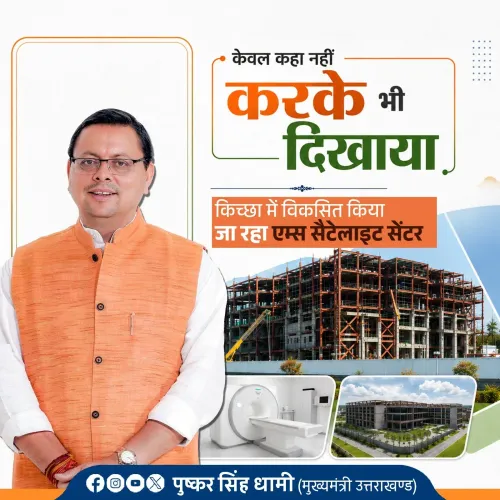
An AIIMS satellite centre at Kichha has been reported as commenced, aimed at extending tertiary healthcare to the Terai belt.
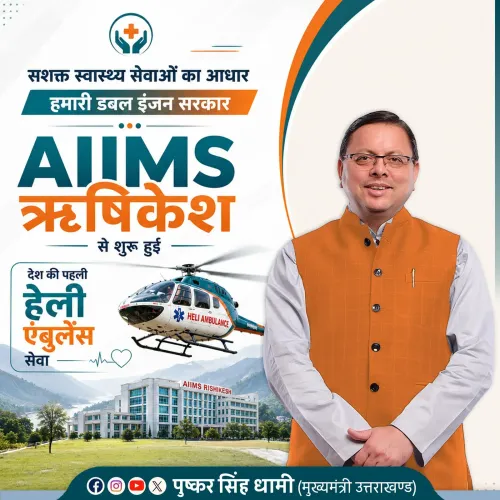
AIIMS Rishikesh has launched what is described as the country's first heli-ambulance service for emergency healthcare in difficult terrain.
The Chief Minister framed all initiatives within the Viksit Bharat 2047 national development goal, calling for citizen participation in the transformation journey.
The Chief Minister's Office of Uttarakhand on Monday, 8 June 2026, outlined a sweeping development agenda for the state, citing progress on ancient temple restoration, three multipurpose dam projects, an AIIMS satellite centre at Kichha, and the launch of the country's first heli-ambulance service at AIIMS Rishikesh.
Context
The post, attributed to Chief Minister Pushkar Singh Dhami, states that alongside the Char Dham pilgrimage sites, the revival and redevelopment of Uttarakhand's ancient temples is being given priority. It cites the Kedarnath and Badrinath Dham redevelopment projects and the Manaskhand Mandir Mala Mission as 'outstanding examples' (utkrish udaharan) of this effort. The Manaskhand mission focuses on restoring heritage temples in the Kumaon region of the state.
The Chief Minister is also quoted as saying that work is under way on the Jamrani, Saung, and Lakhwar multipurpose projects with central government support, which are expected to deliver long-term benefits in irrigation, drinking water, and energy.
Policy Backdrop
The Kedarnath reconstruction drive gained momentum after the catastrophic 2013 flash floods, with coordinated central and state funding channelled into rebuilding the temple town and its approach infrastructure. The Badrinath redevelopment is part of a broader effort to modernise facilities at the Char Dham sites, which together draw millions of pilgrims annually. The Char Dham all-weather road project, approved by the central government in 2016, underpins much of this connectivity push.
The Lakhwar multipurpose dam on the Yamuna is a long-planned project intended to serve irrigation, drinking water, and hydropower needs across the upper basin. AIIMS Rishikesh, sanctioned in 2006 and operationalised from 2012 under the Pradhan Mantri Swasthya Suraksha Yojana, has become the state's flagship tertiary healthcare institution. The satellite centre at Kichha in the Terai belt is intended to extend that reach to a denser, more accessible population corridor.
Stakeholders and Impact
Pilgrims visiting the Char Dham circuit and the Kumaon temple clusters stand to benefit from improved facilities and access roads. Hill farmers and rural households in the catchment areas of Jamrani, Saung, and Lakhwar are the primary beneficiaries of the irrigation and drinking-water components of those projects. Emergency patients across Uttarakhand's mountainous terrain — where road evacuations can take hours — are the direct target group for the heli-ambulance service described as the country's first, based at AIIMS Rishikesh.
The AIIMS Kichha satellite centre is expected to ease the burden on the main Rishikesh campus and bring specialist care closer to the densely populated Udham Singh Nagar district.
What's Next
The Chief Minister linked all these initiatives to the national Viksit Bharat 2047 goal, calling on every citizen of Uttarakhand to become an 'active participant in this journey of transformation' (is parivartan yatra ka sakriya sahbhagi). He said that under the Prime Minister's 'visionary leadership,' India can become a developed, self-reliant nation that guides the world by 2047.
Upcoming state and central budget cycles will be closely watched for funding releases tied to the three dam projects and the Manaskhand mission. Whether the heli-ambulance model is extended to other hill districts — a possibility flagged by health administrators — will be a key indicator of how seriously the state pursues emergency-care equity in its most remote areas.
Point of View
Water infrastructure, and health access into a single Viksit Bharat 2047 narrative, a framing that has become standard for BJP-governed states seeking to align state-level delivery with the central government's long-horizon brand. The pairing of temple redevelopment with dam construction and AIIMS expansion is deliberate: it signals to both the state's pilgrimage economy and its agrarian and healthcare constituencies simultaneously. The heli-ambulance announcement, if operationally sustained, could be a genuine differentiator for Uttarakhand given the lethal delays in mountain evacuations. The real test will come in the next budget cycle, when funding tranches for Lakhwar and the Manaskhand mission will reveal whether the political narrative is matched by fiscal commitment.
NationPress
24 Oct 2026
Frequently Asked Questions
What is the Manaskhand Mandir Mala Mission in Uttarakhand?
The Manaskhand Mandir Mala Mission is an Uttarakhand state initiative focused on the restoration and promotion of ancient temples in the Kumaon region, positioning them as heritage pilgrimage destinations alongside the Char Dham circuit.
What is the Lakhwar multipurpose project?
The Lakhwar multipurpose project is a long-planned dam on the Yamuna river in Uttarakhand, designed to provide irrigation water, drinking water, and hydropower to the upper basin region, being developed with central government support.
Where is the new AIIMS satellite centre in Uttarakhand?
The AIIMS satellite centre is being set up at Kichha in Udham Singh Nagar district in the Terai belt of Uttarakhand, intended to extend the reach of AIIMS Rishikesh to a more accessible and densely populated corridor.
What is the heli-ambulance service at AIIMS Rishikesh?
The heli-ambulance service at AIIMS Rishikesh is described as India's first such emergency medical service, designed to airlift critically ill or injured patients from remote Himalayan areas where road evacuation is slow or impossible.
What is Viksit Bharat 2047 and how does Uttarakhand fit in?
Viksit Bharat 2047 is the central government's vision to make India a developed, self-reliant nation by the centenary of its independence. Uttarakhand's CM has framed the state's temple, dam, and healthcare projects as direct contributions to this national goal.