CM Dhami launches India's first heli-ambulance from AIIMS Rishikesh
Synopsis
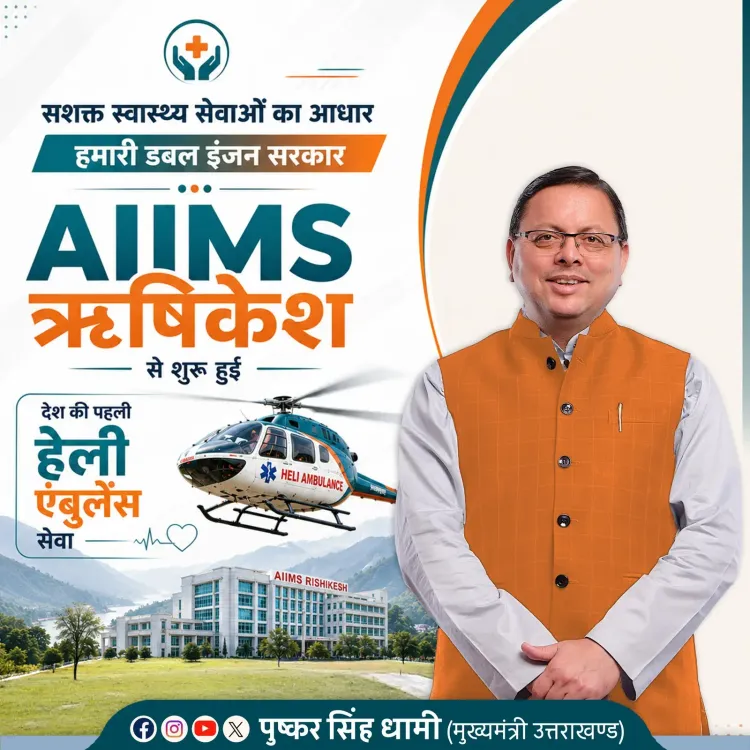
Uttarakhand CM Pushkar Singh Dhami announced the launch of India's first heli-ambulance service from AIIMS Rishikesh on 31 July 2026, aimed at delivering emergency healthcare to remote and mountainous regions of the state.
Key Takeaways
India's first heli-ambulance service was launched from AIIMS Rishikesh on 31 July 2026 .
CM Pushkar Singh Dhami announced the initiative, framing it under the BJP's 'double engine government' policy alignment.
The service is specifically designed to reach remote and mountainous districts of Uttarakhand where road-based ambulances face severe terrain delays.
AIIMS Rishikesh , established in 2012 under the Pradhan Mantri Swasthya Suraksha Yojana, serves as the operational base and receiving hospital.
Operational metrics — response times, patient outcomes, and district coverage — will determine whether the service scales beyond its launch phase.
A helicopter lifting off from AIIMS Rishikesh on Friday, 31 July 2026 marked what Uttarakhand Chief Minister Pushkar Singh Dhami called a historic first — the country's inaugural heli-ambulance service, designed to carry emergency care into the Himalayan terrain where roads run out and minutes cost lives.
What the heli-ambulance service means for mountain emergencies
In his post, CM Dhami wrote: 'AIIMS ऋषिकेश से देश की पहली हेली एंबुलेंस सेवा का शुभारंभ किया गया है' — 'India's first heli-ambulance service has been launched from AIIMS Rishikesh.' He described it as an innovative initiative that will strengthen emergency healthcare in remote and mountainous regions and 'protect the precious lives of the people.'
Uttarakhand's geography makes conventional ambulance response dangerously slow. Dozens of districts sit deep inside Himalayan valleys, connected by winding mountain roads that can add hours to any medical evacuation. A cardiac arrest, a trauma case, or a high-risk obstetric emergency in such terrain has historically meant a race against geography — one the patient often loses.
AIIMS Rishikesh as the launchpad
AIIMS Rishikesh was established under the Pradhan Mantri Swasthya Suraksha Yojana in 2012, explicitly to bring tertiary-level medical infrastructure to a region historically dependent on distant referral centres. Anchoring the heli-ambulance service at AIIMS Rishikesh places the country's most capable trauma and critical-care teams at the receiving end of every airlift — not just a helipad, but a full-spectrum hospital ready the moment the rotors stop.
CM Dhami framed the launch within his government's 'double engine' narrative — the phrase BJP uses to describe policy alignment between a BJP state government and the BJP-led central government. The convergence of central health infrastructure investment and state-level emergency logistics is, in this telling, what made the service possible.
A pattern taking shape across India's hill states
Uttarakhand is not the first hill state to attempt air-based emergency response, but the formal institutionalisation of a heli-ambulance out of a premier national medical institute sets a different benchmark. Similar last-mile emergency care innovations have been attempted across the Himalayan belt, but linking them directly to an AIIMS-grade facility raises the clinical ceiling significantly.
What will matter next is operational scale — how many districts are covered, average response times, and patient outcomes once the service moves beyond its inaugural phase. Extension to additional remote districts will be the real test of whether this remains a flagship announcement or becomes a durable public-health infrastructure.
For the villager in a high-altitude hamlet who has watched a neighbour die on a mountain road, the answer will arrive not in a press release but in the sound of rotor blades overhead.
Point of View
Where geography amplifies both the genuine need and the political dividend. Anchoring the service at AIIMS Rishikesh — a central government institution — lets the state government claim credit while the Centre absorbs the infrastructure cost, a textbook 'double engine' dividend. The real policy test, however, is whether operational budgets and fleet size hold up beyond the inauguration; India's history with air-ambulance schemes is littered with well-publicised launches that quietly contracted. If Uttarakhand sustains and expands coverage to its most isolated districts, it could become a replicable model for Himachal Pradesh, Sikkim, and Arunachal Pradesh.
NationPress
14 Sept 2026
Frequently Asked Questions
What is India's first heli-ambulance service and where was it launched?
India's first heli-ambulance service was launched from AIIMS Rishikesh in Uttarakhand on 31 July 2026 . It is designed to provide emergency medical evacuation to remote and mountainous areas where road access is limited.
Who launched the heli-ambulance service in Uttarakhand?
Uttarakhand Chief Minister Pushkar Singh Dhami announced the launch, crediting the 'double engine government' — the alignment between the BJP state government and the BJP-led central government — for making it possible.
Why was AIIMS Rishikesh chosen as the base for the heli-ambulance?
AIIMS Rishikesh is the region's premier tertiary care hospital, established in 2012 under the Pradhan Mantri Swasthya Suraksha Yojana. Its advanced trauma and critical-care capacity makes it the ideal receiving facility for emergency airlifts from remote Himalayan districts.
Which areas will benefit from the Uttarakhand heli-ambulance service?
The service primarily targets remote and mountainous districts of Uttarakhand , where Himalayan terrain makes conventional road-based ambulance response dangerously slow for time-critical emergencies.
Is a heli-ambulance service available in other Indian states?
Several hill states have attempted air-based emergency response in the past, but the formal launch of a heli-ambulance institutionally linked to an AIIMS-grade facility is described as a first for the country. Similar last-mile emergency innovations are being explored across the broader Himalayan belt.