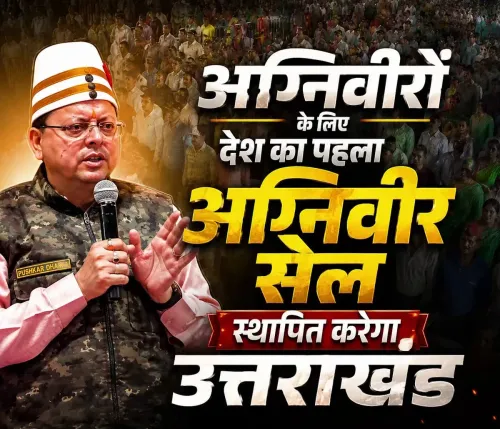
CM Dhami to Set Up India's First Agniveer Rozgar Cell in Uttarakhand
Synopsis
Uttarakhand CM Pushkar Singh Dhami announced the country's first Agniveer Rozgar Cell on 21 July 2026, promising employment opportunities, skill guidance and career counselling for ex-Agniveers in both government and private sectors — building on the state's existing 10% horizontal reservation for Agniveers in government posts.
Key Takeaways
Uttarakhand will set up India's first dedicated Agniveer Rozgar Cell , announced by CM Pushkar Singh Dhami on 21 July 2026 .
The cell will provide employment opportunities in both government and private sectors , along with skill guidance and career counselling.
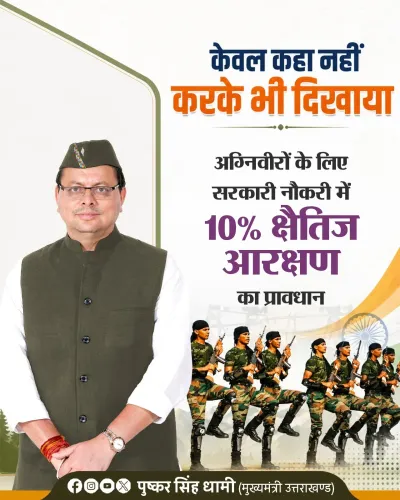
The state had already granted 10% horizontal reservation to Agniveers in state government posts, making it one of the earliest states to formalise such a quota.
The initiative targets Agniveers completing their four-year tenure under the Union Government's Agnipath scheme , launched in June 2022 .
Uttarakhand has a large ex-servicemen population, making military welfare a key policy and political priority for the state government.
The cell's private-sector linkage model could serve as a replicable template for other states managing Agniveer reintegration.
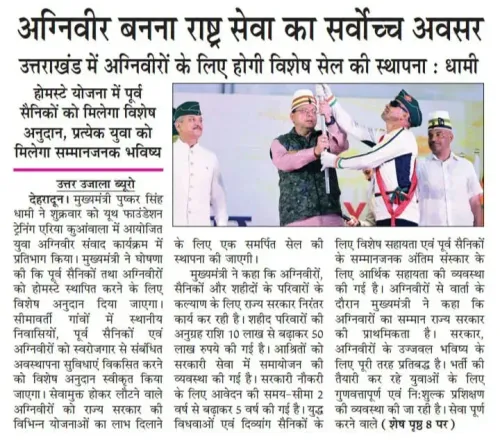
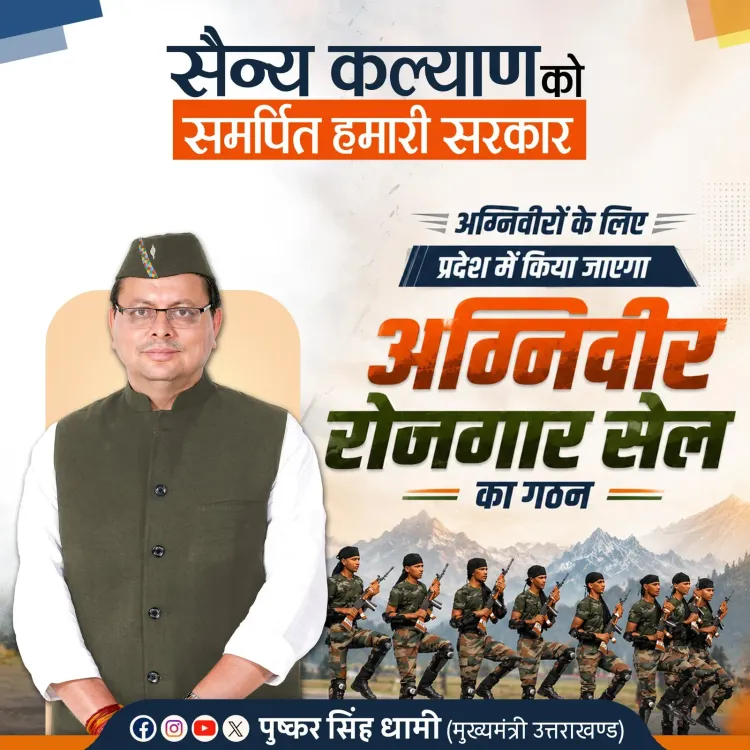
Uttarakhand Chief Minister Pushkar Singh Dhami announced on Tuesday, 21 July 2026 that Uttarakhand will establish the country's first dedicated 'Agniveer Rozgar Cell' — an employment facilitation unit aimed at helping former Agniveers transition into civilian careers across government and private sectors.
Posting in Hindi on X, CM Dhami wrote: 'राष्ट्ररक्षा के प्रति समर्पित अग्निवीरों के सम्मान और उनके उज्ज्वल भविष्य के लिए उत्तराखंड देश का पहला अग्निवीर रोजगार सेल स्थापित करेगा' — ['In honour of Agniveers dedicated to national defence and for their bright future, Uttarakhand will establish the country's first Agniveer Rozgar Cell.'] He added that the cell will provide employment opportunities, skill guidance, and career counselling, linking Agniveers' experience and discipline to the state's development.
Context
Uttarakhand has a historically high density of ex-servicemen relative to its population, making military welfare a politically and socially significant issue in the state. The announcement builds directly on a prior policy move: the state government had already notified a 10% horizontal reservation for Agniveers in state government posts — one of the earliest such formal quotas in the country. The new cell is positioned as the operational complement to that reservation, designed to actively connect eligible candidates with vacancies rather than leaving them to navigate the system independently.
Policy Backdrop
The Agnipath scheme, launched by the Union Government in June 2022, replaced the earlier permanent recruitment model with a short-service tenure of four years, after which most Agniveers return to civilian life. The scheme drew significant criticism at launch, with concerns centred on post-service employment prospects for young recruits who would exit the armed forces in their mid-twenties without a pension. In response, both the central government and several state governments introduced supplementary measures — reservation quotas, skill-bridging programmes, and placement support — to ease reintegration.
Uttarakhand's 10% horizontal reservation, notified in 2023, placed the state among the early movers on formalised Agniveer quotas. The proposed Agniveer Rozgar Cell extends this framework by adding an active placement and counselling function, signalling a shift from passive quota allocation to structured career facilitation.
Stakeholders and Impact
The primary beneficiaries are Agniveers from Uttarakhand completing their four-year service tenures — a cohort that will grow steadily as the first batches inducted under the 2022 scheme complete their terms. For the state government, the cell also serves a broader purpose: channelling the discipline, physical fitness, and technical training of ex-Agniveers into state development programmes and private-sector roles in sectors such as logistics, security, and infrastructure.
Private employers stand to gain a structured pipeline of vetted, trained young candidates. The cell's mandate to forge linkages with the private sector — through what are expected to include formal placement partnerships — could set a replicable template for other states managing similar Agniveer transition challenges.
What's Next
The operational launch date of the Agniveer Rozgar Cell and the modalities of its private-sector partnerships have not yet been announced. Observers will watch for formal memoranda of understanding with employers, the cell's staffing structure, and whether the model prompts a central-level framework or encourages other states to replicate it. Any parliamentary discussion on a nationwide Agniveer transition policy would also shape how state-level initiatives like this one are scaled or standardised.
Point of View
A distinction that matters both administratively and politically. The state's large ex-servicemen constituency gives the BJP government a direct incentive to be seen as the most proactive actor on Agnipath rehabilitation, particularly as the first cohorts of Agniveers near the end of their four-year tenures. By framing the cell around 'honour' and 'discipline linked to state development,' the announcement also attempts to recast the Agnipath scheme's post-service narrative — shifting focus from what Agniveers lose (permanence, pension) to what they gain (structured civilian pathways). If the cell delivers measurable placement outcomes, it could pressure other states and even the central government to institutionalise similar frameworks nationally.
NationPress
20 Oct 2026
Frequently Asked Questions
What is the Agniveer Rozgar Cell announced by Uttarakhand?
The Agniveer Rozgar Cell is a dedicated employment facilitation unit announced by Uttarakhand CM Pushkar Singh Dhami on 21 July 2026. It will provide job opportunities in government and private sectors, skill guidance, and career counselling to Agniveers who have completed their service tenure under the central Agnipath scheme.
Is Uttarakhand the first state to set up an Agniveer employment cell?
Yes, according to CM Dhami's announcement, Uttarakhand will be the first state in India to establish a dedicated Agniveer Rozgar Cell for post-service employment support.
What reservation does Uttarakhand give to Agniveers?
Uttarakhand has already notified a 10% horizontal reservation for Agniveers in state government posts, one of the earliest such formal quotas in the country, introduced in 2023.
What is the Agnipath scheme?
The Agnipath scheme is a Union Government initiative launched in June 2022 that recruits young people into the armed forces for a short-term four-year tenure. Those who serve under this scheme are called Agniveers, and most return to civilian life after their tenure without a pension.
How will the Agniveer Rozgar Cell help former soldiers?
The cell will actively connect ex-Agniveers with job openings in both government and private sectors, offer skill development guidance, and provide career counselling — channelling their military training and discipline into civilian employment opportunities within Uttarakhand.