CM Dhami's Skill Scheme Lands Uttarakhand Nurse Job in Hamburg
Synopsis
Uttarakhand CM Pushkar Singh Dhami met nurse Sapna Rana, who used the state's skill scheme to learn German, clear a language exam, and land a nursing job at Hamburg's Schön Klinik at 3,060 euros per month — one of many placements the Foreign Employment Cell is driving in Japan and Germany.
Key Takeaways
Sapna Rana from Tehri Garhwal secured a nursing post at Schön Klinik, Hamburg, Germany at 3,060 euros (Rs 3,30,000) per month .
The placement was facilitated through Uttarakhand's Mukhyamantri Kaushal Unnayan evam Vaishvik Rojgar Yojana and its Foreign Employment Cell .
She completed German-language training under the scheme and passed the requisite language examination before being selected.
Her schooling was at Jawahar Navodaya Vidyalaya, Paukhal, Tehri Garhwal ; nursing degree from State Nursing College, Dehradun .
The Foreign Employment Cell has already placed approximately 65 youth in Japan and is now expanding placements to Germany's nursing sector .
Cabinet Minister Saurabh Bahuguna confirmed German-language training is ongoing to tap nursing vacancies in Germany.
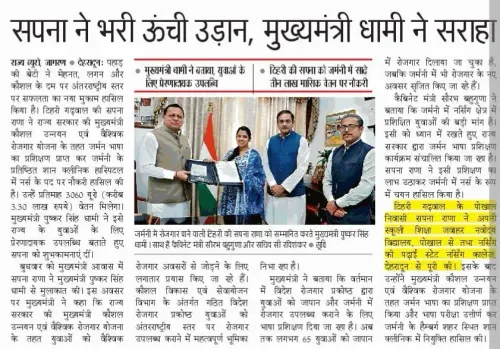
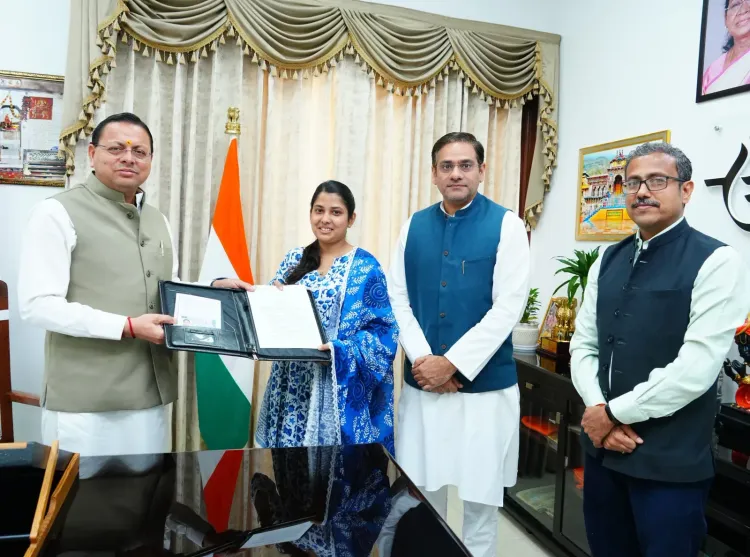
The Chief Minister's Office of Uttarakhand announced on Wednesday, 24 June 2026 that Sapna Rana, a nursing graduate from Tehri Garhwal, met Chief Minister Pushkar Singh Dhami at his official residence after securing a nursing position at Schön Klinik Hospital in Hamburg, Germany, with a monthly salary of 3,060 euros (approximately Rs 3,30,000) — a placement made possible through the state government's Mukhyamantri Kaushal Unnayan evam Vaishvik Rojgar Yojana.
Context
The post details that Sapna Rana enrolled in German-language training offered by the state's Foreign Employment Cell under the Skill Development and Employment Department, cleared the requisite language examination, and was subsequently selected as a nurse at Schön Klinik in Hamburg. Her schooling was completed at Jawahar Navodaya Vidyalaya, Paukhal, Tehri Garhwal, and her nursing degree at State Nursing College, Dehradun. Chief Minister Dhami stated, 'विदेश रोजगार प्रकोष्ठ द्वारा अंतर्राष्ट्रील स्तर पर उपलब्ध रोजगार के अवसरों से राज्य के युवाओं को जोड़े जाने हेतु निरन्तर प्रयास किए जा रहे हैं' ('the Foreign Employment Cell is continuously working to connect the state's youth with internationally available employment opportunities').
Policy Backdrop
The Mukhyamantri Kaushal Unnayan evam Vaishvik Rojgar Yojana is Uttarakhand's flagship scheme linking language training to structured overseas placements, with the Foreign Employment Cell acting as the operational arm for international recruitment facilitation. The cell currently provides language training targeting placements in both Japan and Germany, with approximately 65 youth already placed in Japan under the programme. Cabinet Minister Saurabh Bahuguna, who holds the skill development and employment portfolio, noted that the nursing sector in Germany presents significant opportunities for trained youth, which is why German-language training was introduced alongside the existing Japanese-language track.
Germany has faced a chronic shortage of healthcare workers for several years, creating structured pathways for internationally trained nurses who meet language and qualification benchmarks. Uttarakhand's focus on this corridor mirrors a broader national pattern of Indian states formalising bilateral skilled-migration arrangements to address labour gaps abroad while generating regulated employment and remittances at home.
Stakeholders and Impact
For a hill state like Uttarakhand, which has long grappled with youth out-migration driven by limited local employment, overseas placement programmes offer a structured alternative that converts migration into a regulated, remittance-generating channel. Nursing graduates — a category in which Uttarakhand has invested through institutions such as State Nursing College, Dehradun — are particularly well-positioned to benefit from Germany's healthcare recruitment demand. Sapna Rana's case, emerging from a government school in Tehri Garhwal and a state nursing college, illustrates the scheme's reach into districts beyond the state capital. Secretary C. Ravishankhar was also present at the meeting at the Chief Minister's residence.
What's Next
The state government is expected to expand German-language training batches as placement outcomes from the nursing corridor become more visible. Tracking mechanisms for worker welfare, contract compliance, and remittance flows will be critical indicators of the programme's long-term sustainability. The rollout of additional cohorts for both the Japan and Germany corridors over the coming months will be a key measure of the scheme's scale and institutional depth.
Point of View
Moving beyond Japan placements to tap Europe's healthcare labour deficit. By anchoring the programme to a verifiable success story — a Navodaya school alumna from Tehri Garhwal earning over Rs 3 lakh a month in Hamburg — the Dhami government is building a political narrative around structured migration as a development tool, not a failure of local job creation. The scheme's real test will be whether it can scale beyond individual showcase cases into a reproducible pipeline with robust worker-welfare safeguards. If placement numbers in Germany grow significantly over the next year, Uttarakhand could position itself as a model for other hill states seeking to formalise bilateral skilled-migration corridors.
NationPress
22 Sept 2026
Frequently Asked Questions
What is the Mukhyamantri Kaushal Unnayan evam Vaishvik Rojgar Yojana in Uttarakhand?
It is an Uttarakhand government scheme that provides language and skill training to youth and connects them with overseas employment opportunities, particularly in Japan and Germany, through the state's Foreign Employment Cell.
Who is Sapna Rana and how did she get a job in Germany?
Sapna Rana is a nursing graduate from Tehri Garhwal who trained in German language under Uttarakhand's state skill scheme, cleared the language examination, and was selected as a nurse at Schön Klinik Hospital in Hamburg at a salary of 3,060 euros per month.
How many Uttarakhand youth have been placed abroad under this scheme?
As of June 2026, approximately 65 youth from Uttarakhand have been placed in Japan under the Foreign Employment Cell, with Germany placements now beginning in the nursing sector.
What is the salary of the Uttarakhand nurse placed in Germany?
Sapna Rana has been appointed at Schön Klinik in Hamburg at a monthly salary of 3,060 euros, which is approximately Rs 3,30,000.
Which department runs the Foreign Employment Cell in Uttarakhand?
The Foreign Employment Cell operates under the Skill Development and Employment Department of the Uttarakhand government and is responsible for facilitating international placements through language training and recruitment linkages.