Uttarakhand CM Touts SDG Top Score, 44% Reverse Migration Rise
Synopsis
The Uttarakhand Chief Minister's Office announced on 31 October 2026 that the state jointly topped NITI Aayog's SDG India Index 2023-24 with Kerala, earned 'Leader' status in Startup India rankings, and recorded a 44% rise in reverse migration, signalling broad governance gains.
Key Takeaways
Uttarakhand jointly achieved the highest score in India alongside Kerala in the NITI Aayog SDG India Index 2023-24 .
The state was placed in the 'Leader' category in Startup India's annual state rankings.
Uttarakhand's Single Window System was recognised as a 'Top Achiever' for investor clearances.
The state ranked second nationally in Category C of the Union Government's State Mining Readiness Index and earned 'Achievers' status in Logistics Performance .
The Palayan Nivaran Aayog survey reported a 44% rise in reverse migration , attributed to expanding local livelihood opportunities.
The event was attended by folk legend Narendra Singh Negi , Cabinet Minister Khajan Das , and representatives of the Akhil Garhwal Sabha .
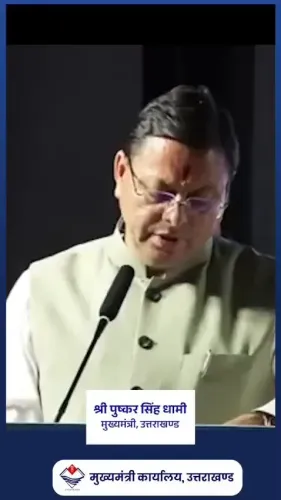
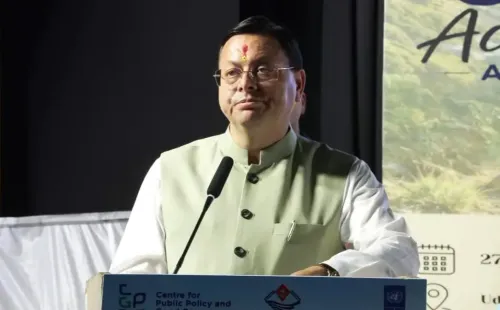
Uttarakhand is no longer just a hill state defined by its scenery — it is now staking a claim as one of India's best-governed. The Chief Minister's Office of Uttarakhand shared remarks on 31 October 2026 in which the Chief Minister laid out a string of national rankings that, taken together, paint a picture of a state quietly climbing India's governance ladder.
Joint top score with Kerala on NITI Aayog's SDG Index
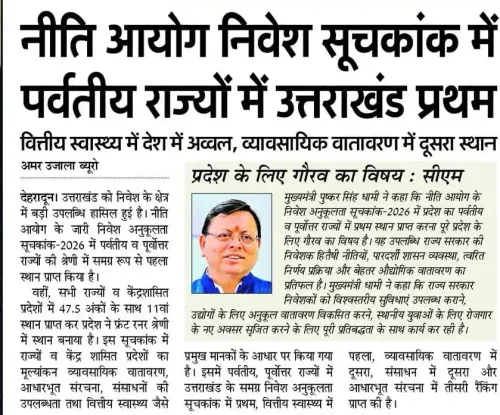
The headline number is striking: Uttarakhand jointly achieved the highest score in the country alongside Kerala in the NITI Aayog SDG India Index 2023-24 — a benchmark that tracks state progress across the United Nations' Sustainable Development Goals. For a landlocked hill state to share the summit with Kerala, long regarded as India's social-development gold standard, is a signal the political class will not ignore. The SDG India Index, published by NITI Aayog since 2018, scores states on health, education, clean energy, economic growth, and institutional quality, among other parameters.
Startup India 'Leader', Single Window 'Top Achiever'
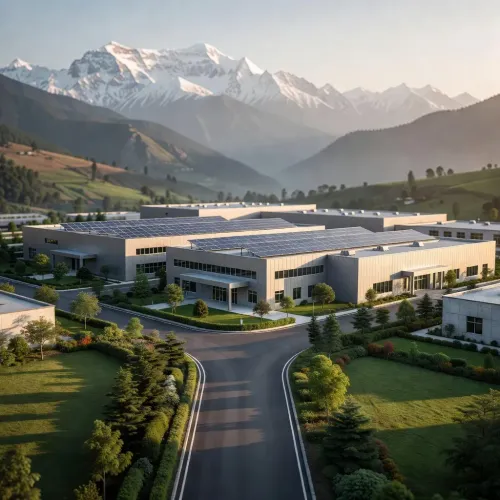
On the business-climate front, the Chief Minister cited Uttarakhand's placement in the 'Leader' category in the Startup India state rankings — a national initiative launched in 2016 to foster entrepreneurship. The state's Single Window System for investor clearances was separately recognised as a 'Top Achiever', a category reserved for the fastest and most transparent approval mechanisms in the country. In the Union Government's State Mining Readiness Index, Uttarakhand secured second place nationally in Category C. Its logistics infrastructure earned it a spot in the 'Achievers' category in the national Logistics Performance rankings. Each of these is a distinct, centrally-evaluated scorecard — making the cumulative picture harder to dismiss as coincidence.
44% jump in reverse migration — and what it means for the hills
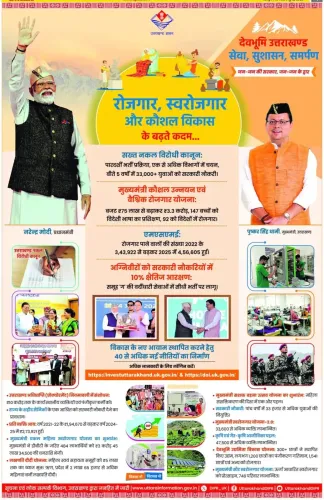
Perhaps the most socially consequential claim concerns migration. The Chief Minister cited a survey by the Uttarakhand Palayan Nivaran Aayog — the state body established to study and reverse out-migration from hill districts — showing a 44 per cent increase in reverse migration. For decades, Uttarakhand's villages have emptied as residents moved to plains cities in search of livelihoods. A reversal, if sustained, would reshape everything from local economies to the viability of rural schools and health posts. The state has run targeted livelihood and employment schemes for returnees since at least 2020, when pandemic-era reverse flows first drew policy attention. The Chief Minister framed the figure as evidence that 'local livelihood and employment opportunities are continuously expanding.'
Akhil Garhwal Sabha and the cultural dimension
The occasion for these remarks was a gathering that also featured Cabinet Minister Khajan Das, office-bearers of the Akhil Garhwal Sabha, folk legend Narendra Singh Negi, singer Sangeeta Dhoundiyal, self-help group women, elected representatives, and a large public audience. The Chief Minister expressed confidence that cultural organisations like the Akhil Garhwal Sabha would continue to preserve and promote Uttarakhand's folk heritage alongside economic development — a deliberate pairing of governance metrics with cultural identity that has become a recurring motif in the state's public communications. He described the government's commitment as a 'vikalp rahit sankalp' — an 'option-less resolve' — to make Uttarakhand one of India's finest states.
Rankings are snapshots, not destinations. The real test will come when NITI Aayog and Startup India release their next indices — and when the Palayan Aayog's migration numbers face independent scrutiny.
Point of View
If independently validated, would add a rare human-welfare dimension to what are often dry governance metrics. Taken together, the Chief Minister is constructing a pre-investment-summit or pre-election narrative of a hill state that has moved from peripheral to exemplary.
NationPress
1 Nov 2026
Frequently Asked Questions
What did Uttarakhand score in the NITI Aayog SDG India Index 2023-24?
Uttarakhand jointly achieved the highest score in the country alongside Kerala in the NITI Aayog SDG India Index 2023-24, placing it among the top-performing states on sustainable development metrics.
What is the Startup India 'Leader' category for states?
The Startup India state ranking system, part of a national initiative launched in 2016, classifies states into tiers — 'Leader' is among the top categories, awarded to states with strong startup ecosystems, policy support, and entrepreneurship infrastructure.
What is reverse migration in Uttarakhand and why does it matter?
Reverse migration refers to people returning to Uttarakhand's hill districts after having moved to plains cities for work. The Palayan Nivaran Aayog survey cited by the Chief Minister reported a 44% increase in this trend, suggesting growing local employment opportunities.
What is the Uttarakhand Single Window System and why was it recognised?
Uttarakhand's Single Window System is a centralised clearance mechanism for business and investment approvals. It was recognised in the 'Top Achievers' category for its speed and transparency in processing investor applications.
Who is Narendra Singh Negi and why was he at this event?
Narendra Singh Negi is one of Uttarakhand's most celebrated folk singers and cultural icons. He attended the gathering alongside the Akhil Garhwal Sabha, reflecting the event's dual focus on governance achievements and the preservation of Garhwali folk culture.