CM Dhami: Uttarakhand's SDG Index top rank proves policies on right track

Synopsis
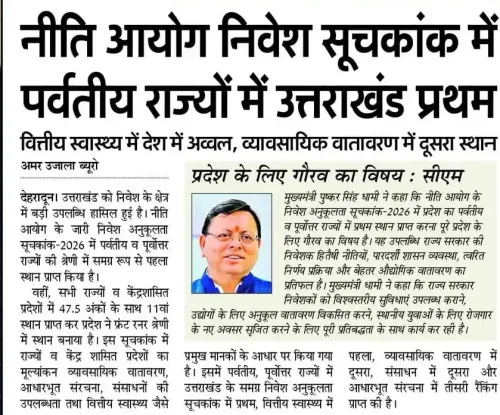
Chief Minister Pushkar Singh Dhami declared Uttarakhand's first-place finish in the NITI Aayog SDG India Index as proof that the state's policies are heading in the right direction, with the official CMO account amplifying the milestone on 27 May 2026.
Key Takeaways
The Chief Minister's Office of Uttarakhand announced on 27 May 2026 that the state secured first place in the SDG India Index .
CM Pushkar Singh Dhami called the ranking 'proof that our policies are moving in the right direction.' The SDG India Index is published by NITI Aayog and ranks all states and union territories across 16 Sustainable Development Goals .
In the earlier SDG India Index 3.0 (2020-21) , Uttarakhand scored 72 and was classified a 'front-runner' but ranked behind Kerala and Himachal Pradesh.
Uttarakhand's economy — centred on tourism, hydropower and agriculture — aligns closely with several SDG targets, giving it structural advantages in ecological indicators.
The ranking is expected to inform future state budget priorities and strengthen India's Voluntary National Review submissions to the United Nations .
The Chief Minister's Office of Uttarakhand on Wednesday, 27 May 2026 quoted Chief Minister Pushkar Singh Dhami saying the state's first-place finish in the SDG India Index validates the direction of the government's policies. The statement, shared via the official CMO account on X, signals that Uttarakhand has climbed to the top of the national ranking among all states and union territories on sustainable development parameters.
Context
Chief Minister Pushkar Singh Dhami stated, 'एसडीजी इंडेक्स में पहला स्थान प्राप्त करना इस बात का प्रमाण है कि हमारी नीतियां सही दिशा में चल रही हैं' ['Securing first place in the SDG Index is proof that our policies are moving in the right direction']. The remark came through the official Chief Minister's Office account and was accompanied by an image, underscoring the government's intent to publicly anchor this achievement as an institutional milestone rather than a personal one.
The SDG India Index is a composite ranking instrument published periodically by NITI Aayog, India's central policy think-tank. It measures the performance of all states and union territories across 16 Sustainable Development Goals using official government data, and was first launched in December 2018 to create a competitive federal framework for tracking SDG progress at the sub-national level.
Policy Backdrop
Uttarakhand has historically featured in the 'front-runner' category in earlier editions of the index. In the SDG India Index 3.0 (2020-21), the state recorded a score of 72, placing it among the better-performing states, though behind Kerala and Himachal Pradesh at that time. A first-place ranking, if confirmed by the latest edition, would represent a significant upward shift from that position.
Uttarakhand's economy is anchored in tourism, hydropower and agriculture — sectors that intersect directly with several SDG targets including clean energy, climate action, and sustainable communities. Himalayan states have traditionally held natural advantages on ecological indicators within the index, and the Dhami government has framed infrastructure, tourism development and environmental stewardship as complementary rather than competing priorities since taking office in 2021.
Stakeholders and Impact
The ranking has direct implications for Uttarakhand's residents across sectors including health, education, poverty reduction and environmental quality — all of which feed into the composite SDG score. State planning officials are likely to use the top ranking to justify budget priorities and attract central government attention to ongoing development programmes.
At the national level, India submits a Voluntary National Review to the United Nations on SDG progress, and strong state-level performances like this one strengthen India's overall standing in that review process. The inter-state competition that the SDG Index deliberately fosters has pushed several states to recalibrate policies in areas where their scores lagged.
What's Next
Attention will now turn to the formal release of the full NITI Aayog SDG India Index edition that underpins this ranking, which would provide a detailed breakdown of Uttarakhand's scores across individual goals and indicators. Observers will watch whether the state translates the ranking momentum into specific budget allocations or new schemes explicitly tied to the remaining SDG targets where gaps persist.
Chief Minister Dhami's framing of the result as policy validation is also a signal ahead of future electoral cycles in the state, where governance credibility on measurable development benchmarks is increasingly a campaign asset. The coming months will test whether the administration can sustain and deepen the performance that earned it this top position.
Point of View
Ahead of what could be a politically active period for the state, means the ranking will serve dual purposes: administrative credibility and electoral narrative. More broadly, it reinforces how the SDG Index has evolved from a technical exercise into a high-stakes inter-state competition that shapes both policy and political messaging.
NationPress
11 Oct 2026
Frequently Asked Questions
What is the SDG India Index and who publishes it?
The SDG India Index is a composite ranking published periodically by NITI Aayog, India's central policy think-tank, that measures the performance of all states and union territories across 16 Sustainable Development Goals using official government data. It was first launched in December 2018.
Has Uttarakhand topped the SDG India Index before?
No previous edition of the SDG India Index placed Uttarakhand first. In the SDG India Index 3.0 (2020-21), the state scored 72 and was categorised as a 'front-runner' but ranked behind Kerala and Himachal Pradesh.
What did CM Pushkar Singh Dhami say about the SDG Index ranking?
CM Dhami stated that securing first place in the SDG Index is 'proof that our policies are moving in the right direction,' a quote shared by the official Chief Minister's Office of Uttarakhand on 27 May 2026.
Why does Uttarakhand perform well on sustainable development indicators?
Uttarakhand's economy is centred on tourism, hydropower and agriculture, sectors that align closely with SDG targets on clean energy, climate action and sustainable communities. Himalayan states also tend to hold natural advantages on ecological indicators within the index.
What happens after a state tops the SDG India Index?
A top ranking typically influences state budget priorities and is used to attract central government attention to ongoing development programmes. It also strengthens India's overall position in its Voluntary National Review submissions to the United Nations.