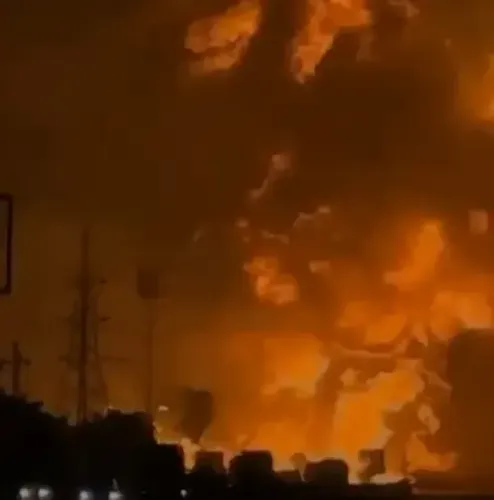
Khargone tanker blast kills shepherd, two critical after welding sparks crude oil explosion
Synopsis
A crude oil tanker exploded during welding at a Khargone workshop on 13 July, killing a shepherd grazing nearby and critically injuring two workers. Preliminary findings point to residual vapour ignition — and to the persistent safety failures at informal petroleum vehicle repair units across rural Madhya Pradesh.
Key Takeaways
A crude oil tanker exploded during welding operations in Magarkhedi village , Khargone , Madhya Pradesh , on 13 July .
A shepherd grazing goats nearby was killed; a tanker driver and a welding mechanic are critically injured.
Superintendent of Police Ravindra Verma said residual vapours in the tanker apparently ignited during rear-section welding.
The blast shattered windowpanes of a nearby private school and a residential house .
Preliminary findings suggest required safety protocols — gas-free certification, thorough cleaning, explosion-proof equipment — were not fully followed.
Police have registered a case; district authorities and the workshop owner are under investigation.
A crude oil tanker exploded during welding operations at a workshop in Magarkhedi village, Khargone district, Madhya Pradesh, on Sunday evening, 13 July, killing a shepherd and leaving two others — a tanker driver and a welding mechanic — in critical condition. The blast occurred under the jurisdiction of Balkwada police station and has prompted a formal investigation into safety lapses at the repair unit.
How the Explosion Unfolded
According to Superintendent of Police Ravindra Verma, welding work was being carried out on the rear section of the tanker when residual vapours inside the vessel apparently ignited, triggering a powerful blast. The shepherd, who was grazing goats in the vicinity, was caught within the explosion's radius and succumbed to his injuries.
The driver and the mechanic, both directly involved in the repair work, sustained severe burns and trauma. They were rushed to a hospital for urgent medical attention and their condition remains critical, according to reports.
Scale of Destruction
The force of the blast was significant enough to shatter windowpanes of a nearby private school and a residential house. No additional casualties have been reported so far, though local residents were left shaken by the sudden incident.
Safety Lapses Under Scrutiny
Preliminary investigations suggest that standard safety protocols for welding on fuel tankers — including thorough cleaning, gas-free certification, and the use of explosion-proof equipment — may not have been fully observed, according to officials. Welding on vessels that previously carried flammable substances such as crude oil is a recognised high-risk activity; residual hydrocarbons must be completely purged before any ignition source is introduced.
Experts have long flagged that informal tanker repair workshops across rural and semi-urban Madhya Pradesh frequently overlook hazardous area classifications, making such tragedies preventable yet recurring. This incident is the latest in a pattern of industrial accidents tied to inadequate safety compliance at unregulated workshops handling petroleum-laden vehicles.
Investigation and Official Response
District authorities have initiated a detailed probe into the incident. Police have registered a case and are examining the workshop owner's role and the extent of safety violations. The local administration has assured full support to the victims' families. The body of the deceased shepherd has been handed over to his relatives following a post-mortem examination, while the two injured continue to receive treatment.
With the investigation ongoing, authorities are expected to determine whether criminal negligence charges apply to the workshop operators.
Point of View
And the consequences are predictably fatal. The Khargone blast follows a well-worn pattern: a petroleum-laden vessel, an untrained welder, no safety audit, and a bystander who paid with his life. The question investigators must answer is not just whether protocols were skipped at this workshop, but why enforcement of industrial safety norms at such units remains effectively absent. Without binding inspections and criminal accountability for workshop owners, the next explosion is already waiting to happen.
NationPress
11 Oct 2026
Frequently Asked Questions
What caused the crude oil tanker explosion in Khargone?
According to Superintendent of Police Ravindra Verma, residual vapours inside the tanker ignited when welding work was being carried out on its rear section. Preliminary investigations suggest that safety protocols such as gas-free certification and thorough cleaning of the vessel were not fully followed before work began.
Who were the victims of the Khargone tanker blast?
A shepherd grazing goats near the workshop was killed in the explosion. A tanker driver and a welding mechanic, both involved in the repair work, sustained severe burns and trauma and are reported to be in critical condition in hospital.
Where did the Khargone tanker explosion occur?
The explosion took place at a local workshop in Magarkhedi village, under the Balkwada police station area in Khargone district, Madhya Pradesh, on the evening of 13 July.
What action has been taken after the Khargone blast?
Police have registered a case and are examining the workshop owner over potential safety violations. District authorities have launched a detailed probe, and the local administration has assured support to the victims' families. The deceased shepherd's body was handed over to relatives after a post-mortem.
Why are crude oil tanker welding accidents common in rural India?
Experts point out that informal tanker repair workshops frequently overlook mandatory safety steps — including gas-free certification and hazardous area classification — required before welding on vessels that carried flammable substances. The absence of regular inspections and enforcement at unregulated units in rural and semi-urban areas makes such accidents a recurring risk.