Vande Mataram row: Karnataka HC hears PIL on state's 2-stanza order
Synopsis
A PIL in the Karnataka High Court has turned a dispute over how many stanzas of Vande Mataram must be sung at state events into a constitutional question: can a state government override Union directives on a national symbol? With BJP legislators defying the government inside the legislature and a Union minister threatening a parliamentary escalation, the controversy is far from contained.
Key Takeaways
The Karnataka High Court on 22 September heard a PIL filed by Girish Bharadwaj challenging the state's decision to restrict Vande Mataram to two stanzas at official events.
Petitioner's counsel argued that the Union Home Ministry's notifications prescribe a six-stanza rendition of approximately 3 minutes 10 seconds and are binding on states.
The state's Advocate General cited a Supreme Court position that singing the National Song is not compulsory , and noted that only two stanzas have been sung at such events since 1932 .
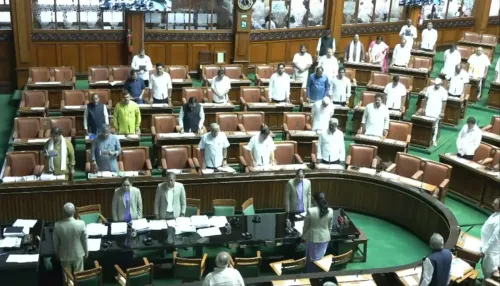
BJP and JD(S) MLAs sang the full version of Vande Mataram inside the Karnataka Legislature on Monday , defying the state directive.
Union Education Minister Pralhad Joshi warned the BJP would raise the issue in Parliament against the Karnataka government.
The Division Bench — led by Justice Anu Shivaraman — is yet to issue a formal order.
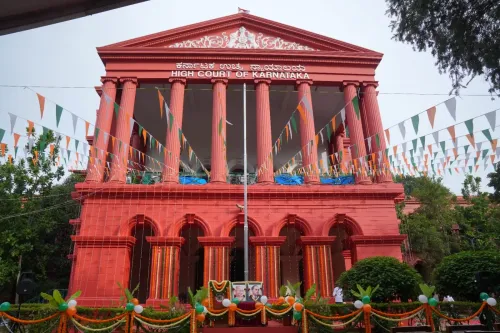
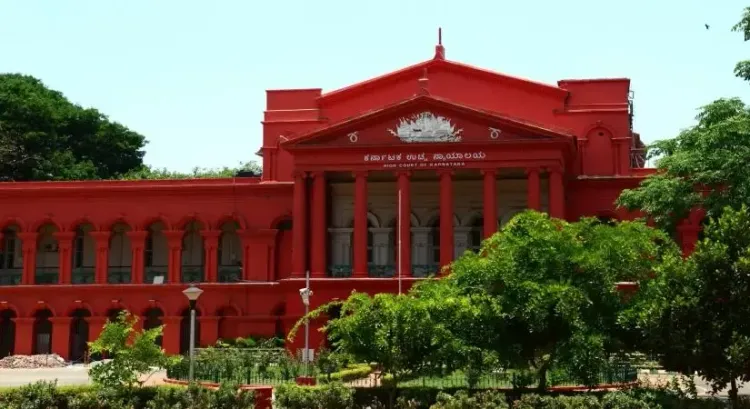
The Karnataka High Court on Tuesday, 22 September took up a Public Interest Litigation (PIL) challenging the state government's decision to restrict the rendition of Vande Mataram to two stanzas at official events — a controversy that has already spilled onto the floor of the Karnataka Legislature and drawn a parliamentary warning from a Union minister.
What the Petition Argues
The PIL was filed by senior counsel and activist Girish Bharadwaj, represented before a Division Bench by senior advocate Angad Kamath. The bench is headed by Justice Anu Shivaraman, sitting alongside Justice T.P. Vivekananda.
Kamath contended that decisions governing the National Anthem and National Song fall exclusively within the Union government's jurisdiction and cannot be independently altered by a state. He submitted that the Union Home Ministry has issued notifications prescribing how Vande Mataram — which comprises six stanzas with a prescribed rendition time of approximately 3 minutes 10 seconds — should be sung at official occasions.
The petitioner further alleged that the state Cabinet's decision to curtail the rendition suffered from procedural lapses: no department had formally proposed the change, and the Cabinet reportedly acted without a proper Cabinet note or supporting document.
The State's Defence
Advocate General Shashi Kiran Shetty, appearing for the Karnataka government, challenged both the petition's merits and its circumstances. He noted that the petitioner had filed the matter on a holiday and approached the court the very next day — a timeline he questioned.
Shetty cited proceedings before the Supreme Court in which the Centre had stated that singing the National Song was not compulsory, while the National Anthem remained mandatory. He also pointed to a communication from the Joint Secretary of the Union government to Chief Secretaries of states, which, he argued, referenced the use of two stanzas at state government events. Shetty further alleged that since 1932, only two stanzas have generally been sung on such occasions, making the state's position consistent with long-standing practice.
The Advocate General additionally alleged that the petitioner had made an incorrect statement in his affidavit by claiming no organisational affiliation, and contended that political considerations were behind the PIL.
The Petitioner's Rebuttal
Kamath maintained that Vande Mataram is recognised as the National Song and that the Supreme Court had addressed the manner of showing respect when the song is played but had not determined the number of stanzas to be rendered. He argued that the Centre's instructions to state governments on this matter were not merely advisory in nature and that the state was bound to comply. He called on the Centre to formally clarify the number of stanzas to be sung, with its directions binding on all state governments.
Political Flashpoint in the Legislature
The court hearing comes amid a sharp escalation of the controversy in the political arena. Union Education Minister Pralhad Joshi warned that the Bharatiya Janata Party (BJP) would raise the matter in Parliament against the Karnataka government. On Monday, BJP and Janata Dal (Secular) (JD(S)) legislators sang the full six-stanza version of Vande Mataram inside the Karnataka Legislature, in a direct act of defiance against the state government's two-stanza directive.
The incident underscores how a seemingly procedural question about a song's rendition has become a flashpoint in the ongoing political contest between the Congress-led Karnataka state government and the BJP-led Centre — with the High Court now drawn into the dispute.
What Happens Next
The Division Bench is yet to issue a formal order or set a next date for the matter. Legal observers note that the court may seek the state government's official response before proceeding further. How the bench interprets the Centre-state division of authority over national symbols could have implications beyond Karnataka.
Point of View
This dispute is less about music and more about federalism — specifically, whether a state can exercise discretion over symbols that the Centre considers part of the national identity. The state's position that only two stanzas have been sung since 1932 is historically defensible, yet the political timing — with a Congress government in Karnataka and a BJP government at the Centre — ensures that procedural nuance will be drowned out by partisan noise. The High Court now faces the uncomfortable task of adjudicating what is both a constitutional question and an election-season flashpoint. What mainstream coverage misses is that the Centre's own stance before the Supreme Court — that the National Song is not compulsory — significantly complicates the petitioner's argument that state compliance is mandatory.
NationPress
22 Sept 2026
Frequently Asked Questions
What is the Vande Mataram row in Karnataka?
The Karnataka government issued a directive restricting the rendition of Vande Mataram at official state events to two stanzas, prompting opposition from the BJP and JD(S) and a PIL in the Karnataka High Court. Critics argue this contradicts Union Home Ministry guidelines that prescribe a six-stanza rendition.
Who filed the PIL in the Karnataka High Court over Vande Mataram?
The PIL was filed by senior counsel and activist Girish Bharadwaj. He is represented before the Karnataka High Court's Division Bench by senior advocate Angad Kamath.
Is singing Vande Mataram compulsory at government events?
According to the Karnataka government's Advocate General, the Centre had stated before the Supreme Court that singing the National Song is not compulsory, though the National Anthem is mandatory. The petitioner, however, argues that the Centre's instructions on the rendition are binding on state governments.
How many stanzas does Vande Mataram have and how long does it take?
Vande Mataram comprises six stanzas, and according to the petitioner, the prescribed rendition takes approximately 3 minutes 10 seconds. The state government's directive limits the song to two stanzas at official events.
What political reactions has the Karnataka Vande Mataram row triggered?
Union Education Minister Pralhad Joshi warned that the BJP would raise the issue in Parliament. BJP and JD(S) legislators also sang the full version of Vande Mataram inside the Karnataka Legislature on Monday in open defiance of the state government's directive.