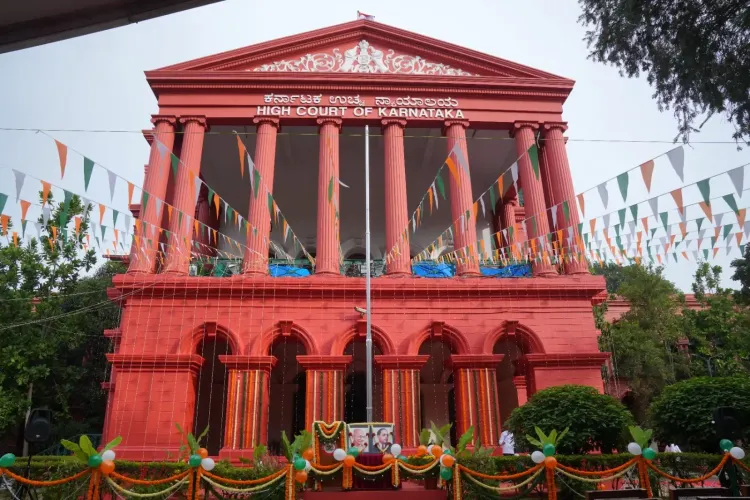
PIL in Karnataka HC challenges state order limiting Vande Mataram to two stanzas
Synopsis
Karnataka's order to sing only the first two stanzas of Vande Mataram at state functions has landed in court — with a PIL arguing the state has overstepped its constitutional authority, defied a Union Home Ministry directive, and sidestepped its own Cabinet procedures. The case now forces the Karnataka HC to rule on whether a state can legally trim a national symbol.
Key Takeaways
A PIL filed in the Karnataka High Court on 15 September 2026 challenges a state order restricting Vande Mataram to two stanzas at government events.
The challenged order stems from a Karnataka Cabinet decision of 3 September 2026 and a Government Order dated 8 September 2026 .
The Ministry of Home Affairs had on 9 July 2026 directed all states to follow the complete six-stanza official version of Vande Mataram.
Parliament enacted the Prevention of Insults to National Honour (Amendment) Act, 2026 , extending statutory protection to the National Song.
The petitioner, advocate Girish Bharadwaj , alleges the decision was taken through an 'Informal Discussion' without a Cabinet Note, sponsoring department, or Law Department advice.
The PIL does not seek to compel any individual to sing Vande Mataram, but asks the court to prevent the state from curtailing the officially prescribed version at its own functions.
A Public Interest Litigation (PIL) has been filed before the Karnataka High Court challenging a state government directive that restricts the singing of the National Song Vande Mataram to only its first two stanzas at state government functions. The petition, filed on 15 September 2026, contends that the Karnataka government's order directly conflicts with instructions issued by the Union government mandating the complete six-stanza composition.
The Order Being Challenged
The PIL targets a Government Order dated 8 September 2026 and the Karnataka Cabinet's decision of 3 September 2026, which directed that at all state government programmes — except those attended by the President, Vice-President, Prime Minister, or Governor — only the first two stanzas of Vande Mataram should be sung. The petition has been filed by advocate Girish Bharadwaj against the State of Karnataka, the Principal Secretary to the Department of Personnel and Administrative Reforms (DPAR), and the Union of India. The matter is expected to be mentioned before the High Court on Tuesday for listing.
What the Union Government Prescribes
According to the petition, the Ministry of Home Affairs (MHA), through a letter dated 9 July 2026, circulated orders relating to the National Song to all states for 'strict compliance'. The petitioner contends that the Union government's directions prescribe the official version of Vande Mataram as the complete six-stanza composition and require this version to be recited during mass singing. Notably, Parliament subsequently enacted the Prevention of Insults to National Honour (Amendment) Act, 2026, extending statutory protection to the National Song — adding a fresh legislative dimension to the dispute.
Constitutional Questions Raised
The PIL raises a fundamental constitutional question: whether a state government can, through an executive order, prescribe the form and content of a national symbol. The petition argues that the subject does not fall under the State List or Concurrent List of the Seventh Schedule and lies within the exclusive legislative competence of Parliament under Entry 97 of the Union List read with Article 248 of the Constitution. It further alleges that the order violates Articles 256 and 257(1), which require state executive power to be exercised in compliance with Union laws and without impeding the Union's executive authority.
Procedural Concerns Over Cabinet Decision
Beyond the constitutional substance, the petition challenges the manner in which the Karnataka government arrived at the decision. The petitioner alleges it was taken through an 'Informal Discussion' — without a Cabinet Note, a sponsoring department, or advice from the Law Department. This procedural objection could independently provide grounds for the court to examine the order's validity, separate from its merits on national symbols law.
Relief Sought and Next Steps
The petitioner has clarified that the PIL does not seek to compel any individual to sing Vande Mataram. Instead, it seeks a court direction that when the National Song is sung at a state government function, the officially prescribed version should not be curtailed. Interim relief has also been sought, given that the order has been in operation at state government functions across Karnataka since 8 September 2026. A representation submitted to the Chief Secretary on 14 September 2026 seeking withdrawal of the order had received no response as of the filing of the petition. All eyes are now on the Karnataka High Court's decision on listing and any interim directions it may issue.
Point of View
And the Centre's July 2026 MHA circular — followed swiftly by a parliamentary amendment to the National Honour Act — looks in hindsight like a pre-emptive response to exactly this kind of state-level divergence. The constitutional argument is strong: national symbols have never been held to fall within state competence, and the Seventh Schedule gives Parliament a clean run under Entry 97. What is equally striking is the procedural allegation — a Cabinet decision taken without a Cabinet Note or Law Department clearance is the kind of governance shortcut that courts have struck down before. If the High Court takes up interim relief, the Karnataka government may find itself in the awkward position of defending not just the policy, but the process.
NationPress
15 Sept 2026
Frequently Asked Questions
What is the PIL filed in the Karnataka High Court about?
The PIL challenges a Karnataka government order that restricts the singing of Vande Mataram to only its first two stanzas at state government functions. Filed by advocate Girish Bharadwaj on 15 September 2026, the petition argues the order contradicts a Union government directive requiring the complete six-stanza official version to be sung.
What did the Karnataka Cabinet decide about Vande Mataram?
The Karnataka Cabinet, through a decision on 3 September 2026 formalised in a Government Order dated 8 September 2026, directed that only the first two stanzas of Vande Mataram be sung at all state government programmes, except those attended by the President, Vice-President, Prime Minister, or Governor.
What is the Union government's position on Vande Mataram?
The Ministry of Home Affairs, through a letter dated 9 July 2026, circulated directions to all states for 'strict compliance', prescribing the official version of Vande Mataram as the complete six-stanza composition to be recited during mass singing. Parliament subsequently enacted the Prevention of Insults to National Honour (Amendment) Act, 2026, giving the National Song statutory protection.
What constitutional arguments does the PIL raise?
The petition argues that prescribing the form and content of a national symbol falls exclusively within Parliament's legislative competence under Entry 97 of the Union List read with Article 248, and is not a state or concurrent subject. It also alleges violations of Articles 256 and 257(1), which require state executive action to align with Union laws and not obstruct Union executive power.
Does the PIL seek to make Vande Mataram compulsory for individuals?
No. The petitioner has explicitly stated that the PIL does not seek to compel any individual to sing Vande Mataram. It only seeks a court direction preventing the Karnataka government from curtailing the officially prescribed six-stanza version at its own state functions.