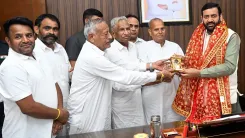
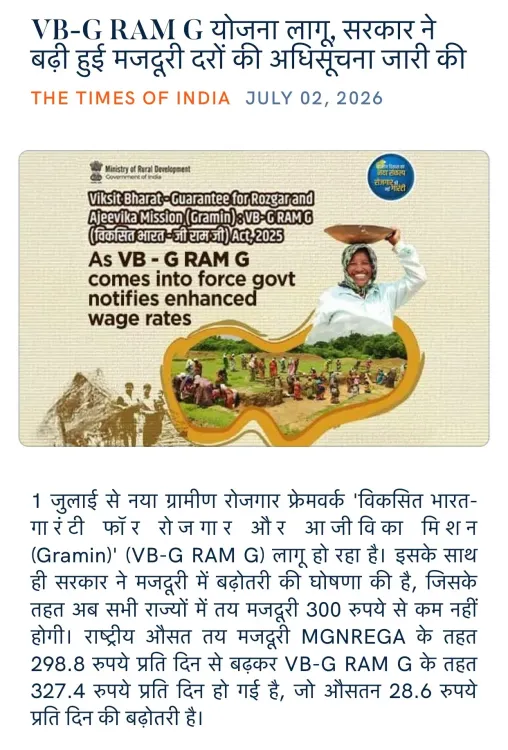
Giriraj Singh: VB-G RAM G Scheme Launched, Wage Rates Notified
Synopsis
Union Textiles Minister Giriraj Singh announced on 2 July 2026 that the VB-G RAM G scheme has come into force, with the government issuing a formal notification of enhanced wage rates. The move is aimed at strengthening labour welfare for workers in India's vast textile and handloom sectors.
Key Takeaways
The VB-G RAM G scheme came into force on 2 July 2026 , as announced by Union Textiles Minister Giriraj Singh .
The government has issued an official notification of enhanced wage rates as part of the scheme's rollout.
Wage revisions under the Minimum Wages Act framework are legally binding on employers across covered establishments.
The textile sector employs an estimated 4.5 crore direct and over 6 crore indirect workers in India.
State governments are expected to issue corresponding orders to align enforcement with the central notification.
Parliamentary scrutiny and state-level compliance monitoring will be key indicators of the scheme's real-world impact.
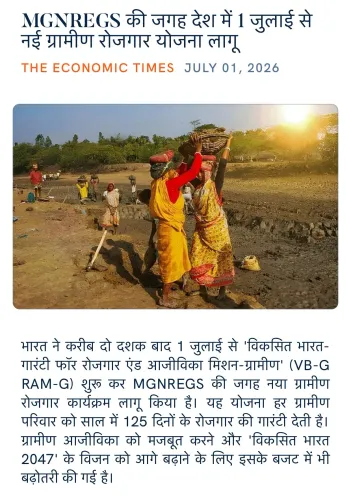
Union Textiles Minister Giriraj Singh announced on Thursday, 2 July 2026 that the VB-G RAM G scheme has come into force, with the government issuing an official notification of enhanced wage rates for workers covered under the initiative. The minister shared the update on X, signalling a significant step in labour welfare within the textiles and allied sectors.
Context
Giriraj Singh's post, shared via the NaMo App, stated: 'VB-G RAM G योजना लागू, सरकार ने बढ़ी हुई मजदूरी दरों की अधिसूचना जारी की' — translated as 'VB-G RAM G scheme implemented, government issues notification of enhanced wage rates.' The announcement marks the formal operationalisation of the scheme, with the enhanced wage notification serving as the legal trigger for its rollout across applicable establishments.
Wage notifications of this nature are typically issued under the Minimum Wages Act framework, which mandates periodic revision of wage floors across scheduled employments to account for inflation and changes in the cost of living. The involvement of the Ministry of Textiles alongside the Ministry of Labour and Employment reflects the scheme's direct relevance to workers in the textile, handloom, and related sectors.
Policy Backdrop
Central governments have historically revised minimum wage rates for scheduled employments at regular intervals, with sector-specific schemes often carrying targeted provisions for piece-rate workers, weavers, and artisans in the unorganised segment of the textile industry. Such revisions are aimed at ensuring that wage floors keep pace with market realities and provide a basic standard of living to millions of workers employed in labour-intensive sectors.
The textile sector is one of India's largest employers, supporting an estimated 4.5 crore direct jobs and over 6 crore indirect jobs, with a significant share in handloom and power-loom segments where wage compliance and worker welfare have historically been areas of policy focus. Enhanced wage notifications, once gazetted, become binding on employers and are enforceable under labour law.
Stakeholders and Impact
Textile workers — particularly those engaged in handloom weaving, garment manufacturing, and allied trades — stand as the primary beneficiaries of the enhanced wage rates. For workers in the unorganised sector, a government-notified wage floor can be a critical income protection mechanism, especially in states where collective bargaining is limited.
State governments are now expected to issue corresponding orders aligning their enforcement machinery with the revised central notification. Compliance monitoring by labour inspectorates and industry associations will determine the on-ground impact of the scheme's rollout. Employer bodies in the textiles sector are likely to assess the cost implications of the revised rates on production economics.
What's Next
Attention will now shift to how swiftly state governments align their own wage schedules with the central notification, and whether parliamentary oversight mechanisms — including questions in both Houses — are invoked to examine the scheme's coverage, beneficiary count, and compliance architecture. The Ministry of Textiles is expected to issue further implementation guidelines to industry stakeholders in the coming weeks.
The rollout of VB-G RAM G will be closely watched as a test case for the government's ability to translate wage notifications into verifiable income gains for workers at the grassroots level, particularly in Bihar, Uttar Pradesh, West Bengal, and other states with large textile labour pools.
Point of View
A state with a large population of textile and handloom workers — such announcements carry both policy and electoral salience. The move fits a broader pattern of the BJP-led government using scheme-based welfare architecture to build direct beneficiary relationships with unorganised sector workers. The real test, however, lies in enforcement: wage notifications without robust state-level compliance machinery often fail to translate into actual income gains on the ground.
NationPress
1 Oct 2026
Frequently Asked Questions
What is the VB-G RAM G scheme?
The VB-G RAM G scheme is a government initiative that came into force on 2 July 2026, under which the central government has notified enhanced wage rates for workers in covered employment categories, with a focus on the textile and allied sectors.
Who announced the VB-G RAM G scheme implementation?
Union Textiles Minister Giriraj Singh announced the scheme's implementation on 2 July 2026 via a post on X, noting that the government had issued the official notification of enhanced wage rates.
How do enhanced wage notifications work in India?
Enhanced wage notifications are issued under the Minimum Wages Act framework. Once gazetted by the central government, they become legally binding on employers in scheduled employments, and state governments are required to align their enforcement accordingly.
Who benefits from the VB-G RAM G scheme wage revision?
Textile workers — including those in handloom weaving, garment manufacturing, and allied trades — are the primary beneficiaries. Workers in the unorganised segment stand to gain the most from a legally enforceable wage floor.
What happens after the central government notifies enhanced wages?
After the central notification, state governments are expected to issue corresponding orders and activate their labour inspection machinery to ensure employer compliance. Parliamentary queries and industry body responses typically follow such notifications.