Giriraj Singh Backs PM-VBRY as India's Social Security Employment Scheme
Synopsis
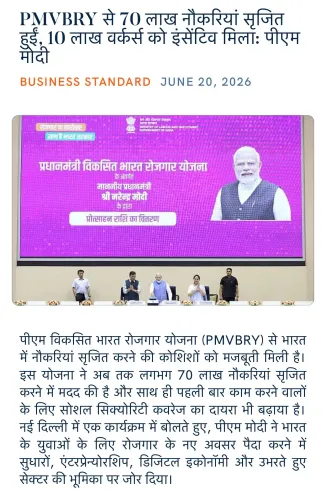
Union Textiles Minister Giriraj Singh on June 14, 2026 amplified PM-VBRY, describing it as the employment scheme that fulfils India's social security promise. The post, shared via the NaMo App, signals the ruling BJP's intent to position the programme as a flagship welfare deliverable ahead of the next Union Budget.
Key Takeaways
Union Textiles Minister Giriraj Singh shared a commentary on PM-VBRY on June 14, 2026 , framing it as India's social security promise fulfilled.
The post was amplified via the NaMo App , indicating ruling party-level endorsement of the scheme's welfare narrative.
PM-VBRY is positioned in the lineage of earlier employment-social security schemes including MGNREGA (2005) , PMRPY (2016) , and the Code on Social Security, 2020 .
The scheme's primary target beneficiaries are youth job seekers and informal sector workers who lack formal EPFO coverage.
The textiles sector , under Giriraj Singh's ministry, employs an estimated 4.5 crore workers and stands to be directly affected by any employment-linked welfare expansion.
Next Union Budget allocations and quarterly EPFO payroll data will be the key metrics to watch for scheme uptake.
Union Textiles Minister Giriraj Singh on Sunday, June 14, 2026 shared a commentary piece on the PM-VBRY scheme, describing it as the employment programme that delivers on India's social security promise. The minister, a senior BJP leader and Lok Sabha MP from Begusarai, Bihar, posted the link via the NaMo App, signalling the ruling party's intent to highlight the scheme's welfare credentials ahead of the next budget cycle.
Context
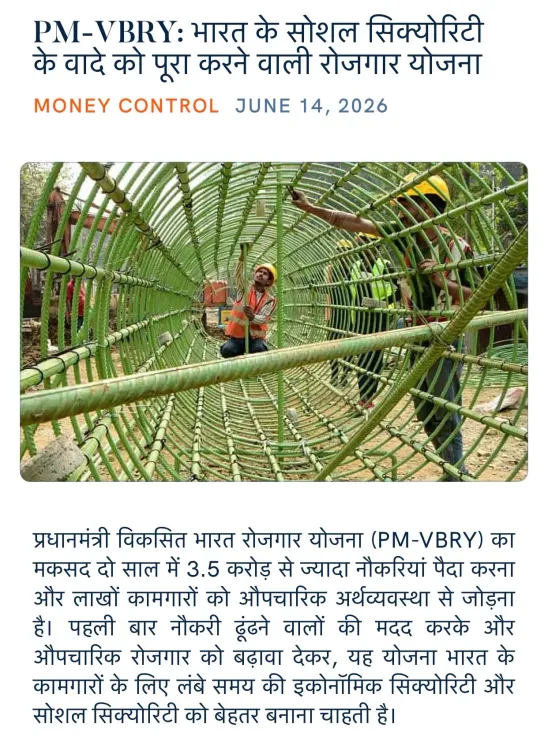
The post's headline — 'PM-VBRY: Bharat ke social security ke waade ko poora karne wali rojgar yojana' ('PM-VBRY: The employment scheme delivering on India's social security promise') — positions the programme explicitly within the broader narrative of the government fulfilling its welfare commitments. By amplifying the piece through the NaMo App, a platform closely associated with Prime Minister Narendra Modi's outreach ecosystem, the minister signals that PM-VBRY is being treated as a flagship social-security deliverable rather than a routine employment measure.
The framing is notable: the post links employment generation directly to social security, a pairing that has become central to the Modi government's labour-market messaging since the passage of the Code on Social Security, 2020.
Policy Backdrop
India's employment-linked social security architecture has evolved through several layers. The Mahatma Gandhi National Rural Employment Guarantee Act (MGNREGA), 2005, established a legal right to 100 days of wage employment in rural areas, setting a baseline for state-backed livelihood support. The Pradhan Mantri Rojgar Protsahan Yojana (PMRPY), 2016, took a different route, subsidising employer contributions to the Employees' Provident Fund (EPF) and Employees' Pension Scheme (EPS) to incentivise formal job creation.
The Code on Social Security, 2020, went further, consolidating 29 central labour laws and extending coverage to gig workers and those in the unorganised sector — a constituency that represents the vast majority of India's working population. PM-VBRY, as framed in the minister's post, appears to continue this trajectory of linking new employment with contributory welfare mechanisms, though full scheme details remain to be officially disclosed in the public domain.
Stakeholders and Impact
The primary beneficiaries of employment-linked social security schemes in India are youth job seekers and informal sector workers, who have historically been excluded from EPFO coverage and other formal welfare nets. Successive Union Budgets have allocated increasing outlays to programmes that subsidise employer costs for new hires, with the goal of accelerating formalisation of the labour market.
For the textiles sector — which Minister Giriraj Singh oversees — employment generation is a particularly acute concern. The industry employs an estimated 4.5 crore workers directly and is among the largest employers of women in rural and semi-urban areas. Any scheme that combines job creation with social security coverage would have direct relevance to the ministry's own sectoral workforce.
What's Next
Attention will now turn to the next Union Budget, where employment outlays and any expanded allocations for PM-VBRY are expected to be closely watched by industry bodies, labour economists, and state governments. Quarterly EPFO payroll data releases will serve as a key indicator of whether the scheme is translating into measurable gains in formal employment. Minister Singh's decision to amplify the scheme's social-security framing at this juncture suggests the government is building a political and policy case for the programme well ahead of the budget season.
Point of View
Embedding the scheme within the Modi government's broader social security narrative. The framing echoes a consistent BJP strategy of presenting employment programmes not merely as job-creation tools but as vehicles for welfare formalisation, a pitch aimed squarely at India's vast unorganised workforce. Coming ahead of the budget cycle, the move suggests the party is building grassroots visibility for PM-VBRY before it becomes a centrepiece of electoral and fiscal messaging. The textiles ministry's implicit stake in the scheme adds a sectoral dimension that could shape how the programme's rollout is prioritised across labour-intensive industries.
NationPress
13 Sept 2026
Frequently Asked Questions
What is PM-VBRY scheme in India?
PM-VBRY is an employment scheme promoted by the Indian government as a social security delivery mechanism for workers, particularly those in the informal sector. Full details of the scheme are expected to be outlined through official government communications and budget announcements.
Why is Giriraj Singh promoting PM-VBRY?
As Union Textiles Minister and a senior BJP leader, Giriraj Singh shared commentary on PM-VBRY on June 14, 2026 to highlight the scheme's role in fulfilling India's social security commitments to workers and job seekers.
How does PM-VBRY relate to MGNREGA and PMRPY?
PM-VBRY continues the policy lineage of earlier employment-social security schemes: MGNREGA (2005) guaranteed rural wage employment, PMRPY (2016) subsidised EPFO contributions for new formal hires, and the Code on Social Security (2020) extended coverage to gig and unorganised workers.
Who benefits from employment-linked social security schemes in India?
The primary beneficiaries are youth job seekers and informal sector workers who lack access to formal EPFO or pension coverage. These schemes aim to accelerate formalisation of India's labour market.
What should I watch for regarding PM-VBRY next?
Key indicators to watch include the next Union Budget's employment outlays, any official government notification on PM-VBRY's eligibility and benefits, and quarterly EPFO payroll data that may reflect scheme uptake.