Cauvery crisis: VCK demands all-party meet as TN gets only 10% of water share
Synopsis
Tamil Nadu has received just 3.6 TMC ft of Cauvery water against an entitlement of 36.4 TMC ft — a 90 per cent shortfall that has already wiped out the Kuruvai season and now threatens the Samba crop. VCK's Thirumavalavan is demanding an all-party meeting, signalling that allied parties are losing patience with the bilateral approach and want coordinated political escalation.
Key Takeaways
VCK president Thol Thirumavalavan on 30 July demanded an immediate all-party meeting on the Cauvery water crisis .
Tamil Nadu has received only 3.6 TMC ft of water at Biligundlu against an entitlement of 36.4 TMC ft — roughly 10 per cent of its due share.
The cumulative water deficit has widened to nearly 33 TMC ft , according to data cited from CWRC Chairman Vineet Gupta .
The CWMA has directed Karnataka to release 3,500 cusecs daily for 15 days , but farmer groups in Karnataka are reportedly opposing even this release.
The Kuruvai cultivation season has already been lost in parts of the Delta; the Samba crop now faces serious uncertainty.
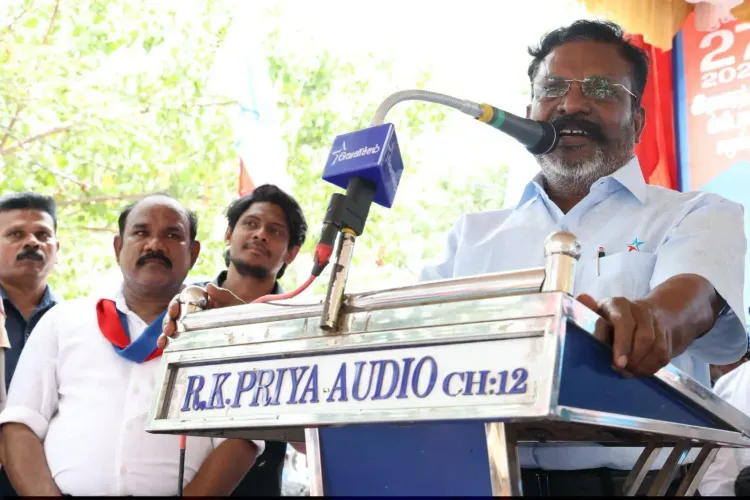
Viduthalai Chiruthaigal Katchi (VCK) president and Lok Sabha MP Thol Thirumavalavan on Thursday, 30 July urged the Tamil Nadu government to immediately convene an all-party meeting over the worsening Cauvery water crisis, warning that Karnataka's continued refusal to release the state's due share had pushed the Cauvery Delta to the brink of an agricultural emergency. The demand comes as Tamil Nadu has received barely 3.6 TMC ft of water at Biligundlu between 1 June and 27 July — against an allocated share of 36.4 TMC ft under the 2018 Supreme Court judgment.
Scale of the Shortfall
According to data cited by Thirumavalavan and attributed to Cauvery Water Regulation Committee (CWRC) Chairman Vineet Gupta, Tamil Nadu has received only about 10 per cent of its entitled water during the June–July period. The cumulative deficit has now widened to nearly 33 TMC ft, placing the state's irrigation infrastructure under severe strain.
The Cauvery Water Management Authority (CWMA) has directed Karnataka to release 3,500 cusecs of water daily for 15 days. However, Thirumavalavan noted that farmer organisations within Karnataka are actively opposing even this limited release — a development that, he argued, reflects an 'anti-Tamil stance' on the inter-state river dispute.
Impact on Farmers and Crops
The VCK chief warned that the water shortage has already cost Tamil Nadu the Kuruvai cultivation season in several parts of the Delta region. Uncertainty now looms over the Samba crop as well, threatening the livelihoods of thousands of farmers across the Cauvery Delta districts and the state's overall food production capacity.
This is not an isolated season of stress. The Cauvery dispute has recurred with near-annual regularity, with Tamil Nadu repeatedly approaching the Supreme Court and regulatory bodies to enforce its allocated share. Critics argue that the existing regulatory architecture — the CWRC and CWMA — lacks adequate enforcement teeth to compel compliance from upper-riparian states.
VCK's Political Demand
Thirumavalavan stressed that Tamil Nadu can no longer rely on Karnataka to voluntarily honour its legal obligations, calling the situation a matter requiring a united political response that cuts across party lines. He called upon the state government to convene an all-party meeting to deliberate on the next course of action and evolve a common strategy to safeguard Tamil Nadu's Cauvery rights.
Notably, the demand for an all-party meeting signals that opposition parties, including the VCK — a key ally of the ruling Dravida Munnetra Kazhagam (DMK) — are seeking to apply coordinated political pressure rather than leave the issue to bilateral negotiations between the two state governments.
What Happens Next
The Tamil Nadu government has not yet formally responded to the VCK's demand for an all-party meeting. If Karnataka fails to comply with the CWMA's directive of 3,500 cusecs for 15 days, Tamil Nadu is expected to escalate the matter before the Supreme Court. The Samba sowing window is narrow, and any further delay in water release could make the crop loss irreversible for the current season.
Point of View
Yet every dry season sees the same cycle: directives issued, directives ignored, Tamil Nadu back in court. Thirumavalavan's demand for an all-party meeting is as much a pressure signal to the DMK government — a reminder that its allies expect visible action — as it is a message to Bengaluru. The harder question, which mainstream coverage sidesteps, is whether the current inter-state water governance architecture is structurally capable of enforcing compliance, or whether it merely provides a procedural veneer over what remains a raw political contest between two states.
NationPress
14 Sept 2026
Frequently Asked Questions
What is the current status of the Cauvery water dispute between Tamil Nadu and Karnataka?
As of 30 July 2025, Tamil Nadu has received only about 3.6 TMC ft of Cauvery water at Biligundlu between 1 June and 27 July, against its allocated share of 36.4 TMC ft under the 2018 Supreme Court judgment — a deficit of nearly 33 TMC ft. The CWMA has directed Karnataka to release 3,500 cusecs daily for 15 days, but compliance remains uncertain.
Why is VCK demanding an all-party meeting?
VCK president Thol Thirumavalavan argues that Tamil Nadu can no longer rely on Karnataka to voluntarily honour its legal obligations, and that a united political response cutting across party lines is now essential. He wants the Tamil Nadu government to convene an all-party meeting to evolve a common strategy to protect the state's Cauvery water rights.
How has the Cauvery water shortage affected farmers in Tamil Nadu?
The shortfall has already resulted in the loss of the Kuruvai cultivation season in several parts of the Cauvery Delta region. The Samba crop now faces serious uncertainty, threatening the livelihoods of thousands of farmers and the state's food production for the current agricultural year.
What has the Cauvery Water Management Authority directed?
The Cauvery Water Management Authority (CWMA) has directed Karnataka to release 3,500 cusecs of water daily for 15 days. However, according to Thirumavalavan, farmer organisations within Karnataka are opposing even this limited release.
What is the 2018 Supreme Court judgment on Cauvery water sharing?
The Supreme Court's 2018 judgment set out the allocated shares of Cauvery water for the riparian states, including Tamil Nadu's entitlement. Tamil Nadu has received only about 10 per cent of its due share for the June–July 2025 period under this allocation, prompting demands for regulatory and political intervention.