BJP's R. Ashoka: Court Ruling in Vinay Kulkarni Case Signals End to Political Murders
Synopsis
R. Ashoka commends the court's ruling on Vinay Kulkarni's involvement in the murder case, suggesting it may be a turning point for politically motivated violence. He also addresses language policy concerns and political turmoil within Congress. Ashoka predicts BJP's rise in upcoming elections.
Key Takeaways
Court ruling implicates Vinay Kulkarni in murder.
Ashoka calls for an end to political violence.
Concerns raised about language policy affecting Kannada.
BJP anticipates electoral success in upcoming polls.
Political uncertainty regarding Chief Minister's position.
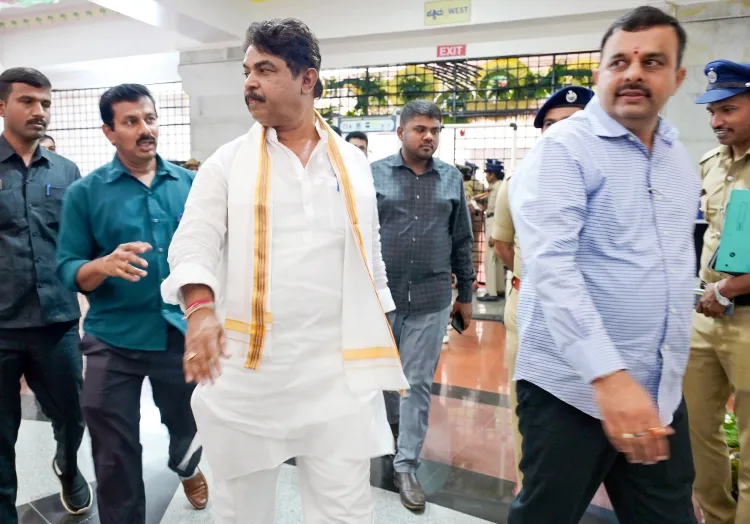
Bengaluru, April 17 (NationPress) In a significant development regarding the murder case involving BJP leader Yogesh Gowda, the conviction linked to Congress leader and current MLA Vinay Kulkarni has been welcomed by the Leader of the Opposition, R. Ashoka. He stated, “This serves as a crucial example of the consequences when crimes are orchestrated by political figures. Without the intervention of the Central Bureau of Investigation (CBI), this case would have likely been concealed by the police.”
“Now, with the evidence presented, the culprits have been confirmed. The court has adjudicated that Vinay Kulkarni was instrumental in the murder. This verdict may very well signify the cessation of politically-driven killings. It is a judgment we welcome,” he added.
R. Ashoka emphasized that two witnesses had come forth during the trial. It's pertinent to recall that the Special Court for MLAs/MPs had concluded the proceedings for recording final statements regarding the sentencing in the murder case of BJP leader Yogesh Gowda, with the verdict reserved for Friday.
On the contentious language issue, he remarked that the government should have made a decision prior to students commencing their Hindi studies. “Creating a ‘Tughlaq-style’ situation during exams was unwarranted. I am also a Kannada advocate and have faced police violence during the Gokak agitation. Kannada is predominantly spoken in Hosur and Kasaragod. If Kannada is overlooked in these regions, it will lead to complications.”
He pointed out that in Urdu schools, the teaching order is Urdu first, followed by English, and lastly Kannada. “If we do not adhere to the three-language formula, Kannada may vanish from such areas. The government ought to have established a House committee or convened an Assembly session for deliberation on matters concerning students. Sudden decisions are inappropriate. We advocate for prioritizing Kannada. It's inaccurate to claim that Kannada will flourish solely through a two-language policy. A comprehensive discussion on the three-language strategy was essential,” he asserted.
Ashoka further remarked that the conundrum surrounding the Chief Minister’s position remains unresolved. “With numerous individuals traveling to Delhi, the government has become ineffective. The offspring of Chief Minister Siddaramaiah and other ministers are asserting that their fathers will assume the CM role. Every household now appears to have its own Cabinet.”
Additionally, he claimed that Muslim leaders in Davanagere are expressing discontent towards Congress regarding perceived injustices. “Minister Zameer Ahmad Khan is also facing scrutiny. The entire party and government seem to be in disarray. Should elections occur today, a BJP-led NDA government would likely emerge victorious. BJP is poised to win in Bagalkot and Davanagere. Muslims have indicated they have no qualms about Narendra Modi as Prime Minister and are inclined to support the BJP. I welcome this shift,” he concluded.
Point of View
The conviction of Vinay Kulkarni marks a pivotal moment in the ongoing struggle against politically motivated violence in India. R. Ashoka's comments reflect a broader concern over the influence of political figures on criminal activities. The discourse surrounding language policies and internal political dynamics within Congress adds another layer to this complex narrative, highlighting the need for strategic governance in the face of regional linguistic identities.
NationPress
19 Sept 2026
Frequently Asked Questions
What was the court's ruling regarding Vinay Kulkarni?
The court ruled that Vinay Kulkarni was guilty of being behind the murder of BJP leader Yogesh Gowda.
What did R. Ashoka say about politically motivated killings?
R. Ashoka stated that the conviction signals an end to politically motivated killings, emphasizing the role of the CBI in uncovering the truth.
How does the language policy affect students?
R. Ashoka expressed concerns that the sudden implementation of the language policy could jeopardize the status of Kannada in regions where it is not prioritized.
What are the implications for the upcoming elections?
Ashoka believes that if elections were held today, the BJP would likely win, particularly in Bagalkot and Davanagere, due to rising support among the Muslim community.
What did Ashoka say about the Chief Minister's post?
He noted that the issue surrounding the Chief Minister’s position remains unresolved, with many political figures seemingly preoccupied with their own ambitions.