West Bengal's Murshidabad and Malda: A Hotbed for Multidimensional Operations
Synopsis
West Bengal faces a rising tide of radicalisation and militancy, particularly in Murshidabad and Malda, as illegal immigration and crime networks expand. This situation poses serious threats not just to local security but also to broader regional stability.
Key Takeaways
Radicalisation and militancy are significant threats in West Bengal.
Illegal immigration contributes to demographic shifts.
Crime networks are expanding in Murshidabad and Malda.
The ISI is using these districts to disrupt national security.
Implications extend to northeastern states and regional stability.
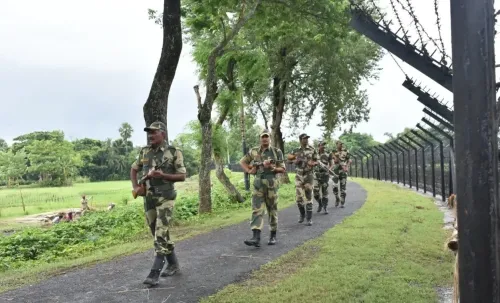
New Delhi, April 15 (NationPress) The Governor of West Bengal highlighted earlier this week that the dual threats of radicalisation and militancy present significant challenges for the state, particularly in the districts of Murshidabad and Malda, which border Bangladesh.
This statement comes at a time when initiatives are underway to combat radicalisation efforts that aim to incite communal discord and orchestrate terror activities.
For several years, intelligence agencies have repeatedly raised alarms about these issues, particularly in the aforementioned districts.
The agencies report that illegal immigration in these regions has surged, leading to demographic shifts where these immigrants now constitute a large portion of the population. They have even overtaken land ownership from the majority community.
An official from the Intelligence Bureau indicated that these illegal immigrants not only dominate in numbers but also possess substantial financial resources and influence. Their wealth primarily stems from activities such as cattle smuggling, drug trafficking, and counterfeiting Indian currency.
According to the official, there is a renewed effort to broaden criminal networks. This includes not just demographic alterations and increasing communal strife but also a significant push towards establishing terror cells.
Moreover, the rise of illegal madrasas in these areas, which serve as sanctuaries, has raised concerns. With the approaching elections, elements backed by the ISI have attempted to escalate the illegal immigration influx.
The ISI has enlisted the help of groups like the Rohingya Solidarity Organisation and the Arakan Rohingya Salvation Army to further their aims. The Ansarullah Bangla Team is also active in these regions, as reported by officials.
Officials noted that the overarching strategy appears designed to keep security forces on high alert while planning a significant strike.
The strategy in West Bengal's border regions is not limited to a single operation. Instead, it encompasses multiple facets, including enhancing smuggling operations, illegal immigration, counterfeiting, demographic shifts, and the establishment of terror modules by the Ansarullah Bangla Team.
Besides creating unrest in West Bengal, these factions are also strategizing to infiltrate northeastern states like Assam for operations there.
These actions aim not only to disrupt stability and internal security but also to undermine India-Bangladesh relations.
Relations, which briefly soured, have recently improved following Bangladesh's national elections that favored the Bangladesh Nationalist Party. Prime Minister Tarique Rahman has emphasized the importance of fostering positive relations with India.
The ISI seeks to destabilize this dynamic by utilizing its networks in Murshidabad and Malda to incite chaos within India. Historically, the ISI has aimed to undermine India from various fronts.
It is attempting to deploy terrorists in Jammu and Kashmir, while also facilitating the formation of local terror modules in Delhi and other areas.
Additionally, it is collaborating with Khalistani terror groups to instigate unrest in Punjab.
Similar plans are being devised for West Bengal and the northeastern states. An official remarked that the increased activities in Murshidabad and Malda should not be interpreted solely in the context of West Bengal’s security.
The broader agenda is to leverage these modules for extensive operations in the Northeast, aiming to disrupt peace in those regions.
Instability in border-sharing states poses a severe risk and significantly impacts national security, the official added.
Point of View
Particularly in Murshidabad and Malda, signifies a critical threat to national security. The interplay of illegal immigration, radical activities, and organized crime not only jeopardizes local stability but also poses a broader risk to regional peace. Authorities must act decisively to combat these growing challenges.
NationPress
21 Sept 2026
Frequently Asked Questions
What are the main challenges facing West Bengal?
The main challenges include radicalisation, militancy, and illegal immigration, particularly in the districts of Murshidabad and Malda.
How does illegal immigration affect these districts?
Illegal immigration has led to demographic changes, increased crime, and the establishment of radical elements in Murshidabad and Malda.
What role does the ISI play in this situation?
The ISI is reportedly using networks in Murshidabad and Malda to incite unrest and destabilize India-Bangladesh relations.
What are the implications for northeastern states?
The activities in West Bengal could spill over into northeastern states like Assam, posing additional security challenges.
How can these issues impact India-Bangladesh relations?
Instability in West Bengal can strain diplomatic ties, especially if radical elements exploit the situation to incite conflict.