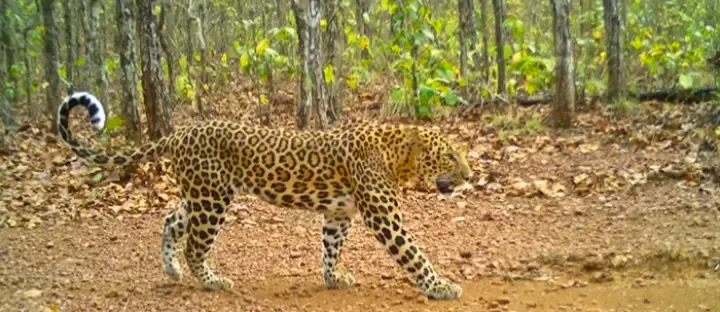
Leopard populations declining in Odisha, WII study warns of extinction risk
Synopsis
A Wildlife Institute of India study reveals leopards are functionally extinct in two Odisha wildlife sanctuaries and critically scarce in a third — even as India's national large-carnivore numbers climb. The culprit is a collapsing prey base, which is also pushing hungry leopards into villages. The east-central region is falling visibly behind the national conservation curve.
Key Takeaways
A Wildlife Institute of India (WII) study, sponsored by the Odisha Forest Department , found a declining trend in both leopard and prey populations across the Similipal-Satkosia landscape .
Leopards are functionally extinct in Kuldiha and Hadagarh wildlife sanctuaries, and critically sparse in Rebana at 2.2 ± 0.70 leopards per 100 km² .
Highest densities recorded in Satkosia ( 17.9 ± 1.75 ) and Mahanadi ( 11.9 ± 1.66 ) per 100 km² , correlating with better prey availability.
Depleted prey is driving leopards towards villages, escalating human-wildlife conflict .
Researchers recommend establishing ecological corridors , prey supplementation, and improved monitoring in unprotected areas as urgent priorities.
A Wildlife Institute of India (WII) study has found a declining trend in leopard and prey populations across key forest landscapes in Odisha, even as India's overall large-carnivore numbers have risen. The study, sponsored by the Odisha Forest Department, underscores a troubling regional divergence — the east-central zone is not keeping pace with national conservation gains.
Key Findings from the WII Study
Researchers assessed leopard and prey populations at multiple sites within the Similipal-Satkosia landscape, a fragmented forest complex spanning both protected and non-protected areas. Systematic camera-trap surveys were conducted across Kuldiha Wildlife Sanctuary, Hadagarh Wildlife Sanctuary, Rebana Reserve Forest, and the Satkosia and Mahanadi wildlife divisions of Satkosia Tiger Reserve (STR).
Leopards were identified using their unique rosette markings. Density estimates relied on maximum-likelihood spatially explicit capture-recapture (SECR) models, while prey relative abundance indices (RAI) were calculated from detections per 100 trap-nights. Leopard diet in STR was further analysed through trichotaxonomic examination of medullary guard hairs from field-collected scat samples.
Where Leopards Survive — and Where They Have Vanished
The highest leopard densities were recorded in Satkosia and Mahanadi, at 17.9 ± 1.75 and 11.9 ± 1.66 leopards per 100 km², respectively — figures that corresponded with higher availability of medium- and large-sized prey, which formed a major part of the leopard diet.
In stark contrast, the study found that leopards were functionally extinct in Kuldiha and Hadagarh, with medium- to large-sized ungulates either absent or recorded at very low densities in those areas. In Rebana, leopard density remained critically low at 2.2 ± 0.70 leopards per 100 km². Small-bodied prey were the most common across all study sites, indicating a broader collapse of the natural prey base.
Threats Driving the Decline
The report identified habitat destruction, poaching, and human-wildlife conflict as the primary threats facing leopards in the region. Notably, the depletion of prey populations also indirectly drives conflict — while leopards are generally shy and prefer to avoid humans, hunger increasingly drives them towards villages in search of food. This is a pattern seen across other prey-depleted forest landscapes in central India.
The study stressed that healthy prey populations are crucial for sustaining large carnivores, and called on state governments to intervene periodically to restore prey populations in vulnerable areas.
What Conservationists Are Recommending
'Based on the preliminary data, our findings highlight the need for a comprehensive, landscape-scale leopard conservation strategy,' the report stated. It called for protecting prey species, promoting population growth through supplementation efforts, reducing human-related threats, improving monitoring in unprotected areas, and establishing ecological corridors to maintain leopard populations and expand their range across the landscape.
This comes amid growing concerns among wildlife ecologists that fragmented forest patches — common across Odisha's forest belt — are unable to sustain viable large-carnivore populations without active intervention. The findings are expected to inform the Odisha Forest Department's long-term wildlife management plans.
Point of View
Often treated as the resilient backup to tigers, are proving just as vulnerable when prey collapses — and the functional extinction label for Kuldiha and Hadagarh should trigger urgent policy action, not just a research footnote. The human-wildlife conflict angle also signals a cost to local communities that rarely makes it into conservation dashboards. Without mandatory, state-funded prey restoration programmes linked to carnivore monitoring, Odisha risks losing leopards from larger swathes of its forest estate than the study currently covers.
NationPress
4 Oct 2026
Frequently Asked Questions
What did the WII study find about leopards in Odisha?
The Wildlife Institute of India study, sponsored by the Odisha Forest Department, found a declining trend in both leopard and prey populations across the Similipal-Satkosia landscape. Leopards were found to be functionally extinct in Kuldiha and Hadagarh wildlife sanctuaries, and critically low in density in Rebana Reserve Forest.
Where are leopard populations still surviving in Odisha?
The highest leopard densities were recorded in the Satkosia and Mahanadi wildlife divisions of Satkosia Tiger Reserve, at 17.9 ± 1.75 and 11.9 ± 1.66 leopards per 100 km², respectively. These areas also had higher availability of medium- and large-sized prey, which the study linked directly to leopard survival.
Why are leopard populations declining in parts of Odisha?
The study identified habitat destruction, poaching, and human-wildlife conflict as the primary threats. A collapse in medium- and large-sized ungulate populations — the core prey for leopards — is also a key driver, leaving leopards with insufficient food and pushing them into villages.
How does prey decline lead to human-wildlife conflict?
When natural prey becomes scarce, leopards are forced to venture closer to human settlements in search of food. Although leopards are generally shy and avoid humans, hunger overrides that instinct, increasing the likelihood of livestock predation and direct encounters with people.
What conservation measures has the WII recommended?
The WII report recommended a comprehensive, landscape-scale leopard conservation strategy that includes protecting prey species, supplementing prey populations, reducing human-related threats, improving monitoring in unprotected areas, and establishing ecological corridors to help leopards expand their range across the landscape.